High-Performance Warehouse Pallet Racking Systems
Explore our rigorously tested structural steel racking solutions engineered for dynamic logistics distribution centers, heavy industrial manufacturing facilities, and automated cold-chain logistics operations.
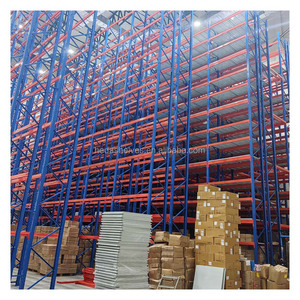
China Factory Price Steel Selective Heavy Duty Storage Racking Industrial Pallet Rack
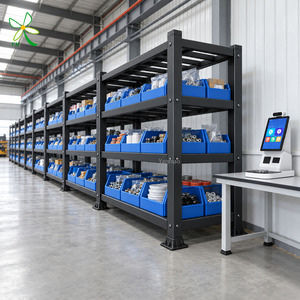
Global Export Corrosion Protection Lightweight Stackable Production Area 1200mm FRP Storage Rack
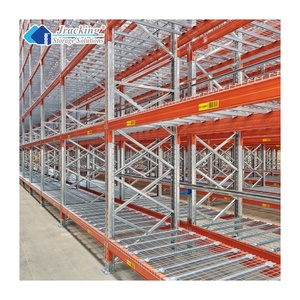
OEM ODM Racks Warehouse Storage Shelf AU Standard Heavy Duty Pallet Racking System
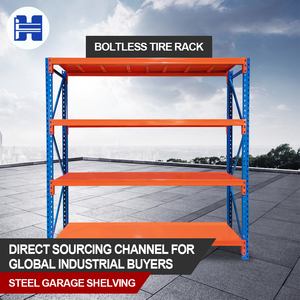
Long Span Medium Duty 5-Layer Durable Steel Industrial Shelving Boltless Storage Rack
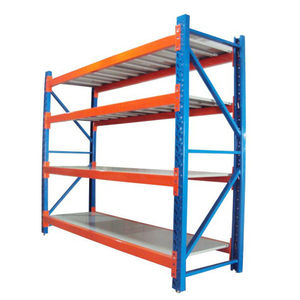
Heda Factory Heavy Duty Industrial Warehouse Storage Rack Shelf Steel Stacking System
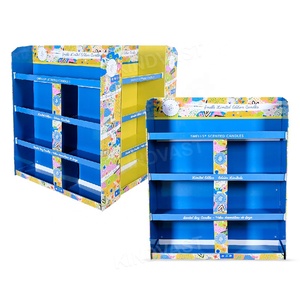
Custom Supermarket Club Half Full Pallet Displays Corrugated PDQ Trays Retail Display Rack
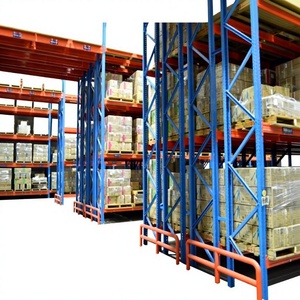
Very Narrow Aisle Pallet Racking VNA Rack Heavy Duty Warehouse Storage Racking System

Double Sided Supermarket Rack 1310*900*350mm Low Base Shelf Narrow Aisle Gondola
Kinematic Mechanics & Physics of Live Pallet Racking Systems
In modern supply chain management, throughput velocity and space volumetric utilization represent two opposing forces. Conventional static racking configurations prioritize selective reachability while suffering from pervasive floor footprint losses, often dedicating up to 55% of warehouse floor area exclusively to forklift operating aisles. Conversely, Live Pallet Racking Systems—universally classified in European engineering taxonomies as Pallet Flow or Gravity Flow Racking—bridge high cubic density with automated physical inventory movement under the unpowered kinetic force of gravity.
Governed structurally by rigorous international codes such as EN 15512:2020 (Steel static storage systems), EN 15620 (Tolerances, deformations and clearances), and FEM 10.2.02, live pallet racking systems rely on sloped roller or wheel conveyor beds pitched meticulously at angles between 3.0% and 4.0% (1.7° to 2.3°). Pallets introduced into the elevated rear loading face glide smoothly down lane profiles toward the front discharge picking face. This physical trajectory guarantees strict FIFO (First-In, First-Out) stock rotation, eliminating batch obsolescence across fast-moving consumer goods (FMCG), pharmaceuticals, perishable dairy, cold meat chains, and high-turnover chemical intermediates.
Crucially, for international procurement directors and civil consulting structural engineers across GCC nations (UAE, Saudi Arabia, Qatar, Oman, Kuwait, Bahrain) and European markets, dynamic pallet flow systems mitigate rack-truck collisions. Forklift trucks operate strictly at the outer perimeter aisles—loading from the rear access corridor and unloading from the front dispatch aisle—thereby completely isolating material handlers from internal rack tunnels. The result is a documented reduction in racking upright collision damage by more than 85% compared to drive-in racking schemes.
Dynamic Speed Regulation & Centrifugal Braking
Uncontrolled gravity descent causes accelerated pallet inertia, posing destructive collision hazards at the discharge end. We integrate continuous self-regulating centrifugal brake rollers spaced at calculated intervals along each flow track.
- ✓ Controls pallet terminal descent speed below 0.25 to 0.30 m/s
- ✓ Operates autonomously without external power supply
- ✓ Polyurethane compound prevents rim flat-spotting in cold stores (-30°C)
Mechanical Pallet Separation Mechanisms
When multiple heavy pallets rest in a single lane, downstream back-pressure makes extracting the lead pallet mechanically perilous for forklift mast hydraulics. Our mechanical separator isolates the extraction pallet from the rear column load.
- ✓ Absorbs cumulative back-pressure of up to 25 metric tons
- ✓ Automatic mechanical pedal reset upon lead pallet extraction
- ✓ Eliminates line jams and ensures zero operator mast resistance
High-Precision Upright & Beam Cold Roll-Forming
Dynamic systems induce both static dead weight loads and continuous dynamic deceleration shocks. Our columns feature continuous 11-fold Omega profiles cold-rolled from certified high-tensile structural steel.
- ✓ Certified Q235B and Q355B coil stock with mill cert documentation
- ✓ Automated CNC precision punching maintaining ±0.2mm pitch tolerances
- ✓ Structural safety factor ≥ 1.5 in adherence to European CE CPR standards
High-Density Pallet Storage Systems Comparative Technical Analysis
Evaluating structural capital expenditures (CAPEX), operational efficiencies (OPEX), and space metrics across commercial warehouse storage topologies.
| Storage Topology | Space Volumetric Density | Inventory Rotation | Direct Pallet Accessibility | Forklift Cycle Times | Upright Impact Exposure | CE & EN Compliance |
|---|---|---|---|---|---|---|
| Live Pallet Racking (Flow) | Maximum (Up to 80%) | Strict FIFO (100% Gravity Flow) | Lane Facing Selective | Fastest (Decoupled Loading/Picking) | Extremely Low (Forklifts never enter) | EN 15512 / CE 2435-CPR |
| Selective Pallet Racking | Low (35% - 45%) | Flexible FIFO / LIFO | 100% Direct Selective | Moderate (Travel Distance Intensive) | High (Constant In-Aisle Maneuvering) | EN 15512 / ISO 9001 |
| Drive-In Racking | High (65% - 75%) | Strict LIFO | Low (Single SKU Lane Depth) | Slow (Deep Truck Reversing Required) | Severe (High Column Impact Risk) | EN 15512 / CE 2435-CPR |
| Push-Back Racking (Carts) | Moderate-High (60% - 70%) | LIFO (2 - 6 Pallets Deep) | Lane Selective | Moderate (Forklift Pushes Dynamic Load) | Moderate (Perimeter Loading Face) | EN 15512 / ISO 9001 |
| Radio Shuttle Automation | Maximum (Up to 85%) | Configurable FIFO / LIFO | Shuttle Controlled Access | High (Semi-Automated In-Lane Transfer) | Low (No Truck Entry Into Lanes) | CE Machinery Directive / EN |
Macro Trends Shaping Industrial Pallet Racking Procurement
Enterprise procurement directors are fundamentally changing how intralogistics capital projects are evaluated. Below are the key engineering and economic imperatives driving sourcing decisions through the coming decade.
AGV / AMR and Automated Picking Integration
Traditional live storage systems depended entirely on manual counterbalanced or reach forklifts. Next-generation installations are re-engineered specifically for Autonomous Mobile Robots (AMRs) and Automated Guided Vehicles (AGVs). This transition demands tighter floor tolerance levels conforming to DIN 18202 standards, micro-tolerance entry guides at discharge zones, and optical optical-sensor brackets along picking faces to enable robotic clamp and fork docking without human intervention.
Zero-Power Kinetic Storage in Cold-Chain Facilities
In energy-intensive refrigerated and sub-zero blast freezer warehouses (-25°C to -30°C), thermal losses from active automated machinery and lighting are cost-prohibitive. Dynamic live flow racking harnesses gravity as a 100% passive power source. By shrinking warehouse cubic envelopes by up to 45% for an identical pallet count, cold-store facility operators reduce refrigeration power consumption by megawatt hours annually, aligning capital investments with international ESG targets.
Climatic Resilience for Extreme Heat, Dust & Salt Air
Procurement teams across GCC territories (Riyadh, Dammam, Dubai, Khalifa Port) and humid littoral zones are rejecting standard catalogue paint finishes that fail prematurely. Sourcing specifications now mandate intensive multi-stage pickling, iron phosphating, and thick electrostatic polyester powder coating cured at 200°C, or hot-dip galvanization exceeding ISO 1461 requirements, ensuring zero surface micro-cracking and salt-spray resistance exceeding 500 hours under ASTM B117 protocols.
Civil Defense & Seismic Risk Mitigation
Municipal approvals—such as Civil Defense authorities in the UAE and Saudi Arabia—require verifiable third-party seismic calculation sheets, documented flue clearances for overhead fire sprinkler deluge penetration, and stamped structural verification. Global exporters who provide full 3D CAD stress modelling and accredited CE factory production control documentation are systematically displacing uncertified regional fabricators.
Our 10-Step In-House Precision Manufacturing & Quality Control
Operating out of our dedicated 30,000 square meter modernized manufacturing complex with 300+ technical personnel and a 30,000-ton monthly capacity, Guangzhou Heda Shelves Co., Ltd. exercises rigorous in-house control over every physical fabrication milestone.
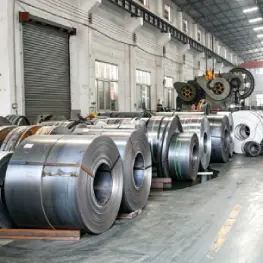 Step 01
Prime Steel Coil Sourcing & Spectral Test
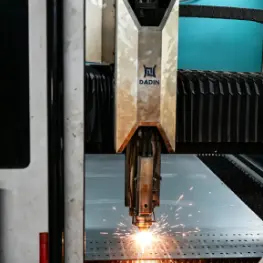 Step 02
High-Speed Laser & Precision CNC Slitting
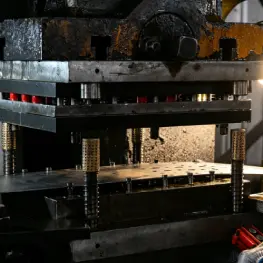 Step 03
Automated Synchronous Column Punching
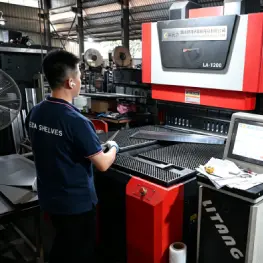 Step 04
Continuous Multi-Roller Cold Forming
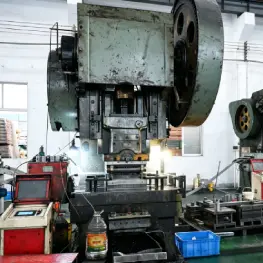 Step 05
Beam Interlock & Step Profile Calibrating
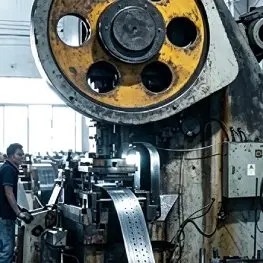 Step 06
Automated Deburring & Surface Conditioning
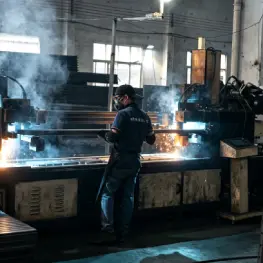 Step 07
Robotic Connector Welding (CO2/MIG)
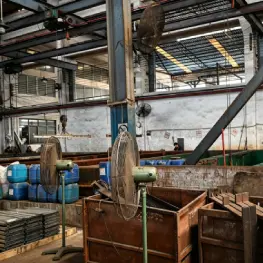 Step 08
Multi-Tank Acid Pickling & Phosphating
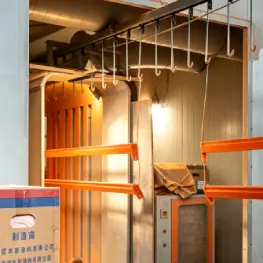 Step 09
Automated Powder Coating & Curing Tunnel
 Step 10
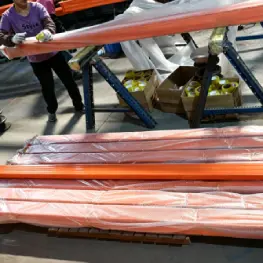
QC Stress Audit & Marine-Grade Bundling
Verifiable Global Certification & Export Track Record
Guangzhou Heda Shelves Co., Ltd. backs all storage system designs with accredited documentation suitable for local civil consultants, general contracting tenders, and statutory municipal inspections:
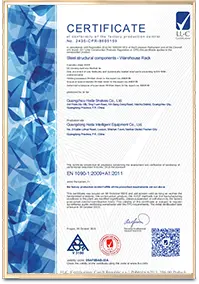
- ✓ CE Certification (No. 2435-CPR-8605159): Factory Production Control conforming to European Construction Products Regulation (EU CPR 305/2011).
- ✓ ISO 9001:2015 Quality Management (No. 18624Q00169R0M): Certified systematic quality oversight valid through 2027-06 across design, cutting, rolling, coating, and testing.
- ✓ RoHS & REACH Compliance: Certified chemical safety in non-toxic surface coatings for sensitive pharmaceutical, organic food, and baby-care warehousing.
- ✓ Dedicated GCC Ocean Port Logistics: Turnkey scheduled deliveries with customized container strapping to Jebel Ali, Khalifa Port, Jeddah Islamic Port, King Abdulaziz Port Dammam, Hamad Port, and Sohar.

CE Certified
No. 2435-CPR-8605159
Structural EN Standards

ISO 9001:2015
Cert 18624Q00169R0M
Quality Management

RoHS Certified
Eco-friendly Coating
Heavy Metal Free
Audited Facility
30,000 m² Complex
10,000+ Realized Projects
Frequently Asked Questions by Industrial Sourcing Teams
Detailed engineering answers addressing structural integrity, pallet flow physics, cold storage resilience, and ocean freight logistics.
What are the key technical parameters required to engineer a live pallet racking system? +
How does gravity flow racking prevent pallet runaway speed and dynamic impact damage? +
Can live pallet racking accommodate plastic, metal, or non-standard wooden pallets? +
How does your live racking perform in Middle East extreme ambient heat and dusty environments? +
Does HEDA Shelves assist with Civil Defense and municipal structural permits? +
What are the lead times and container loading specifications for overseas export? +
Ready to Maximize Warehouse Storage Density & Throughput?
Consult directly with senior warehouse logistics structural engineers. Share your warehouse CAD layouts or building parameters, and receive a complete 2D layout, 3D visualization model, and detailed engineering quote within 24 business hours.