Featured Industrial Racking & Pallet Handling Systems
Precision-machined structural steel components, tested under stringent dynamic and static deflection parameters to optimize warehouse volumetric storage efficiency.
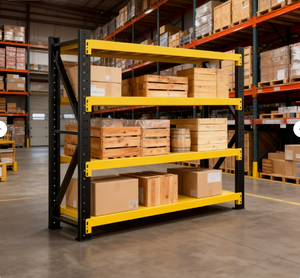 Heavy-Duty Steel
Estantes Metal Warehouse Adjustable Steel Storage Shelves
View Specifications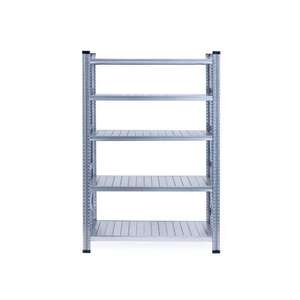 Galvanized
5-Layer Adjustable Galvanized Boltless Stacking Rack Shelf
View Specifications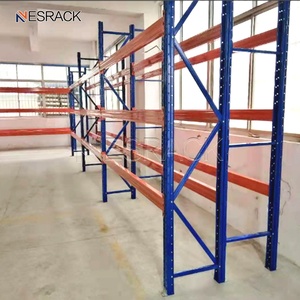 Intelligent AS/RS Ready
Intelligent Warehouse Storage Pallet Racking Beams & Uprights
View Specifications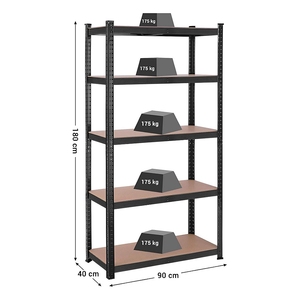 Quick Assembly
5-Layer Supermarket Boltless Shelving Iron Industrial Storage
View Specifications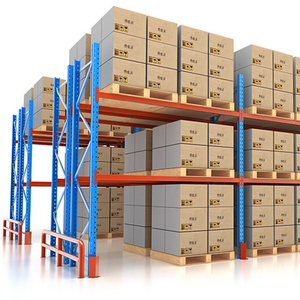 CE Certified
Heavy Duty Steel Single & Double Deep Selective Pallet Racks
View Specifications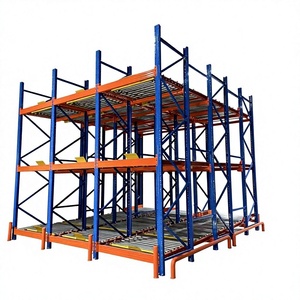 FIFO Dynamic
Pallet Flow Racking Gravity Roller FIFO High Density Storage
View Specifications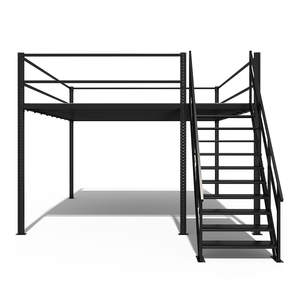 Multi-Tier Floor
Heavy Duty Rack Industrial Mezzanine Interlocking Floor System
View Specifications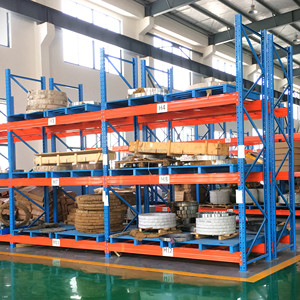 Custom Engineered
OEM Customized Heavy Duty Steel Warehouse Pallet Racking
View SpecificationsPush-Back Racking Engineering: Mechanics, Physics & CE Compliance
Push-back pallet racking systems (Push Rack Systems) operate on an engineered inclined rail and nested cart mechanism, delivering exceptional storage density without sacrificing SKU accessibility.
Kinematic Principles & Gravity-Assisted Accumulation: Push-back racking systems utilize a pair of inclined structural steel channel tracks operating on a gradient calibrated strictly between 1.5% and 2.5% (equivalent to approximately 1° to 1.5°). In this dynamic configuration, pallets are loaded sequentially onto nested carts that glide along heavy-duty flanged steel wheels equipped with sealed precision bearings. When loading the primary pallet, it rests on the topmost nesting cart. As subsequent pallets are introduced via counterbalance or reach forklift trucks, the operator gently pushes back the previous pallet, revealing the sub-adjacent cart. This mechanical accumulation profile supports lane depths from 2-deep to 6-deep configurations, reclaiming up to 75% of vacant floor space typically consumed by conventional operating aisles.
Structural Dynamic Load Calculations (EN 15512:2020 & RMI MH16.1): Dynamic pallet movement introduces cyclic deceleration pulses and horizontal point loading absent in static selective systems. Factory structural calculations must incorporate both static gross gravitational mass (typically up to 1,500 kg per pallet) and dynamic horizontal impulse forces ($F_h = m \cdot a + F_f$). To prevent progressive rail spreading, torsion-resistant tubular structural tie beams are welded transversely between upright frame chords. Upright columns are cold-roll-formed from high-yield Q235B or Q355B structural carbon steel, ensuring beam deflection ratios comply strictly with maximum structural thresholds of $\delta \le L/200$ under full working load.
CE Certification Requirements & Construction Products Regulation (CPR): Under European Union standard EN 15512:2020 (Steel static storage systems – Adjustable pallet racking systems – Principles for structural design) and the Construction Products Regulation (EU No. 305/2011), verified push rack systems must pass mandatory Factory Production Control (FPC) audits. As a verified manufacturer holding CE Certificate No. 2435-CPR-8605159, our manufacturing processes undergo non-destructive structural weld testing, yield strength verification, and accelerated dynamic cart cyclic endurance testing exceeding 50,000 continuous push-retract cycles.
Engineering Matrix: Push Rack vs Alternative Warehouse Systems
Evaluating high-density storage geometries across critical operational parameters to guide enterprise capital expenditure (CapEx) decisions.
| Performance Attribute | Push-Back Rack System | Selective Pallet Rack | Drive-In Racking System | Radio Shuttle Automation |
|---|---|---|---|---|
| Storage Density | High (75% Footprint Utilization) | Low (40-45% Floor Utilization) | Very High (80% Footprint) | Maximum (85-90% Footprint) |
| Inventory Access Logic | LIFO (Last-In, First-Out) per Lane | 100% Direct Selective Access | Strict LIFO (High Honeycombing) | Flexible FIFO / LIFO Software-Driven |
| Handling Cycle Speed | Fast (Zero Forklift Lane Entry) | Standard | Slow (Mast Enters Structure) | Fast Automated Cart Travel |
| Structural Collision Risk | Minimal (Loading at Aisle Face) | Moderate (Aisle Flank Hits) | Severe (High Column Impact Risk) | Negligible (External Dock Loading) |
| Capital Expenditure (CapEx) | Moderate (Pure Mechanical Gravity) | Low (Baseline Steel Structure) | Moderate | High (Robotics, Batteries & Sensors) |
| Maintenance & TCO | Low (Sealed Bearings, No Electronics) | Minimal | High (Frequent Column Repairs) | High (Preventative Robot Maintenance) |
| Cold Storage Applicability | Exceptional (-30°C Low-Temp Grease) | Good | Good (Slow Turnaround) | Battery Degradation Concerns |
Guangzhou HEDA Shelves: Manufacturing Scale & Quality Control
Operating continuously since 2001, Guangzhou Heda Shelves Co., Ltd. supplies high-spec racking systems to global distribution centers across the Middle East, Europe, the Americas, and Southeast Asia.
Traceable Certifications
Factory production governed by CE Certificate No. 2435-CPR-8605159 and ISO 9001:2015 Quality System (Certificate No. 18624Q00169R0M). Every batch includes raw steel mill test reports (MTR).
10-Step In-House Production
Continuous automated roll-forming, CNC punching, robotic welding, 9-stage chemical pickling & zinc phosphating, and electrostatic epoxy-polyester powder coating baked at 200°C.
Dynamic FEA Simulation
In-house mechanical engineers model static load stress points, dynamic impact vibrations, and regional seismic response spectra using ANSYS software before structural fabrication begins.
Export Container Packing
Steel frames are custom-bundled with moisture-barrier corrugated wrapping and labeled to match installation layout blueprints, ensuring fast assembly at ports like Jebel Ali, Dammam, and Rotterdam.
Future Procurement Trends in High-Density Push Rack Systems
How automation compatibility, environmental regulations, and extreme climatic demands are reshaping industrial racking specifications across global supply chains.
1. Hybrid AGV/AMR Interface Compatibility
Logistics hubs are migrating away from pure manual forklift handling. Future push rack installations incorporate front-lane visual positioning markers, magnetic floor induction loops, and sensor reflectors enabling automated guided vehicles (AGVs) and autonomous reach trucks to handle push and retrieve operations seamlessly without human intervention.
2. Extreme Climate & Cold-Chain Resilience
With the aggressive expansion of pharmaceutical and frozen food cold chains in hyper-arid zones such as the Middle East and Southeast Asia, push racks require specialized metallurgical formulations. This includes pre-galvanized cold-formed rails, synthetic polyurea low-viscosity bearing greases operable to -35°C, and anti-condensation thermal isolator footplates.
3. Circular ESG & Low-Carbon Structural Steel
Procurement directors are actively tracking embodied carbon within warehouse structural systems. Factories are adopting electric arc furnace (EAF) steel with certified recycled scrap content above 65%, utilizing VOC-free zero-effluent powder coating compounds that drastically reduce Scope 3 carbon intensity while retaining CE and RoHS structural compliance.
Frequently Asked Engineering & Sourcing Questions
In-depth technical answers addressing fire codes, deflection allowances, seismic coefficients, and maintenance protocols for global warehouse operators.
What specific structural parameters define a CE certified push rack system under EN 15512?
How does the push rack system prevent pallet jamming or dynamic runaway?
Can push rack systems comply with NFPA 13 and Civil Defense in-rack sprinkler regulations?
What pallet types and dimensional variations are compatible with nested push carts?
How does surface finish selection impact longevity in coastal, humid, or refrigerated facilities?
What information is required by the engineering team to generate a turnkey CAD layout and calculation quote?
Request a Certified High-Density Push Rack Engineering Review
Connect directly with our senior structural calculation engineers. Receive a complimentary 2D CAD floor plan, 3D dynamic warehouse rendering, and certified factory-direct pricing for your logistics facility.
Get Catalog