Engineered Automation Racking Systems
From single-deep automated pallet warehouses to dynamic multi-tier cold-storage shuttles and heavy-gauge sheet metal retrieval towers, our automated storage installations optimize vertical cube utilization up to 90% while driving down cycle times.
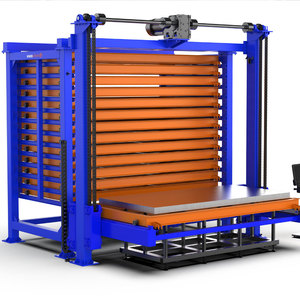
Automatic Sheet Metal Storage with Loading Robot
Vertical cassette tower system equipped with automated gantry feeding robots for direct, damage-free laser-cutting machine integration.
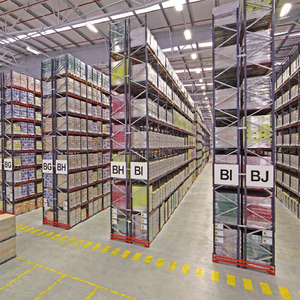
Heavy-Duty Adjustable Automation-Ready Pallet Racking
Precision-manufactured structural upright frames with tight deflection tolerances engineered for automated narrow aisle and crane handling.
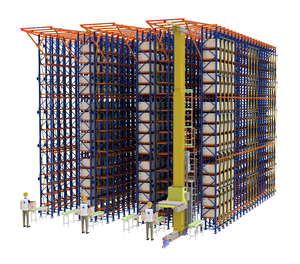
Labor-Saving AS/RS Automated Retrieval System
End-to-end automated storage and retrieval infrastructure featuring high-speed inbound conveyors, sorting loops, and automated racking cells.
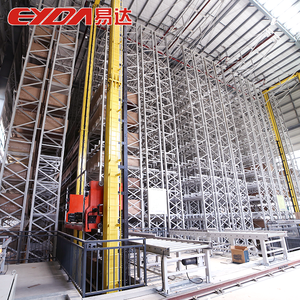
Intelligent Cold Storage AS/RS Shuttle Racking
Low-temperature alloy formulation designed to eliminate cold-bridge brittle fractures and operate flawlessly in high-density cold rooms.
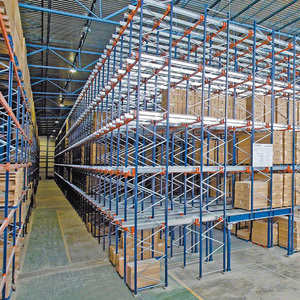
High-Density Radio Shuttle Pallet Racking
Semi-automated deep lane channel racking utilizing precision guide rails and heavy-duty battery-powered shuttle vehicles with zero lift truck rack entry.
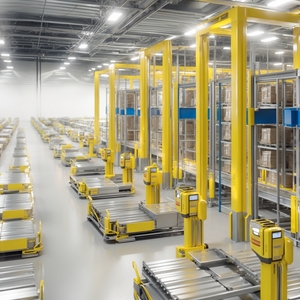
Smart AS/RS Pallet Shuttle & Forklift AGV System
Intelligent intralogistics system linking multi-tier shuttle racks with unmanned laser-guided automated guided vehicles (AGVs) for non-stop buffering.
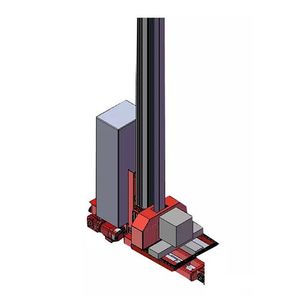
Stacker Crane & Roller Conveyor AS/RS System
Heavy structural crane runways integrated directly with continuous roller and chain conveyor loops for maximum hourly throughput rates.
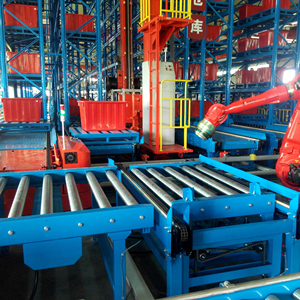
High-Bay Automated Pallet Storage & Retrieval System
Clad-rack or free-standing high-bay automated racking built with ultra-stringent vertical plumbness tolerances to ensure uninterrupted crane travel.
Structural Architecture & System Selection Matrix
Selecting an automation racking system requires balancing volumetric footprint, throughput cycle demands, and capital expenditure amortization. Below is the comparative engineering baseline used across our international projects.
| Storage Topology | Space Efficiency | Throughput Velocity | Civil Slab Flatness Spec | Structural Standards | Primary Application |
|---|---|---|---|---|---|
| Unit-Load AS/RS (Stacker Crane) | Maximum (90%+) | Very High (80–140 Pallets/Hr/Aisle) | DIN 18202 Table 3 / ASTM E1155 F-min 75 | FEM 9.831 / EN 15620 Class 100-200 | High-bay regional distribution hubs, FMCG, cold chain |
| 4-Way Radio Shuttle Matrix | Ultra-Dense (85–92%) | High (Dynamic Multi-Vehicle Scalability) | DIN 18202 Table 3 Line 4 | FEM 10.2.02 / EN 15512 | Finished goods buffering, beverage, multi-SKU retail |
| Semi-Automated 2-Way Shuttle | High (75–85%) | Moderate (Dependent on Reach Truck) | Standard Industrial Superflat (FF 45 / FL 35) | RMI MH16.1 / EN 15512 | Raw material holding, low-SKU bulk chemical manufacturing |
| Vertical Sheet Metal Smart Tower | Ultra-Dense (80% Footprint Saving) | Precision Cycle (30–60 Sec per Tray) | Standard Reinforced Industrial Concrete | ISO 9001 / Machine Directive 2006/42/EC | Laser cutting, stamping, heavy plate automated fabrication |
Unlike static pallet racking, which accommodates small operational deflections under forklift placement, an automation racking system operates as a precision kinematic guide track for high-speed automated storage and retrieval machines (SRMs), autonomous radio shuttles, and overhead shuttles. Upright frames are subject not only to static vertical gravity loads ($G_k$) but also to substantial dynamic horizontal forces ($F_h$) caused by crane acceleration, braking deceleration, and rotational sway during full-mast extensions.
At Guangzhou HEDA Shelves Co., Ltd., we utilize high-grade continuous hot-rolled structural coils (Q235B and Q355B structural steel grades) with strict yield strengths ranging from 235 MPa to 355 MPa. The cold-roll profiling lines employ multi-station progressive roll passes to eliminate residual internal stresses, preventing upright twist and camber. Our vertical plumbness tolerances adhere to FEM 9.831 and EN 15620 Class 100/200 specifications, maintaining cumulative upright deviation below $1/1000$ across heights exceeding 30 meters. This structural rigidity is critical to preventing optical misalignment in automated positioning sensors, laser rangefinders, and industrial photoelectric interlocks.
Future Procurement Trends in Automation Racking (2025–2035)
Global supply chain leaders and EPC contractors are transitioning from standalone static steel frameworks to cyber-physical intralogistics ecosystems. These four core procurement shifts dictate modern specification sheets.
4-Way Shuttle & AMR Convergence
Procurement is shifting away from rigid single-aisle stacker cranes toward flexible 4-way pallet shuttle matrices interfaced with autonomous mobile robots (AMRs). Buyers demand decoupled throughput where vehicles can be scaled dynamically during seasonal supply peaks.
Sub-Zero Cold Chain Electrification
Rising energy tariffs across pharmaceutical and frozen food cold chains drive the procurement of ultra-dense automated storage. Specifications require low-temperature lithium-iron-phosphate (LiFePO4) power cells, thermal condensation barriers, and anti-embrittlement structural alloy treatments.
Digital Twin & Open API Architecture
Warehouse automation tenders now enforce digital twin simulation capabilities prior to steel cutting. Racking manufacturers must provide certified finite element analysis (FEA) files, standard open API protocols for WCS/WMS handshakes, and virtual commissioning models.
Modular Brownfield Retrofitting
Due to industrial real estate costs and construction lead times, supply chain operators are converting conventional manual warehouses into automated nodes. Demand has surged for modular automation racks that can be anchored to existing standard concrete slabs without deep piling.
Eliminates manual forklift drivers, pallet staging bottlenecks, and human search-and-pick transit cycles.
Converts unutilized warehouse air-rights into active storage bays up to 40 meters high.
Automated optical position encoding, RFID tracking, and WMS software integration prevent misplaced inventory.
Direct factory engineering and reduced operational overhead yield rapid return on investment (ROI).
Guangzhou HEDA Shelves Co., Ltd. Competencies
Established in 2001, Guangzhou HEDA Shelves Co., Ltd. operates as one of China's premier heavy industrial storage and automated racking manufacturers, offering integrated OEM/ODM fabrication, structural simulation, and global export execution.
30,000 m² Intelligent Factory Base
Our heavy industrial manufacturing complex in Guangzhou houses 32 continuous cold-roll forming lines, high-speed automated CNC punch presses, and robotic gantry welding units capable of handling complex automated high-bay racking systems.
- 30,000 Tons Monthly Steel Throughput
- 300+ Skilled Technicians and Engineers
- Continuous Robotic Laser Profiling Lines
10-Stage Anti-Corrosion Finishing
Automation racking components undergo a rigorous multi-stage pre-treatment regimen including chemical degreasing, acid pickling, rust removal, and zinc phosphating prior to electrostatic powder coating, providing long-term corrosion resistance for harsh coastal and sub-zero environments.
- Automated Acid Pickling & Phosphating
- Electrostatic Powder Coating (60–90μm)
- ASTM B117 Neutral Salt Spray Compliant
Certified Traceability & Standards
We maintain formal international certifications required by EPC contractors, civil defense bodies, and project insurers worldwide. Every production heat number is traceable from raw steel coil to container packing lists.
- CE Certified (No. 2435-CPR-8605159)
- ISO 9001:2015 Quality System (18624Q00169R0M)
- Full RoHS Environmental Compliance
Automation Racking Procurement FAQ
Answers to the most critical technical, civil engineering, and procurement questions raised by warehouse operators, supply chain directors, and EPC contractors.
What civil concrete floor flatness specifications are required for high-bay AS/RS racking?
High-bay automated racking systems utilizing automated storage retrieval machines (SRMs) or narrow-aisle cranes require superflat industrial concrete slabs. The baseline specification is DIN 18202 Table 3, Line 4 (or ASTM E1155 $F_{min} 75 / F_{min} 100$). Variations in elevation along crane running tracks must not exceed ±1.5 mm over a 2-meter gauge to prevent mast sway, kinetic rail friction, and sensor misalignment.
How does HEDA Shelves integrate racking steelwork with third-party WCS, WMS, and PLC hardware?
Our engineering team designs structural mounting brackets, precision cable trays, busbar runs, photoelectric target reflectors, and barcode flag mounts directly into our CAD/BIM models. We collaborate directly with leading intralogistics system integrators using open industrial fieldbus protocols (Profinet, EtherCAT, Ethernet/IP) to align mechanical clearances with sensor focal lengths.
What are the structural design criteria for seismic zones in automated high-bay racks?
In accordance with EN 16681, FEM 10.2.08, and RMI MH16.1, seismic calculations for automated racks must evaluate dynamic modal response spectrums. Our engineers analyze ground acceleration coefficients ($S_s, S_1$), structural ductility factors ($q$), soil classifications, and the dynamic interaction between the stored pallet mass and the flexible high-bay steel frame to configure upright sections, heavy baseplates, and high-tensile chemical wedge anchors accordingly.
What is the typical manufacturing lead time and export delivery process for turnkey AS/RS racking?
Engineering layout generation and structural calculation require 5–7 working days. Once architectural approval is finalized, factory fabrication for 500–2,000 pallet positions typically takes 25–35 calendar days. Shipments are bundled with color-coded, labeled tags matching erection drawings and loaded into standard 40ft HQ shipping containers via our direct logistics terminals for delivery to key global ports including Jebel Ali, Dammam, Jeddah, Singapore, Rotterdam, and Los Angeles.
Accelerate Your Warehouse Intralogistics Transformation
Partner with China's leading automated racking systems manufacturer. Send us your architectural CAD floor plan, pallet dimensions, clear building heights, and throughput objectives. Our structural engineering team will deliver a comprehensive 2D/3D layout, static FEA analysis, and a factory-direct quotation within 48 hours.