Featured Industrial Warehouse Racking Systems
Precision roll-formed, high-grade structural Q235B/Q355B steel storage configurations custom-engineered for distribution centers, manufacturing warehouses, cold chain facilities, and multi-tier logistics hubs.
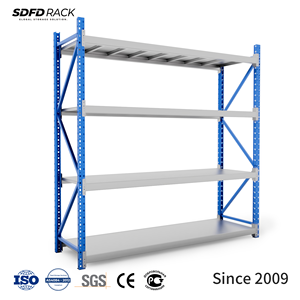
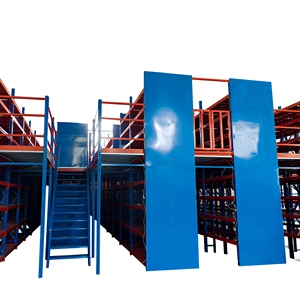
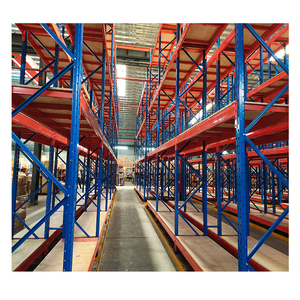
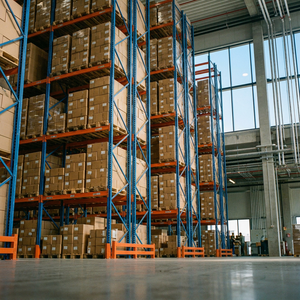
Engineering Capabilities of Leading Chinese Racking Manufacturers
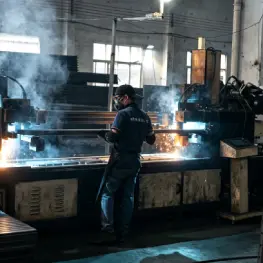
Sourcing structural warehouse racking from China has transitioned from basic price-arbitrage procurement to high-precision engineering collaboration. Tier-1 Chinese racking manufacturing complexes deploy continuous automatic roll-forming lines, automated punch tooling, automated dual-gun robot welding stations, and specialized electrostatic powder polymer coating tunnels. In-house metallurgical consistency and rigorous structural calculations ensure compliance with international structural frameworks, including EN 15512:2020 (European Steel Static Storage Systems), RMI ANSI MH16.1 (Specification for the Design, Testing and Utilization of Industrial Steel Storage Racks), and AS 4084-2023 (Steel Storage Racking Standards).
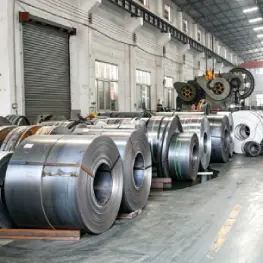
Certified Prime Steel Ingot & Coil
We source exclusively from primary state-owned mills (Baosteel, Shougang, Ansteel) utilizing certified Q235B and high-yield Q355B (equivalent to ASTM A572 Grade 50 / S355JR) cold-rolled strip steel. Mill certificates accompany every production batch with verified tensile, elongation, and yield strength data.
Continuous Roll-Forming Tolerances
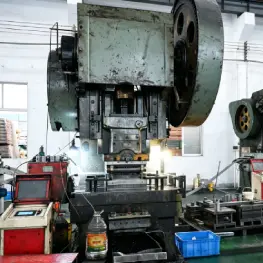
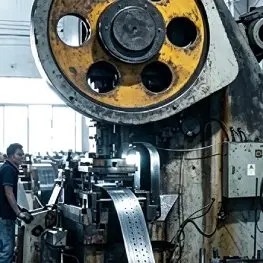
Equipped with 24-station continuous cold-bending roll formers with inline high-speed hydraulic punching. Upright profiles achieve structural column straightness deviation strictly within 1/1000 of overall member length, guaranteeing pitch repeatability within ±0.1mm for seamless automated lock-pin engagement.
9-Stage Chemical Surface Passivation
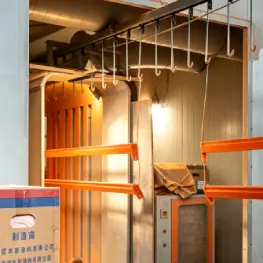
Prior to coating, steel members undergo immersion pickling, alkaline degreasing, ultrasonic water rinsing, and high-density zinc phosphating. Finished in automatic GEMA electrostatic powder coat booths with thermosetting polyester resin baked at 180°C–200°C, achieving 500+ hours in neutral salt spray (ASTM B117).
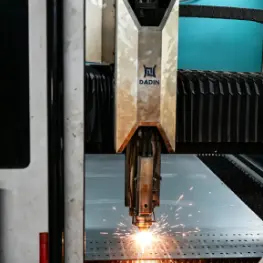
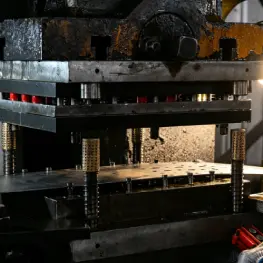
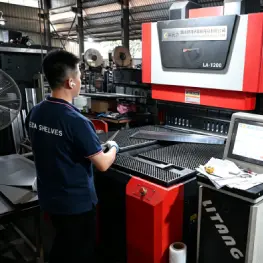
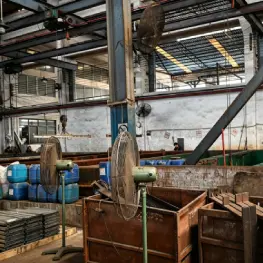
Standardized 10-Stage Industrial Production & Quality Control Workflow
Every structural element is tracked via digital barcoding across ten rigorous shop-floor stages to ensure zero field assembly deviation at overseas project jobsites.
Future Procurement Trends in Industrial Storage Racking (2025–2030)
Global supply chain shocks, shifting e-commerce profiles, rising industrial land values, and heightened sustainability mandates have permanently changed the procurement matrix for warehousing directors and general contractors.
1. Total Cost of Ownership (TCO) vs. Initial Capital Outlay
Procurement teams are moving away from evaluating storage bids solely on price-per-tonne of steel. TCO analysis now accounts for assembly speed, field reconfigurability, beam deflection rates under permanent load, and post-impact column repair costs. Advanced cold-formed sections featuring omega-profile uprights (incorporating 11 to 13 structural bends) provide up to 26% higher torsional resistance compared to traditional 7-bend sections, allowing higher load per kilogram of installed steel and drastically lowering freight overhead per pallet location.
2. Low-Carbon Steel & Scope 3 Supply Chain Mandates
Multinational logistics brands (DHL, DB Schenker, Maersk) and global FMCG retailers now actively demand traceable environmental product declarations (EPD) from Chinese manufacturers. Chinese mills are rapidly expanding Electric Arc Furnace (EAF) short-process steelmaking powered by renewable regional grids. Powder coating facilities are migrating to zero-VOC heavy-metal-free polyester formulations, reducing embedded carbon by up to 18% per square meter of racking footprint.

3. Seismic Performance Specification (EN 16681 & ASCE 7)
Whether deploying distribution hubs in seismic zones of California, Chile, New Zealand, or Southern Europe, international buyers require advanced finite element dynamic seismic response spectra modeling. High-tier Chinese manufacturers now deliver fully stamped structural calculations detailing inter-story drift limits, rotational stiffness (Sj), and ductility behavior (R-factor) of column-base and beam-connector joints under maximum design earthquake ground accelerations.
4. Container-Optimized Modular Crating & BIM Pre-Assembly
With volatile maritime container shipping indices, factory-direct packaging intelligence represents a major financial differentiator. Computer-assisted 3D container stuffing algorithms pack maximum structural tonnage into 40ft High Cube containers without crushing powder-coated surfaces. Custom color-coded bundles, barcode-tagged structural members, and factory pre-assembled upright truss frames reduce field installation labor by up to 35% on job sites in the US, Europe, and the Middle East.
Technological & Architectural Evolution of Modern Storage Systems
The line dividing structural static storage and automated robotics has dissolved. Industrial racking is transforming from passive steel shelving into high-tolerance mechanical scaffolding that integrates autonomous mobile robots, automated pallet shuttles, and warehouse execution software.
High-Bay AS/RS Rack-Clad Architecture
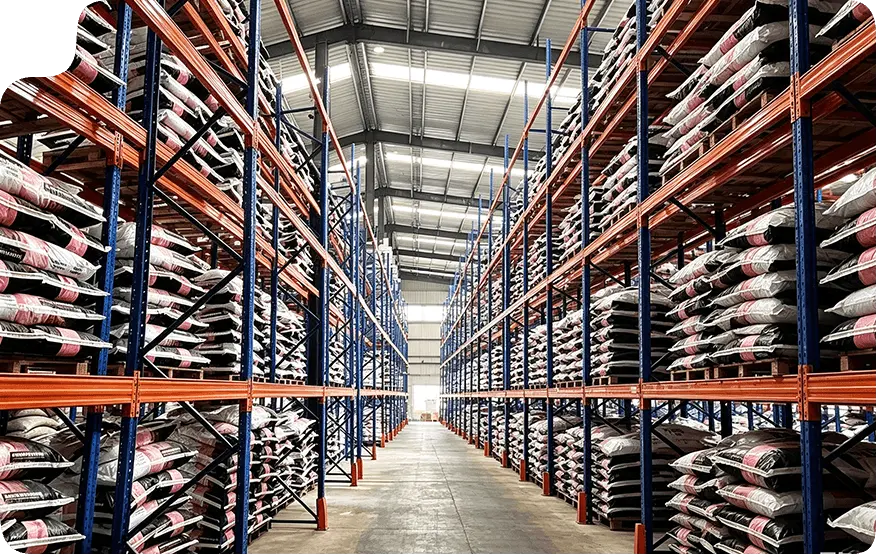
Rack-supported buildings (Rack-Clad) utilize the structural uprights to support not only pallet loads but also building wall cladding, roofing, and wind/snow loads. Reaching heights exceeding 35 to 45 meters, this engineering eliminates separate building column grids, slashing foundation and construction schedules by 20–30%.
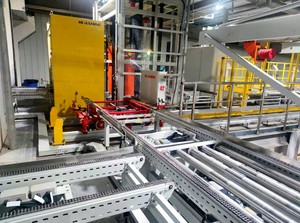
4-Way Pallet Shuttle Automation
Transitioning beyond linear 2-way shuttles, high-density 4-way multi-directional intelligent shuttles travel seamlessly along transverse and longitudinal rails inside racking lanes. The system operates autonomously with vertical elevators, dynamically reallocating SKUs based on real-time fulfillment priority.
Digital Twin & IoT Strain Monitoring
Sensors integrated into critical upright baseplates and top-tie members monitor structural deflection, ground settling, and forklift collision micro-strains in real time. Data feeds directly into facility SCADA and Building Management Systems (BMS) to trigger preventative maintenance before structural failure occurs.
Technical Comparison: Heavy-Duty Racking Architectures
| System Architecture | Floor Footprint Utilization | Direct SKU Accessibility | Handling Equipment Required | Typical Max Height | Inventory Rotation Rule |
|---|---|---|---|---|---|
| Standard Selective Racking | 35% – 45% (Aisle 3.2m–3.6m) | 100% Immediate Access | Standard Counterbalance / Reach Truck | Up to 12.0 Meters | FIFO (First-In, First-Out) |
| Very Narrow Aisle (VNA) | 55% – 65% (Aisle 1.6m–1.9m) | 100% Immediate Access | Wire/Rail Guided VNA Man-up / Turret | Up to 17.0 Meters | FIFO (First-In, First-Out) |
| Drive-In / Drive-Through | 65% – 75% (Dense Channels) | 15% – 20% (Lane Limited) | Standard Counterbalance / Reach Truck | Up to 11.0 Meters | LIFO (Last-In, First-Out) / FIFO |
| Radio Shuttle Cart System | 75% – 85% (Ultra-Deep Lane) | Indexed by Lane / Level | Forklift + Semi-Automated Shuttle | Up to 22.0 Meters | Configurable FIFO or LIFO |
| Automated AS/RS Crane System | 85% – 95% (Maximized Cube) | 100% Automated Retrieval | Automated Stacker Cranes (SRM) | Up to 40.0+ Meters | Fully Dynamic WMS Controlled |
Audited Quality Systems & Global Compliance Credentials
Guangzhou Heda Shelves Co., Ltd. (operating since 2001) maintains continuous third-party surveillance audits across international mechanical and structural performance criteria. Every shipment carries formal traceability records verifiable with certification bodies.
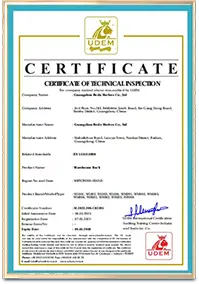
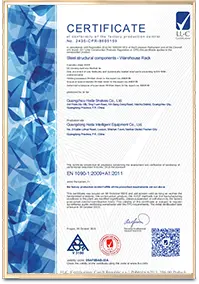 CE Conformity Certificate
Ref No. 2435-CPR-8605159 (EN 15512)
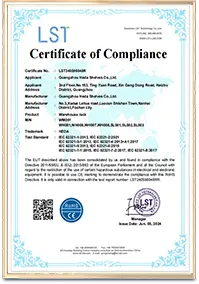
 ISO 9001:2015 Certification
Reg No. 18624Q00169R0M (Valid 2027)
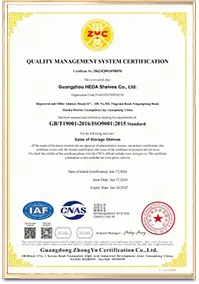
 RoHS Compliance
Zero Heavy Metal Eco Powder Passivation
 Mechanical Loading Test
Full-Scale Upright Stub & Beam Deflection
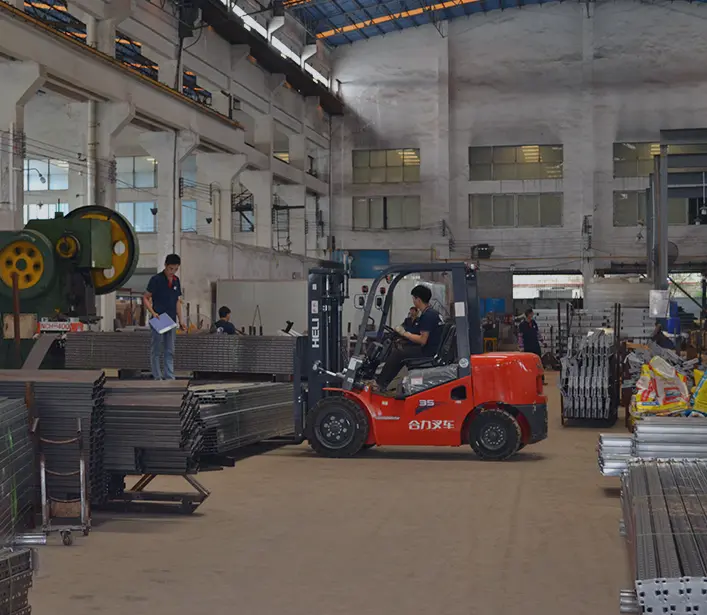
Full-Scale Laboratory Testing Rigs
Unlike trading entities, top Chinese factories maintain in-house destructive mechanical test stands. Full-scale testing protocols validate:
- Upright Stub Column Crushing Test: Evaluates actual effective cross-sectional area (Aeff) and short-column buckling behavior under axial compression.
- Beam-End Connector Moment-Rotation Bending: Calibrates actual connector stiffness (Kφ) and loosened slip moment according to EN 15512 Appendix A.
- Floor Baseplate Uplift & Shear Anchorage: Measures anchor bolt shear resistance in cracked and uncracked concrete foundations.
- Continuous Dynamic Salt Spray Endurance: Verifies corrosion durability in coastal and chemical environments.
Engineering & Procurement FAQ for International EPC Buyers
Detailed answers addressing engineering tolerances, steel metallurgy, building safety approvals, and installation guidelines.
What is the definitive engineering difference between Q235B and Q355B steel in racking?
Q235B offers a guaranteed minimum yield strength ($f_y$) of 235 MPa and ultimate tensile strength ($f_u$) of 370–500 MPa, with an elongation at break ≥26%. It is optimal for standard roll-formed beams, shelves, and low-to-medium height uprights where deflection limits govern rather than yield stress.
Q355B (equivalent to ASTM A572 Grade 50 and EN 10025 S355JR) provides a minimum yield strength of 355 MPa and tensile strength of 470–630 MPa. In high-bay systems exceeding 8 meters, AS/RS structures, or seismic zones, Q355B allows thinner material thicknesses while withstanding significantly higher combined axial compression and bending moments without premature elastic-plastic local buckling.
What allowable beam deflection criteria are enforced by international standards?
Under international norms such as EN 15512 and ANSI MH16.1, the allowable vertical deflection of a pallet rack beam under design working load is strictly limited to $\delta \le L / 200$ (where $L$ is the clear distance between upright columns). For sensitive automated picking lanes, robotic interfaces, or AGV pick points, engineering calculations often specify a more stringent deflection criterion of $\delta \le L / 300$ or $L / 400$ to prevent automated sensor misalignment.
How do factory designs support local Civil Defense, OSHA, and insurer approvals?
Factory engineering packages include:
1. Stamped 2D Plan Layouts illustrating net aisle widths, forklift turning radiuses, emergency exit clearances, and accessible flue spaces (longitudinal and transverse flue gaps of 75mm–150mm for fire sprinkler water penetration per NFPA 13).
2. Structural Engineering Calculations verifying foundation floor-slab point load transmission and anchor pullout forces.
3. Color-coded load notice placards designed per OSHA and EN 15635 standards specifying permissible compartment and bay loads.
What surface treatment is best suited for extreme heat, high humidity, or cold chain freezers?
For standard dry indoor warehouses, our 9-stage phosphate pre-treatment followed by a 60–90 micron thermoset polyester electrostatic powder coat provides optimal durability. For extreme coastal conditions (such as the Arabian Gulf, Caribbean, or SE Asia) and cold storage freezers (-25°C to -30°C where condensation cycles occur), we recommend either Hot-Dip Galvanizing (HDG) per ISO 1461 (achieving 65–85μm zinc barrier coating) or Continuous Galvanized Strip (pre-galvanized Z275) coupled with zinc-rich epoxy primers.
What information is needed to generate a free 2D CAD and 3D BIM warehouse model?
To provide a fully calculated layout within 24–48 hours, our structural engineers require:
• Architectural building CAD file or PDF drawing with column positions, wall dimensions, and door/dock locations.
• Clear building height to the lowest roof truss, sprinkler header, or HVAC ductwork.
• Pallet dimensions ($W \times D \times H$, including pallet overhang) and maximum gross pallet weight.
• Make, model, mast collapsed height, and turning radius of your material handling equipment (forklift / reach truck / VNA).
• Warehouse temperature specifications and seismic zone location.
What export packaging measures prevent damage during maritime transport?
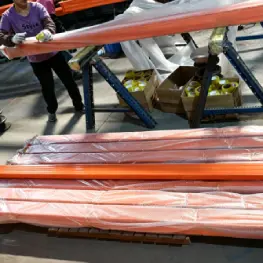
All upright frames are bundled with protective corrugated paper buffers, air-cushion film, and non-marking high-strength polymer strapping. Beams are nested with wood spacers to eliminate metal-to-metal rubbing during container transit. Small hardware, baseplates, connectors, and anchor bolts are packed in sealed, export-grade fumigated wooden crates with internal moisture-absorbing desiccant packs.
Request an Engineered Warehouse Storage Layout & Factory Quote
Partner directly with an established Chinese structural racking manufacturer. Send us your building dimensions, load requirements, or tender specifications for a comprehensive 2D CAD layout, 3D rendering, and factory-direct quotation.