Engineering Overview: The Architecture of Heavy-Duty Movable Pallet Racking Systems
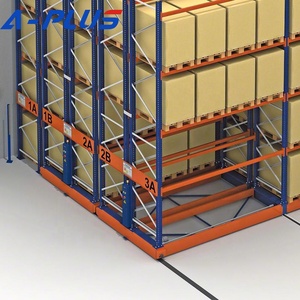
In modern industrial intralogistics, commercial real estate costs, explosive SKU proliferation, and cold-chain energy expenditures have rendered static wide-aisle pallet racking commercially sub-optimal for high-density operations. A movable pallet racking system—commonly referred to in heavy industry as an Electric Mobile Racking System (EMRS) or motorized carriage-mounted pallet rack—transforms conventional static storage into an active, space-optimized mechanical installation. By mounting standard heavy-duty pallet racking superstructures on electrically driven motorized chassis running across flush or low-profile floor guide rails, EMRS consolidates multiple access corridors into a single dynamic aisle, unlocking up to 85% to 90% greater storage capacity within identical building footprints.
Unlike standard static racking systems that require fixed 3.0-meter to 3.5-meter aisles between every single rack row, an electric movable pallet racking system operates as a contiguous block. When picking or replenishment orders arrive via Warehouse Management System (WMS) dispatch, industrial geared motors simultaneously traverse the movable bases along high-precision structural steel tracks, opening a single operational aisle precisely where required. This enables 100% selective individual pallet accessibility while eliminating up to 50% of otherwise wasted transitional floor area.
Technical Information Gain: For enterprise procurement directors evaluating floor area utilization, movable pallet racks bridge the performance gap between low-density selective racks and blind-density systems (such as drive-in racks). They maintain full 100% SKU selectivity while achieving the cubic volumetric density typically found in automated storage and retrieval systems (ASRS), at a capital investment cost 40% to 60% lower than fully robotic shuttle warehouses.
Kinematic Chassis, Bogie Engineering, and Drive Electronics
The structural core of an industrial movable pallet racking system is the heavy-duty wheeled chassis (bogie carriage). Each carriage consists of cold-formed, shot-blasted Q235B or Q355B structural steel profiles box-welded to resist substantial torsion, dynamic braking shear, and eccentric point loads. Spheroidal graphite cast iron wheels (ductile iron GGG70 or forged 42CrMo alloy) ride along ground-embedded guide rails and flat load-bearing rails, engineered to distribute localized ground pressure safely over reinforced concrete slab floors.
Carriage traction is achieved through a decentralized multi-motor architecture: independent helical-bevel geared motor assemblies are distributed uniformly along the chassis length. This distributed drive methodology guarantees smooth, synchronized starting and stopping profiles via variable frequency drive (VFD) controllers. Inverter acceleration and deceleration ramps mitigate horizontal harmonic oscillations, preventing pallet shifting, packaging deformation, or structural tipping moments during carriage movement.
Integrated Safety Sensor Arrays
Dual-level optical photoelectric barriers create active perimeter shields. Emergency stop pull-cords, chassis bumper sensors, and aisle floor laser scanners interrupt motorized traction within milliseconds should any obstacle, vehicle, or human enter the dynamic movement envelope.
PLC & Remote Radio Control
Equipped with Siemens S7 or Schneider PLCs, movable racking units support remote RF terminal operation directly from forklift cabs, wall-mounted touchscreens, or automated WCS routing. Features include night-park ventilation spacing and fire-flue mode auto-separation.
Cold Storage & Sub-Zero Rating
Engineered to operate continuously in deep-freeze environments down to -30°C. Features internal motor heating coils, low-temperature synthetic lubricants, condensation-sealed IP65 electrical junction boxes, and low-temperature ductile cold-formed structural steels.
Comparative Engineering Matrix: Movable vs. Conventional Racking Systems
Logistics planners must weigh throughput requirements, capital expenditures, land acquisition constraints, and future operating costs. The comparative matrix below demonstrates structural and operational metrics across commercial racking methodologies:
| Storage Topology |
Floor Space Utilization |
SKU Selectivity Ratio |
Civil Slab Leveling Tolerance |
Throughput Velocity |
Relative CAPEX / Pallet |
| Electric Movable Pallet Racking |
85% - 90% (Maximum) |
100% Direct Access |
DIN 18202 Line Class 3 |
Moderate (35-45 sec aisle shift) |
Medium-High |
| Standard Selective Racking |
40% - 45% (Low) |
100% Direct Access |
Standard Industrial Flat |
High (Immediate Access) |
Low (Base Level) |
| Drive-In / Drive-Through Rack |
70% - 80% (High) |
15% - 25% (LIFO/FIFO Blind) |
Standard Industrial Flat |
Low (Forklift inside lanes) |
Low-Medium |
| Very Narrow Aisle (VNA) |
55% - 65% (Medium) |
100% Direct Access |
DIN 15185 Superflat |
Very High (VNA Man-Up Turret) |
Medium |
| Radio Shuttle Cart Racking |
80% - 85% (High) |
30% - 50% (Channel Bound) |
Standard Industrial Flat |
High (Automated Cart Run) |
High |
Strategic Procurement Trends & Future Market Evolution (2025–2035)
The international procurement landscape for movable pallet racking systems is undergoing significant structural shifts driven by automated logistics integration, skyrocketing industrial real-estate lease rates, and global carbon reduction mandates. B2B procurement directors and EPC logistics engineers are increasingly prioritizing lifecycle return on investment (ROI) over initial purchasing prices. Key macro trends shaping the procurement cycle include:
1. The Cold-Chain Energy Crisis & Volumetric Efficiency Modeling
Cold storage facilities represent the fastest-growing application sector for movable pallet racking systems globally. Operating a refrigerated or frozen warehouse entails immense continuous energy expenditure, where refrigeration compressors account for 60% to 75% of operational power. Because cooled warehouse air circulates throughout unused volume, wide operating aisles represent wasted energy. By deploying electric mobile racking, cold storage operators eliminate unnecessary open aisles, reducing refrigerated airspace by up to 45% per pallet stored. Facilities in high-power-cost regions report complete amortization of the EMRS mechanical carriage premium within 18 to 26 months strictly through electricity kilowatt-hour savings.
2. Seamless Convergence with Autonomous Mobile Robots (AMRs) and AGVs
Historically, movable racking was operated manually by forklift drivers triggering radio transmitters from reach trucks. Modern procurement mandates require native API connectivity between the mobile rack PLC control cabinet and automated industrial machinery. Through standardized industrial Ethernet protocols (Profinet, EtherNet/IP, Modbus TCP), modern electric mobile racks interface directly with Warehouse Control Systems (WCS). As an Autonomous Counterbalanced Forklift or Automated Guided Vehicle (AGV) approaches, the racking block dynamically opens the target aisle without human intervention, validates the safe-entry optical perimeter, and commands the AGV to retrieve or deposit the pallet.
3. IoT Structural Telematics & Predictive Maintenance
Enterprise procurement teams now require continuous structural health monitoring built into manufacturing bids. Guangzhou Heda Shelves integrates embedded IoT sensors directly into carriage drive wheel assemblies and structural uprights. Real-time vibration accelerometers monitor wheel bearing wear, motor thermal sensors track gearbox health, and laser rangefinders measure carriage skew along long rails (preventing crabbing). These telematics feed predictive maintenance alerts to facility managers before mechanical binding or motor overload occurs, eliminating costly unscheduled warehouse downtime.
4. Low-Carbon High-Strength Cold-Formed Steels
With corporate Environmental, Social, and Governance (ESG) requirements becoming integral to enterprise vendor selection, leading Chinese manufacturers are adopting high-yield structural cold-rolled coil steels (such as Q355B and automotive-grade high-tensile micro-alloyed sheets). By utilizing computer-optimized profile geometry—incorporating multiple stiffening ribs along upright profiles—structural engineers achieve equal or superior load-bearing capacity (tested to EN 15512 and FEM 10.2.02 codes) while reducing overall steel weight by 12% to 18%. This reduces embodied carbon, lowers marine shipping container weights, and minimizes raw material costs.
Factory Engineering & Manufacturing Advantages: Guangzhou Heda Shelves Co., Ltd.
When sourcing heavy-duty movable racking from China, manufacturing consistency, metallurgical integrity, and robotic dimensional tolerances represent the difference between smooth daily operation and mechanical failure. Founded in 2001, Guangzhou Heda Shelves Co., Ltd. has spent over two decades developing integrated manufacturing systems tailored specifically to international export standards, heavy-payload warehousing, and demanding GCC/Middle East, Southeast Asian, European, and American environments.
Our dedicated 30,000 square meter manufacturing base in Guangzhou, staffed by more than 300 experienced engineers, production technicians, and logistics specialists, delivers complete in-house control over the entire production cycle. Producing up to 30,000 tons of precision-engineered racking per month, we eliminate third-party processing markups, maintain strict quality control, and guarantee predictable project lead times.
The 10-Step Precision Manufacturing Process
Every component fabricated for our movable and static pallet racking systems passes through an exhaustive, traceable 10-step production line:
Step 01
Raw Material QC
Ultrasonic steel coil testing for tensile strength, yield, and metallurgical composition.
Step 02
Precision CNC Cutting
Laser and high-speed CNC shearing ensuring sub-millimeter component tolerances.
Step 03
Automated Punching
Continuous high-speed progressive mechanical presses forming upright pitch holes.
Step 04
Cold Bending Forming
Multi-station heavy cold-roll forming lines shaping complex cross-section profiles.
Step 05
Profile Calibration
Laser straightness verification and camber correction across entire beam spans.
Step 06
Robotic Welding
Multi-axis automated welding cells attaching structural beam connectors and carriages.
Step 07
Surface Polishing
Mechanical descaling and robotic deburring ensuring seamless component interfaces.
Step 08
Pickling & Phosphating
Multi-stage chemical pre-treatment removing microscopic oxides for coating adhesion.
Step 09
Electrostatic Powder
Automated Swiss Gema powder coating lines baking durable polymer finishes at 200°C.
Step 10
Final QC & Pack
Full structural dry-assembly checks, barcoded bundle labeling, and export strapping.
Global Compliance, Certifications & Engineering Services
HEDA Shelves products hold international third-party certifications including CE Certification (No. 2435-CPR-8605159), ISO 9001:2015 Quality Management (No. 18624Q00169R0M), and verified RoHS environmental compliance. Every project engineered by HEDA includes complimentary 2D CAD structural layout designs, 3D photorealistic renderings, structural finite element analysis (FEA), and building civil-defense submittal drawings indicating live loads, dead loads, wind shear, and seismic ground acceleration ratings.
Movable Pallet Racking Procurement FAQ (Technical & Commercial)
What concrete floor slab specifications and leveling tolerances are required for electric mobile racks?
Because electric mobile racking carriages concentrate immense wheel loads onto ground rails, the concrete slab must be engineered according to DIN 18202 (typically Part 5, Table 3, Line 3 or 4) or ASTM E1155 F-min standards. The foundation must be a reinforced concrete slab capable of bearing point loads from 5 to 18 tons per wheel bogie. Floor flatness along the rail track path must not deviate more than ±1.5 mm over a 2-meter straight edge. In new construction facilities, guide rails are cast directly into pre-formed floor troughs and leveled using adjustable micro-leveling leveling bolts before high-strength non-shrink cementitious grouting. In retrofit existing buildings, precision diamond-wheel floor saw-cutting creates trenches for rail embedding.
How long does an aisle change take, and how does that affect forklift cycle times?
Modern inverter-controlled electric mobile carriages traverse along rails at a linear velocity between 4.0 and 5.5 meters per minute. Opening an average 3.2-meter-wide working aisle takes between 35 and 50 seconds. To maximize operational picking throughput, standard operating procedures utilize remote RF controllers mounted in forklift operator cabins. Forklift drivers initiate the aisle-change sequence via radio command while in transit from the inbound staging dock or previous aisle. By the time the forklift reaches the racking block, the target aisle has fully traversed, positioned, and initiated safety lockouts, resulting in zero dead-wait time for operators.
How do mobile racking systems address emergency power failures or outages?
HEDA Shelves incorporates redundant fail-safe systems into all electrical mobile racking installations. In enterprise facilities, the central control panel is connected to the warehouse emergency backup diesel generator or UPS line with automatic transfer switching (ATS). In facilities without backup generator infrastructure, our carriages are equipped with mechanical hand-crank decouplers or manual hydraulic bypass ratchets. By inserting a lever into the high-torque gearbox auxiliary input shaft, a single warehouse technician can manually roll the mobile base to access any pallet load during an extended blackout.
What fire suppression and sprinkler configurations (NFPA 13) are used with mobile racks?
Movable pallet racking complies with international fire safety codes, including NFPA 13 (Standard for the Installation of Sprinkler Systems). The system integrates directly into the building's central Fire Alarm Control Panel (FACP). When the master alarm triggers (smoke, thermal, or flow-switch signal), the rack PLC immediately overrides all local user commands and enters automated "Fire Evacuation & Flue-Space Mode." The motorized carriages traverse into predetermined positions, opening uniform 150 mm to 300 mm longitudinal flue spaces between every single mobile row, enabling overhead ESFR (Early Suppression Fast Response) ceiling sprinklers to deliver unimpeded water penetration down to the lower tier pallets.
Can mobile racking systems operate reliably inside deep-freeze cold storage (-25°C to -30°C)?
Yes. Deep-freeze warehousing is one of the primary deployment sectors for HEDA mobile racks. Cold-store versions are engineered with customized metallurgical and electrical specifications: structural steel uprights and beams are fabricated from low-temperature impact-tough steels resisting brittle ductile-to-cleavage transitions; industrial gearboxes utilize specialized sub-zero synthetic lubricants that do not congeal at -30°C; drive motors include internal thermostatically regulated anti-condensation heating elements; and electronic control modules are housed within IP65 heated insulated cabinets.
How does HEDA handle international container packing, sea freight, and on-site assembly?
All manufactured racking elements are bundled, wrapped, and banded with heavy-duty PET straps inside our Guangzhou plant. Uprights and beams are bundled with dedicated wooden spacers and high-strength lifting loops, engineered to match 40-foot High Cube (40'HQ) container internal dimensions for straightforward crane or forklift unloading at destination ports (including Jebel Ali, Dammam, Jeddah, Rotterdam, Santos, and Los Angeles). Bundles are barcoded with individual tracking numbers cross-referenced to detailed CAD installation blueprints. We supply comprehensive English installation manuals and 3D step-by-step video guides, and dispatch factory field engineers for on-site commissioning on large-scale international contracts.
Conclusion: Maximizing Cubic Warehouse Value with HEDA Shelves
Investing in a movable pallet racking system is a long-term capital decision that fundamentally redefines an enterprise's supply chain capacity, operational velocity, and facility operating margins. By partnering directly with Guangzhou Heda Shelves Co., Ltd., international buyers eliminate trading company premiums, secure direct engineering calculations tailored to local building codes, and obtain commercial-grade structural steel storage systems tested across more than 10,000 global installations.