China Best Pallet Rack Supply Suppliers & Exporters

Precision Engineering, High-Density Logistics Infrastructure & Global Compliance Systems Direct from Guangzhou Manufacturing Hub Since 2001

CE No. 2435-CPR-8605159 ISO 9001:2015 Certified 30,000 m² Facility · 30,000t/Month
Export Quality Portfolio

Engineered Heavy-Duty Racking & Multi-Tier Storage

Factory-tested, cold-rolled structural steel solutions engineered to optimize volumetric cubic capacity across distribution networks, bonded free-zones, cold stores, and e-commerce fulfillment hubs.

Guangzhou HEDA Shelves Co., Ltd. Advantage

Why Global Supply Chain Leaders Source Factory-Direct

Combining 25+ years of continuous manufacturing experience with end-to-end quality assurance, we eliminate export trading intermediaries to give our partners unparalleled structural reliability and commercial savings.

2001
Established In Guangzhou
30,000 m²
In-House Manufacturing Area
30,000 t
Monthly Steel Profile Output
120+
Export Destination Countries

Free 2D CAD & 3D Modeling

We configure structural layout plans based on building clear heights, floor slab PSI, column grids, forklift turning radiuses, and pallet load matrices before raw steel coil slitting starts.

Hot & Corrosive Climate Guard

Every profile undergoes automatic shot blasting, pickling, and phosphating prior to Swiss Gema electrostatic powder baking, ensuring corrosion resilience against high coastal humidity and heat.

Coded Container Packing

Pallet rack components are bundle-strapped, padded with air-bubble film, and bundled with color-coded barcodes corresponding strictly with CAD installation guide sheets for smooth customs unpacking.

Verified European CE Standard

Conforms to EN 15512, EN 15620, and ISO 9001:2015 frameworks (Cert: 18624Q00169R0M). Fully compliant with Middle East Civil Defense safety regulations and international warehouse structural checks.

Industry Technical Report

The Strategic Horizon: Procurement Dynamics & Structural Trends (2025–2030)

As modern global supply chains face warehouse footprint inflation, micro-fulfillment demands, and robotic convergence, selecting the correct racking ecosystem is a long-term capital efficiency decision.

1. Convergence of AS/RS & Radio Shuttles

Standard static selective racking is increasingly being transitioned into semi-automated radio shuttle channels and automated storage and retrieval systems (AS/RS). The requirement to store more units in temperature-controlled spaces—such as deep-freeze grocery hubs across GCC territories—has driven depth-density systems to reduce energy consumption per stored pallet by up to 35%.

2. High-Strength Thin-Wall Profile Roll Forming

Modern metallurgical manufacturing has replaced heavy, inefficient structural sections with custom cold-rolled high-yield steel (such as Q355B and micro-alloyed cold coil). This produces upright sections with up to 24 roll-formed folds, significantly reducing steel weight while improving torsional rigidity and impact deflection thresholds.

3. Digital BIM Twins & Dynamic Sensors

Future-ready warehouse racking structures are now manufactured to integrate directly into 3D Building Information Modeling (BIM). Real-time telemetry sensors installed on load-bearing crossbeams register impact deflections from handling equipment, giving operations managers immediate visibility into structural strain before frame failure occurs.

Racking Architecture Floor Space Utilization Direct Pallet Accessibility SKU Mix Profile Forklift Compatibility Ideal Application Case
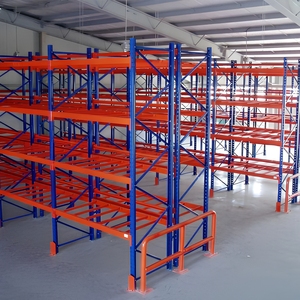
Selective Pallet Racking 40% – 45% 100% (Instant) High SKU variety / High turnover Counterbalance, Reach Trucks General 3PL, FMCG retail, auto spare distributions
Double Deep Racking 55% – 60% 50% (Two-deep) Medium SKU, predictable batch lines Pantograph Reach Forklift Dry grocery distribution, building materials
Drive-In / Drive-Through 70% – 75% Low (LIFO / FIFO Lanes) Uniform SKUs, massive batch volume Narrow Counterbalance Seasonal beverage bottling, bulk commodity staging
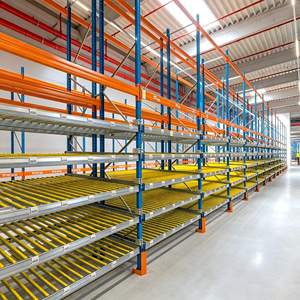
Radio Shuttle System 80% – 85% Automated Lane-Level FIFO/LIFO High volume, medium-to-low SKU variance Standard reach at aisle face Cold storage (-25°C), pharmaceutical cold-chain
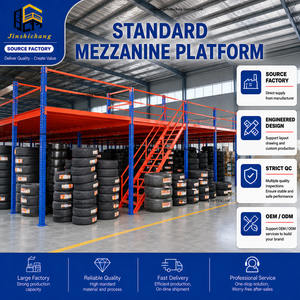
Multi-Tier Mezzanine Platform Up to 250% (Multi-level) 100% Manual / Split-Case Extensive high-density small parts Integrated lifts, vertical conveyors E-commerce fast-pick parcel depots, fashion apparel
Expert Procurement Guidance

Frequently Asked Questions for Warehouse Pallet Racks

Key technical, regulatory, and logistics answers compiled by senior structural engineers for overseas project managers and procurement officers.

What parameters are needed for a comprehensive warehouse design quotation?

To produce an engineered, compliant 2D CAD layout and 3D rendering, our team requires:

1. Architectural warehouse drawing showing structural columns, clear height under roof joists, and emergency fire door exits.
2. Pallet parameters: Depth (mm) × Width (mm) × Height (inclusive of goods), along with tare and net maximum weights.
3. Forklift performance data: Mast collapsed height, maximum lift height, and minimum right-angle aisle stacking turning radius (Ast).
4. Concrete floor specifications: Slab thickness (typically 150mm–250mm), reinforcement details, and compressive strength (e.g., C25/C30 grade).

How do HEDA racking solutions withstand high-humidity and hot industrial environments?

Standard commercial paints crack and bubble when exposed to high temperatures and coastal humidity. HEDA Shelves runs a multi-phase pre-treatment regime: cold rolled coil components undergo mechanical derusting, zinc-phosphating, and continuous clean-water rinsing to remove all mill scale and surface grease.

Components are then baked in a conveyorized curing oven using high-adhesion polyester thermosetting powder resin. For extreme outdoor marine applications or coastal port free-zones, hot-dip galvanizing per ISO 1461 standards is available.

How does HEDA ensure cargo safety during containerized maritime shipping?

Structural racking uprights and beams are susceptible to transit scuffing and deflection during open ocean voyages. We bundle all upright components in steel-strapped bundles with perimeter corrugate guards, high-tensile stretch film, and wooden dunnage blocks.

Fasteners, column baseplates, drop-in pins, and anchor bolts are packed in water-resistant crates with itemized packing slips to ensure immediate sorting on your site.

Can HEDA warehouse storage solutions pass local Civil Defense and fire authority approvals?

Yes. Our engineering drawings specify longitudinal and transverse flue spaces (typically 75mm–150mm) to allow overhead ESFR (Early Suppression Fast Response) fire sprinkler water to penetrate down the rack columns.

We provide structural load limit signage, calculation packages showing seismic drift margins, and steel grades to assist your licensed engineering consultant with civil authority submissions.

What is the standard production cycle and ocean transit turnaround?

Because our Guangzhou production facility operates continuous automated punching and roll-forming lines with a monthly throughput of 30,000 metric tons, standard container production runs are completed in 15 to 25 business days. Direct maritime shipping from nearby Nansha or Huangpu ports reaches Jebel Ali, Dammam, Singapore, Rotterdam, or Long Beach on established commercial container loops.

Ready to Engineer Your High-Capacity Warehouse?

Consult with our structural engineering team today to receive a complimentary 2D CAD floor layout, customized 3D rendering, and factory-direct volume pricing tailored to your logistics requirements.