Engineering-Grade Pallet Shelving Systems: The Global Sourcing Paradigm
How Tier-1 Chinese racking manufacturing ecosystems engineered structural reliability, high throughput, and seismic safety for global distribution hubs.
Modern global logistics networks are experiencing unprecedented structural pressure. With commercial land valuation indices soaring across North America, Europe, the GCC, and Southeast Asia, warehouse facility directors can no longer afford horizontal footprint expansion. Modern supply chain operations demand that every cubic millimeter of vertical clearance delivers maximum ROI, rigorous load integrity, and complete operational safety under demanding cycle rates. Sourcing warehouse pallet shelving systems directly from top-tier Chinese manufacturers has transformed from a purely cost-reduction tactic into an enterprise capital allocation strategy driven by precision roll-forming automation, advanced Q235B/Q355B cold-rolled steel metallurgy, and rigorous international compliance standards (including FEM 10.2.02, EN 15512, and ANSI MH16.1).
Historically, overseas procurement directors were confronted with trade-offs between local distributor markups and the technical ambiguity of offshore fabrication. Today, industry-leading Chinese factories operate fully automated continuous roll-forming lines, automated robotic CO2 shielded arc-welding centers, and 10-stage pre-treatment chemical immersion tunnels followed by electrostatic epoxy-polyester hybrid powder coatings. The result is structural warehousing hardware engineered to withstand dynamic forklift impacts, structural fatigue, cyclic thermal shocks in sub-zero cold-storage facilities, and harsh ambient salt-fog coastal humidity.
High-Performance Warehouse Pallet Shelving & Industrial Systems
Factory-calibrated structural solutions certified for high-bay stability, seismic resistance, and extreme pallet throughput.
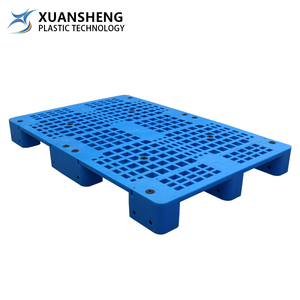
HDPE Grid Nine Foot Forklift-Compatible Pallet 1200*1000*140 MoistureProof Plastic Warehouse Stacking Platform Shelf Floor
- Dimensions: 1200 × 1000 × 140 mm
- Material: Virgin HDPE / Copolymer
- Static / Dynamic: 3000 kg / 1000 kg
- Entry Type: 4-Way Forklift & Jack
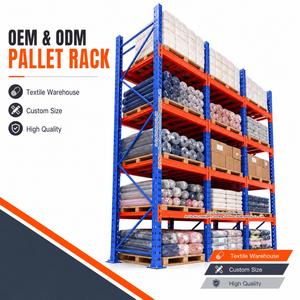
4-level Heavy Duty Rack Warehouse Storage Rack Heavy Duty Pallet Shelving Factory Supply Wholesale Garment Fabric Manufacturer
- Tier Capacity: 800 - 3,000 kg / Beam
- Upright Profile: 90×70 / 100×70 mm
- Decking Type: Cold Steel / Wire / Plywood
- Pitch Adjustment: 50 mm / 75 mm
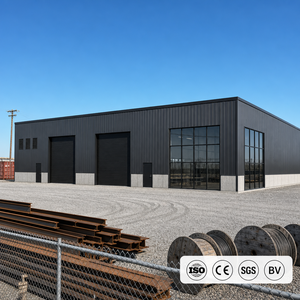
Pre-Fabricated Weather-Resistant Steel Structure Warehouse For Agricultural Storage Direct Factory Durable Construction
- Frame Steel: Q355B H-Section Steel
- Wind Load: Up to 0.85 kN/m² (Custom)
- Corrosion Spec: Epoxy Zinc-Rich Primer
- Span Capacity: 18m - 36m Clear Span
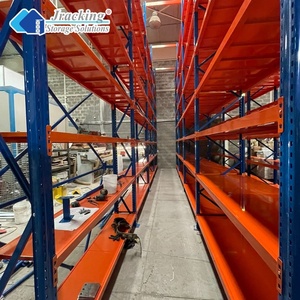
Jracking EURO Standard Warehouse Storage Racks Heavy Duty Steel Pallet Racking System for Distribution
- Engineering Norm: FEM 10.2.02 / EN 15512
- Bay Capacity: Up to 24,000 kg Frame
- Safety Pins: Heavy Zinc Plated Spring
- Deflection: ≤ L/200 Under Max UDL
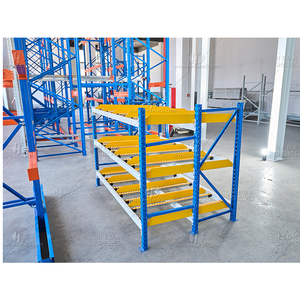
Hot Sale Adjustable Multi-Level Painted Steel Warehouse Stacking Heavy Duty Carton Flow Racks System Metal Shelving Racks
- Picking Principle: Strict FIFO Gravity Feed
- Roller Tracks: High Impact Polymer/Alloy
- Track Gradient: 3% - 5% Adjustable Pitch
- Application: FMCG, E-Commerce, Pharma
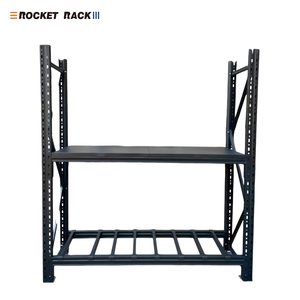
Heavy Duty Selective Pallet Rack 3 Layer Warehouse Storage Rack with Wire Mesh Decking
- Wire Mesh: 50×50 / 50×100 mm Grid
- Support Channel: 3 to 4 Cold Formed Ribs
- Fire Compliance: Over 70% Open Area (NFPA)
- Finish: Hot-Dip Galv / Powder Coat
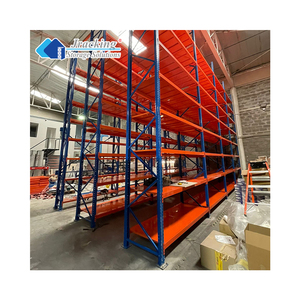
Jracking Dexion Style Warehouse Shelving Heavy Duty Pallet Rack
- Compatibility: 100% Dexion Compatible
- Hook Connector: 4-5 Prong Interlocking Claw
- Upright Punching: 76.2 mm (3-Inch) System
- Seismic Index: Zone 4 Baseplate Engineered
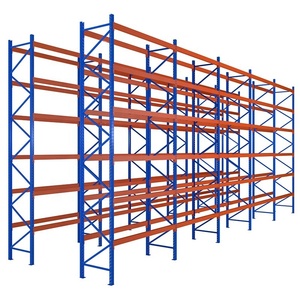
Heavy Duty Metal Storage Pallet Rack Industrial Shelving Warehouse Rack
- Steel Thickness: 1.5 - 2.5 mm Cold Rolled
- Beam Profiles: 80 - 160 mm Box Beams
- Surface: Automated Electrostatic 80µm
- Accessories: Column Guard, Row Spacer
Engineering Configuration Matrix: Racking Systems Comparison
Compare footprint utilization, inventory accessibility, crane/forklift clearances, and capital expenditure indices.
| Racking Topology | Pallet Selectivity | Floor Footprint Utilization | Forklift / MHE Interface | Load Limit (Per Bay) | Target SKU Profile |
|---|---|---|---|---|---|
| Selective Pallet Racking | 100% Immediate Direct Access | 35% - 40% Floor Utilization | Standard Counterbalance / Reach | Up to 24,000 kg | High SKU Variance, Low Volume/SKU |
| Double-Deep Pallet Rack | 50% Direct Access (2 Pallets Deep) | 50% - 55% Floor Utilization | Pantograph / Deep-Reach Forklifts | Up to 22,000 kg | Medium SKU Variance, Medium Turnover |
| Drive-In / Drive-Through | LIFO / Strict FIFO Batch Access | 65% - 75% Floor Utilization | Narrow Mast Counterbalance | Up to 18,000 kg | Low SKU Variance, High Bulk Pallets |
| Radio Shuttle Automation | Automatic LIFO / FIFO Capability | 75% - 85% Floor Utilization | Standard Forklift + Autonomous Shuttle | Up to 30,000 kg | Cold Storage, Food/Beverage, FMCG |
| Carton Flow / Gravity Roller | 100% Dynamic FIFO Picking Face | 60% Picking Line Compaction | Manual Picker / AMR Tugger Integration | Up to 1,500 kg/Level | Fast-Moving Piece & Case Picking |
Verified Factory Advantages: 25+ Years of Structural Leadership
From single distribution hubs to multi-tier enterprise regional cross-dock platforms across 120+ countries.
30,000 m² Mega Manufacturing Base
Established in 2001 in Guangzhou, our production lines operate round-the-clock delivering over 30,000 tons of structural steel components per month with full mill test certification.
Certified European & US Standards
Every beam, column, and connector is built to strict international codes, holding formal CE certification (No. 2435-CPR-8605159), ISO 9001:2015 QA systems, and RoHS testing clearance.
Free 2D CAD & 3D Photorealistic Design
Our 300+ technical engineering team generates structural load calculations, spatial aisle layouts, and Civil Defense fire sprinkler clearance diagrams before steel fabrication begins.
Extreme Climate Pre-Treatment
Components undergo continuous immersion pickling, phosphating, and 80-micron electrostatic epoxy coating engineered for high humidity, coastal fog, and sub-zero cold chain durability.
The 10-Step Automated Production Lifecycle
End-to-end quality assurance guaranteeing millimeter tolerances from prime steel coil slitting to container stuffing.
Steel Inspection
Certified Q235B/Q355B coils verified via yield strength tensile testing.
Laser CNC Slitting
High-speed laser cutting & CNC multi-axis automatic punching dies.
Roll-Forming
Continuous 22-station cold roll-forming ensures upright straightness.
Robotic Arc Welding
Automated CO2 welding centers attach beam claws without spatter.
Chemical Phosphating
Multi-stage ultrasonic pickling cleans oil, mill-scale & prevents rust.
Electrostatic Powder
Automated Swiss Gema powder line bakes tough 180°C - 200°C polymer coat.
Load Deflection Test
Hydraulic test rigs evaluate ultimate limit state and deflection under load.
Anti-Corrosion QC
Cross-hatch adhesion and 500-hour salt spray chambers guarantee longevity.
Modular Bundling
Pre-sorted packing labeled with CAD numbers speeds up on-site assembly.
Export Containerizing
Heavy steel dunnage strapping prevents maritime transit and ocean damage.
Future Procurement Trends in Warehouse Storage (2025–2030)
How global supply chain leaders are adjusting their capital equipment RFPs to balance automation, sustainability, and flexibility.
Total Cost of Ownership (TCO) Prioritization
Procurement teams are moving away from initial bid-price metrics toward whole-lifecycle ROI. Key evaluation criteria now prioritize fatigue lifespan under automated handling equipment, seismic resilience certifications, and standardized beam connectors that reduce re-slotting downtime during operational transitions.
Direct-to-Factory Engineering Integration
Tier-1 3PLs and distribution giants now bypass intermediate distributors to collaborate directly with Chinese factory structural engineering teams. Direct CAD/BIM file exchanges accelerate delivery timelines, eliminate commission markups, and allow customized upright profiles tailored to specific floor slabs and ceiling trusses.
Decarbonization & Circular Metallurgy
With Scope 3 carbon emission disclosures becoming mandatory across North America and the European Union, buyers actively mandate EPD (Environmental Product Declaration) filings. Sourcing from factories utilizing scrap-recycled electric arc furnace steel with eco-friendly VOC-free powder coats is rapidly becoming standard.
Technological Development Trends in Pallet Shelving Systems
The convergence of mechanical steel racking with autonomous robots, dynamic load telemetry, and digital twins.
AS/RS & Shuttle-Ready Engineering
Standard manual racking is being re-engineered into ultra-rigid, tight-tolerance skeletons designed for Autonomous Guided Vehicles (AGVs), Autonomous Mobile Robots (AMRs), and Radio Shuttles. Deflection tolerances under load have been tightened from L/200 down to L/400 to ensure optical scanner alignment.
IoT-Enabled Structural Health Monitoring
Modern racking installations in seismic zones and mega-fulfillment centers now integrate embedded strain gauges, piezoelectric impact sensors, and wireless telemetry transmitters. Facility managers receive real-time alerts upon forklift collisions or beam overloads, preventing progressive structural collapse.
Digital Twin & Automated Space Simulation
Before cold-rolled steel coils are slit, 3D structural simulations stress-test warehouse models under real-world pallet movement scenarios. Finite Element Analysis (FEA) models simulate second-order P-Delta structural effects, optimizing steel distribution across column gauges without compromising safety factors.
Frequently Asked Questions: Industrial Pallet Racking Procurement
Practical, engineering-grade answers to the most common questions raised by procurement managers, operations directors, and project engineers.
What specific technical data is required to generate an accurate warehouse racking layout and price quote?
- Warehouse Architectural Drawings: DWG/DXF or dimensional PDF format showing slab dimensions, clear building height under low-roof steel rafters, column grid spacing, sprinkler clearance envelopes, and warehouse door positions.
- Pallet Profile: Pallet dimension (Length × Width × Height including cargo overhang), pallet bottom configuration (two-way or four-way entry, perimeter base, or nine-foot), and maximum loaded unit gross weight.
- Material Handling Equipment (MHE): Specific forklift make/model, maximum fork lift elevation, mast collapsed height, and manufacturer-mandated minimum Right Angle Stacking Aisle (AST) dimension.
- Environmental Data: Operating temperature range (e.g., ambient vs. -28°C frozen storage) and local municipal seismic zone acceleration coefficient ($S_s, S_1$).
How do Chinese steel grades Q235B and Q355B compare to North American (ASTM) and European (EN) standards?
- Q235B Steel: Offers a minimum yield strength of 235 MPa with excellent cold-bend plasticity and roll-forming characteristics. It serves as the direct metallurgical equivalent to ASTM A36 in North America and EN 10025 S235JR across Europe.
- Q355B Steel (formerly Q345): High-strength low-alloy structural steel with a minimum yield strength of 355 MPa. It serves as the direct equivalent to ASTM A572 Grade 50 and EN 10025 S355JR. It is typically specified for heavily loaded upright columns exceeding 12 meters in height or seismic moment frame configurations.
How does the factory guarantee rack structural integrity and prevent maritime shipping corrosion?
To prevent rust during 30 to 45 days of ocean freight across high-salinity maritime routes, components undergo a comprehensive 10-stage pre-treatment: hot alkaline degreasing, clean-water cascading rinses, acid pickling to eliminate mill scale, and micro-crystalline zinc phosphating. Finished components are cured with an 80-micron electrostatic epoxy-polyester powder layer. For export packaging, components are separated by corrugated spacers, wrapped in high-density polyethylene moisture-barrier film, steel-strapped onto solid hardwood skids, and braced with custom container dunnage.
Can factory-direct racking systems integrate into local Civil Defense and NFPA fire code compliance approvals?
What is the typical production and delivery cycle for a 40-foot high-cube container (40HQ) racking project?
- Engineering Approval (3–5 Days): Detailed floor plan CAD layout, 3D renderings, and load capacity verification are submitted to your technical team for formal sign-off.
- Factory Production (15–20 Days): Coil slitting, continuous roll-forming, robotic welding, surface chemical pre-treatment, powder coating, and final assembly quality checks.
- Packing & Container Stuffing (2–3 Days): Bundles are tagged with CAD assembly reference numbers and loaded into 40HQ containers using protective dunnage.
- Maritime Transit (14–35 Days): Delivery lead times vary by port of call (typically 12–16 days to Southeast Asia/Middle East ports such as Jebel Ali or Dammam; 25–35 days to European and North American ports).