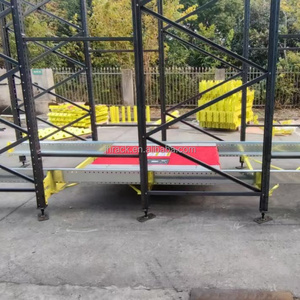
Smart Heavy Duty Pallet Shuttle Racking
- Payload: 500 – 1,500 kg / pallet
- Semi-automated bidirectional radio cart
- Ideal for high-density FIFO / LIFO channels
Engineered to FEM 10.2.02 and EN 15512 structural specifications for high-throughput fulfillment, chilled distribution centers, and bulk manufacturing facilities.
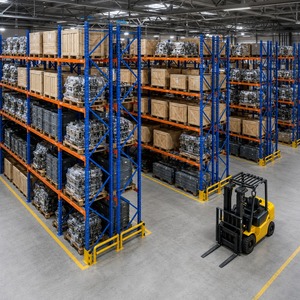
A technical treatise on live gravity storage mechanics, kinetic braking dissipation, pallet deflection thresholds, and floor-space utilization metrics.
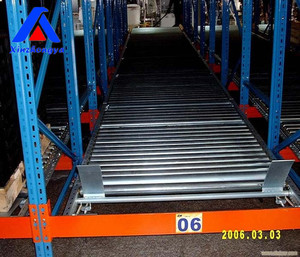
Pallet flow systems rely on an inclined gradient ranging between 3.0% and 4.0% (approx. 1.7° to 2.3°). Correct slope calculation is governed by the friction coefficient (μ) of the pallet bottom runners, maintaining kinetic motion without uncontrolled gravitational runaway.
Brake rollers operate dynamically: internal planetary gears spin against internal centrifugal friction linings, matching counter-resistance directly to pallet weight. Pallets travel at an engineered terminal speed below 0.3 m/second.
In deep lanes exceeding 10 pallets, line pressure at the discharge face can exceed 15 metric tons. HEDA's mechanical separators isolate the front pallet from trailing stock, ensuring forklift drivers pull free pallets without binding or crushing.
By eliminating internal access aisles, roller flow systems pack inventory into dense cubic footprints, reducing refrigerated warehouse air-volume loss by up to 45%. Fitted with -35°C rated low-viscosity synthetic bearing grease.
Evaluating high-density warehouse storage systems against operational throughput, SKU density, and total structural ROI.
| Storage Topology | Space Utilization | Inventory Rotation | Forklift Cycle Time | Active Mechanical Risk | Cold Chain ROI |
|---|---|---|---|---|---|
| Gravity Roller Flow Racking | Very High (Up to 85%) | Strict FIFO (1st-In, 1st-Out) | Extremely Fast (Separated Aisles) | Low (Passive Gravity Rollers) | Maximum (Highest Energy Savings) |
| Selective Pallet Racking | Low (35% - 45%) | Random / FIFO / LIFO | Moderate (Forklifts Enter All Aisles) | None (Static Steel Beams) | Low (Cools Large Empty Aisles) |
| Drive-In Pallet Racking | High (65% - 75%) | Strict LIFO (Last-In, 1st-Out) | Slow (Mast Drives Inside Racks) | Medium (Forklift Upright Collision) | Moderate (Slow Throughput Cycles) |
| Radio Shuttle Automation | Maximum (80% - 90%) | Flexible FIFO or LIFO | High Efficiency | Medium (Lithium Battery / Electronics) | High (Capital Intensive Initial Cost) |
Direct supply from Guangzhou, China to top global seaports. Comprehensive CE, ISO 9001:2015, and RoHS compliance backed by rigorous continuous quality control.
Our 30,000 m² Guangzhou production facility houses 300+ skilled workers, operating 16 automated high-speed roll-forming lines, computerized continuous column punching machines, and robotic precision laser welding cells.
Every profile passes through our 10-stage automated pre-treatment system: chemical pickling, neutral rinse, iron phosphating, and electrostatic powder coating, delivering 60–90 micron dry film thickness for corrosive industrial and maritime ports.
Backed by active European CE Certification (No. 2435-CPR-8605159), ISO 9001:2015 Quality Management Accreditation (No. 18624Q00169R0M, valid to 2027), and full RoHS compliance for environmentally controlled warehouses.
Before steel is punched, HEDA structural engineers provide free layout calculations, static floor load distributions, rack-to-forklift clearance analysis, and full-color 3D architectural renderings tailored to your pallet inventory.
Heavy upright frames and roller beds are bundled with high-tensile strapping, edge-protectors, and weather-resistant moisture wrap. Palletized and pre-sorted to simplify container de-vanning and jobsite installation worldwide.
Custom upright punch patterns, bespoke bracket integrations, custom RAL color combinations, and localized seismic structural engineering under RMI and EN design frameworks.
How smart intralogistics, pallet design standardization, and automated material handling systems are reshaping global roller racking investments.
Modern distribution hubs are phasing out manual forklift interaction at the picking face. Next-generation gravity roller beds feature end-stop optical sensors and cantilevered discharge lips that interface directly with autonomous reach AGVs and mobile pickers, ensuring uninterrupted order consolidation.
Predictive maintenance is moving into gravity channels. Prototype systems feature internal self-powered dynamo rollers capable of transmitting rolling speed anomalies, load pressure spikes, and bearing wear telemetry over low-power LoRaWAN networks to building management systems.
Procurement is moving from standard carbon steel profiles to micro-alloyed, high-yield grades (such as Q355B and automotive-grade high-strength galvanized coil). This reduces raw steel deadweight by 12% while boosting structural beam moment capacity and dynamic impact margins.
To preserve operational agility, 3PL logistics facilities are adopting modular "drop-in" roller cassettes. These allow standard selective pallet racking bays to be converted into dynamic FIFO flow channels within hours as contract profiles fluctuate.
Detailed engineering, operational, and shipping guidance for industrial facility managers and international supply chain directors.
Speak directly with our senior intralogistics engineering team. Receive custom 2D layout plans, full 3D visual renderings, and complete structural calculations tailored to your site.