Structural Precision, Cold-Formed Steel Dynamics & Global Logistics Architecture
As warehouse footprints expand and vertical clearances in modern logistics parks exceed 12 to 18 meters, bolted pallet rack frameworks have emerged as the premier structural standard over traditional fully-welded configurations. Leveraging high-yield, cold-formed structural steel (Q235B and Q355B equivalents), precision-bolted upright trusses provide superior energy dissipation during seismic stress, minimize maritime shipping displacement, and enable effortless component replacement under high-cycle forklift operations.
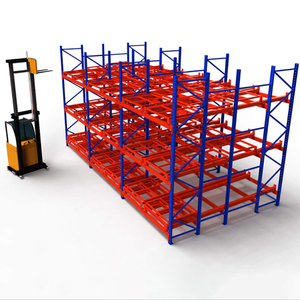
Push Back Pallet Rack System
High-density nested cart system operating on inclined structural rails. Maximizes lane utilization with Last-In, First-Out (LIFO) inventory control and minimizes aisle requirements.
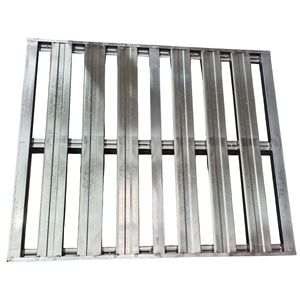
1000KG Zinc Galvanized Steel Pallet
Rust-proof, heavy-duty hot-dip galvanized steel pallets engineered for rack storage, cold chain environments, and harsh coastal logistics yards.
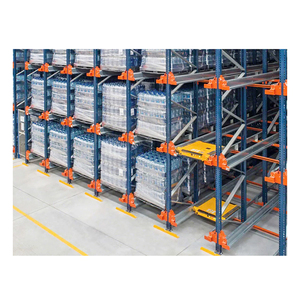
Automated Pallet Shuttle System
Semi-automated radio shuttle carrier running on precision profile rails for high-throughput buffer storage. Lowers equipment impact risks and saves labor.
Specialty Hanging & Roll Racking
Engineered cantilever and horizontal bar racking custom-configured for cylindrical rolls, carpet textiles, display samples, and long-load storage modules.
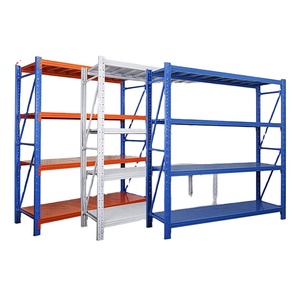
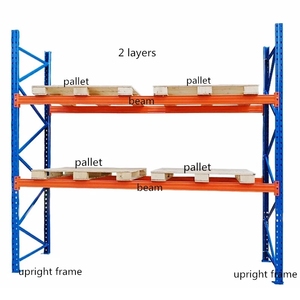
Standard 5-Layer Industrial Pallet Rack
Modular teardrop and omega-profile upright frames with adjustable box beams. The most adaptable selective storage platform for high-mix SKU environments.
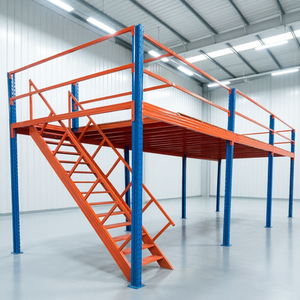
Rack-Supported Mezzanine Floor
Integrated multi-tier structural mezzanine platform. Multiplies cubic footprint for order fulfillment zones, manual pick modules, and warehouse loft offices.
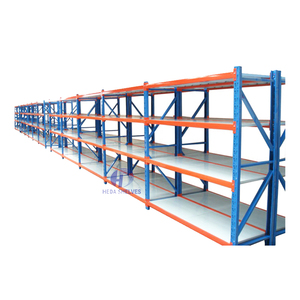
Adjustable Stacking Storage Racks
Heavy-duty transportable post racks providing flexible block stacking capabilities for seasonal volume surges, temporary staging, and heavy machinery components.
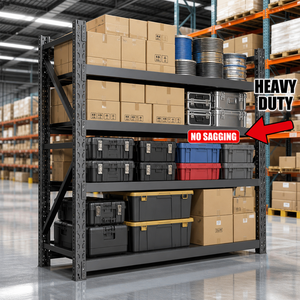
4-Tier Heavy-Duty Boltless Shelving
Industrial teardrop and slot design shelving unit for tool cribs, automotive workshops, and bulk picking levels. Supports rapid no-tool height adjustments.
Engineering Distinction: Why Bolted Pallet Racks Dominate Modern Warehousing
A detailed examination of metallurgical integrity, seismic resilience, surface passivization, and mechanical assembly metrics that differentiate HEDA Shelves engineering from generic commodity racking.
High-Tensile Cold Forming
Manufactured utilizing continuous CNC roll-forming lines with multi-station profiling. We use cold-rolled structural steel coils exceeding ASTM and EN standards, giving upright profiles superior torsional resistance under full static and dynamic rated live-loads.
Seismic Joint Dissipation
Unlike welded frames that suffer stress concentrations at heat-affected weld zones (HAZ), our high-grade 8.8 tensile bolted bracing system transfers kinetic shear stresses uniformly, allowing micro-flexibility without structural rupture during seismic shockwaves.
10-Stage Surface Passivation
Every truss and beam undergoes an automated 10-step chemical process: high-pressure degreasing, acid pickling, zinc phosphating, and deionized water rinsing before thermosetting polyester powder coating cures at 200°C for lasting salt-spray resistance.
Precision Slot Geometry
Advanced CNC hydraulic punching ensures hole pitch accuracy within ±0.1mm along the entire 12-meter continuous column length. This precision ensures seamless beam lock engagement, rapid beam elevation re-profiling, and complete safety-pin seated alignment.
Ocean Freight Optimization
Welded uprights trap extensive dead air during ocean transit, dramatically increasing shipping costs. Our knockdown bolted system packs upright columns and horizontal/diagonal braces into dense nesting bundles, reducing container freight spend by up to 60% per project.
Field Maintenance Modularity
In dynamic distribution facilities, forklift mast impacts inevitably damage lower rack bays. A bolted system enables swift unbolting and replacement of isolated lower leg sections or diagonal braces without cutting, structural field welding, or rebuilding entire rack rows.
Future Strategic Procurement & Engineering Trends in Warehouse Racking
Comprehensive industry analysis of emerging procurement vectors, automation integrations, and regulatory shifts shaping intra-logistics capital investments from 2026 through 2035.
| Procurement Factor | Traditional Welded Pallet Rack | Modern Engineered Bolted System | Next-Gen Automated (ASRS/Shuttle) System |
|---|---|---|---|
| Seismic Stress Performance | Rigid weldments susceptible to brittle fracture under high cyclical fatigue. | Bolted friction connections flex elastically, dissipating seismic energy safely. | Strict finite element deflection models integrated into building superstructures. |
| Shipping & Logistics Density | Extremely inefficient; requires 3x to 4x 40ft HQ containers for equivalent storage. | Ultra-dense bundle packaging; maximizes shipping weight-to-cube limits. | Standardized knockdown modular sub-assemblies packed in dedicated cassettes. |
| MHE & AMR Integration | Limited adjustment flexibility; costly to re-profile as forklift fleets change. | Adjustable on 50mm/75mm increments; easily modified for robotic reaches. | Sub-millimeter laser guide profiles, sensor brackets, and busbar integration. |
| Maintenance & TCO | High repair costs; requires specialized on-site hot work permits and cutting. | Rapid single-component replacement using off-the-shelf standard hardware. | Predictive maintenance via embedded IoT structural strain-gauge sensors. |
| Regulatory & Green Compliance | Excessive steel tonnage needed to compensate for welded connection limits. | Optimized cold-formed cross sections minimize embodied carbon footprints. | High-tensile, lightweight alloy formulations with cradle-to-gate EPD documentation. |
1. Transition to Hybrid Automated Pallet Shuttle Systems
Procurement teams are rapidly shifting capital from low-density selective racking toward hybrid shuttle racks. By combining heavy-duty bolted upright structures with automated 4-way electric shuttles, facilities achieve 80% higher space utilization without the extreme capital expenditure of full-scale automated high-bay ASRS cranes. This modular upgrade path protects long-term infrastructure investments.
2. Stringent Seismic and Structural Code Enforcement
Global industrial developers are adopting harmonized structural engineering frameworks (such as RMI ANSI MH16.1, EN 15512, and AS 4084). Procurement teams now require full finite element analysis (FEA) simulations verifying live-load capacity under local seismic conditions, slab load bearing limits, and dynamic load amplification factors before signing fabrication contracts.
3. Extreme Weather and High-Humidity Surface Engineering
Accelerated logistics expansion across harsh coastal hubs (such as the Middle East, Southeast Asia, and Latin America) requires upgraded protective treatments. Standard electro-galvanizing is increasingly replaced by hot-dip galvanizing (HDG) and specialized high-adhesion outdoor powders to protect structural integrity against salt air corrosion and rapid thermal cycling.
4. Digital Twin Modeling & BIM Structural Integration
Racking procurement has evolved from static 2D layout drawings into full 3D Building Information Modeling (BIM) asset integration. Modern logistics developers mandate native Autodesk Revit and IFC structural data files to verify clear flue spaces for fire protection sprinklers (NFPA 13), validate autonomous mobile robot (AMR) navigation paths, and coordinate MEP infrastructure before container dispatch.
Guangzhou HEDA Shelves Co., Ltd.: 25 Years of Factory-Direct Authority
From our 30,000-square-meter facility in Guangzhou, China, we operate an integrated manufacturing ecosystem serving multi-national supply chains, 3PL logistics parks, and cold-storage distribution centers across 120+ countries.
30,000 m² Automated Facility
Equipped with high-precision automated roll-forming lines, multi-station CNC punching platforms, robotic welding arms, and continuous electrostatic powder-coating tunnels that produce over 30,000 metric tons of certified steel racking monthly.
Certified Engineering Rigor
Our products hold official CE Certification (No. 2435-CPR-8605159), ISO 9001:2015 Quality Management Certification (No. 18624Q00169R0M), and full RoHS compliance, ensuring smooth local civil defense and engineering authority approvals.
Complimentary 2D CAD & 3D Design
Our dedicated structural engineering team provides complete warehouse layout blueprints, aisle-width optimization based on your forklift turning radius, and clear 3D renderings within 24 to 48 hours to accelerate project stakeholder approvals.
Export-Grade Bundle Packaging
To protect surfaces across 6,000-mile ocean shipments, every upright bundle, beam cassette, and accessory carton is padded with heavy air-bubble film, wrapped in moisture-barrier stretch plastic, and banded with steel strapping to prevent ocean transit damage.
Turnkey Technical Support
Every shipment includes numbered piece-mark erection drawings, torque specification sheets, and assembly manuals. For multi-tier mezzanine and high-bay racking systems, we offer live remote video engineering support and on-site project supervisors.
Bespoke OEM/ODM Adaptation
We accommodate custom corporate RAL paint palettes, brand-stamped beam connectors, specialized footplate footprints for under-rated concrete slabs, and custom shelf decking (wire mesh, galvanized steel panels, or drop-in timber support bars).
Frequently Asked Procurement & Technical Questions
Clear, data-driven answers to structural engineering, certification, shipping logistics, and layout planning questions from global procurement directors.
Bolted pallet rack uprights offer three major advantages for international procurement. First, freight optimization: bolted upright components (columns, horizontal struts, diagonal braces, and footplates) are shipped nested in dense bundles, reducing required shipping containers by 50% to 65% compared to welded frames. Second, field maintainability: when a forklift strikes an upright frame, a bolted system allows fast replacement of the affected strut or lower column using standard high-tensile hardware, avoiding hot-work permits or replacing entire multi-level bays. Third, seismic resilience: precision-engineered bolted joints flex elastically under dynamic ground acceleration, safely dissipating seismic energy rather than transferring brittle failure stresses into weld points.
To provide a fully calculated 2D CAD floor plan and competitive price proposal within 24 to 48 hours, our structural team requires: (1) Building architectural plan: clear height under roof joists, slab depth and PSI ratings, floor expansion joint locations, and building column grids. (2) Pallet load specifications: pallet dimensions (Width × Depth × Height, including product overhang), maximum pallet gross weight, and pallet entry style (2-way or 4-way). (3) Material handling equipment (MHE): make and model of your forklift fleet, maximum mast lift height, and minimum right-angle stacking aisle requirements (AST). (4) Operational parameters: total required pallet positions, SKU velocity (FIFO vs. LIFO), and local seismic acceleration coefficients.
Our standard production includes an automated 10-stage pre-treatment line that cleans surfaces of mill scale and oils through high-pressure pickling and applies a micro-crystalline zinc phosphate conversion coating. This is followed by an electrostatic thermosetting polyester powder coating baked at 200°C, producing an abrasion-resistant finish with dry film thicknesses between 60 to 90 microns that meets stringent salt-spray test benchmarks. For sub-zero blast freezers (-30°C), exterior yards, or coastal distribution hubs subject to saline humidity, we supply hot-dip galvanized (HDG) steel components that offer permanent sacrificial zinc barrier protection against oxidation and rust.
Our systems are manufactured in compliance with international racking standards, including European EN 15512, EN 15620, and American RMI ANSI MH16.1 specifications. Guangzhou Heda Shelves Co., Ltd. maintains active ISO 9001:2015 Quality Management Certification (Certificate No. 18624Q00169R0M, valid through June 2027), comprehensive CE Certification (No. 2435-CPR-8605159), and full RoHS compliance. Every production run undergoes raw material yield-strength tensile verification, hole-punch pitch alignment calibration, weld seam penetration checks, and powder adhesion cross-hatch testing. Complete inspection test reports (MTR) are provided before container dispatch.
Standard factory production lead times range from 15 to 25 business days depending on total project tonnage and paint customizations. Shipped direct from major South China ports (Guangzhou, Shenzhen, or Nansha), maritime transit times range from 12 to 18 days for Middle East destinations (Jebel Ali, Dammam, Jeddah) and 20 to 30 days for European or North American ports. Every shipment includes container packing manifests, numbered piece-mark layout drawings, and step-by-step installation guides. We provide remote video engineering support for local erection crews, and can deploy experienced project supervisors for multi-tier mezzanine and high-density shuttle projects.