Featured Industrial Drive-Through & Drive-In Systems
Engineered from premium Q235B/Q355B cold-rolled micro-alloyed steel, our continuous-channel systems achieve up to 85% warehouse volumetric efficiency with verified static structural calculations.
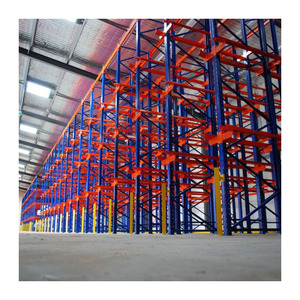
Mracking Industrial Drive-In Racking System Corrosion Protected
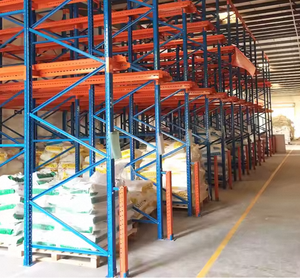
Adjustable Drive-Through Pallet Rack System Folding Metal Frame
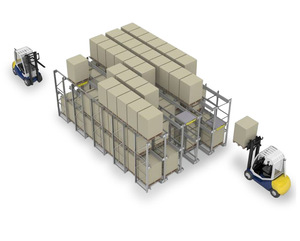
High-Density Drive-Through Storage Solution High Turnover
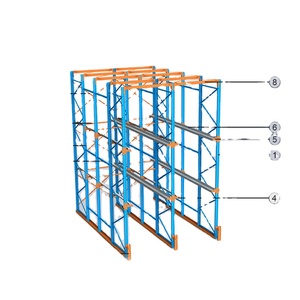
Factory-Direct Heavy Duty Steel Pallet Drive-In/Through Rack
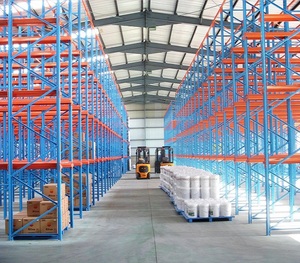
Heavy Duty Warehouse Pallet Storage Drive-In / Through Rack
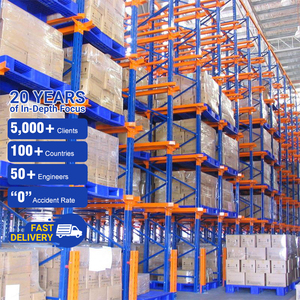
High Quality Heavy Duty Drive-In Storage Steel Shelves
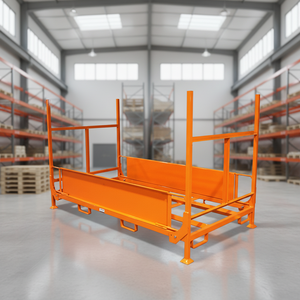
Industrial Drive-Through Pallet Stacking Corrosion Protected
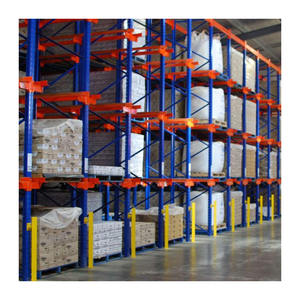
Customizable 5-Layer Drive-Through High Bay Pallet Rack
Structural Principles & Optimization of Drive-Through Racking Systems
As international supply chains experience severe footprint costs and rising cold-storage expenditures, logistics engineering teams increasingly prioritize cubic volumetric utilization over conventional selective pallet layouts. Drive-through racking stands as the apex configuration for high-density, First-In, First-Out (FIFO) material handling, eliminating auxiliary forklift corridors while establishing unbroken product channels across large industrial footprints.
First-In, First-Out (FIFO) vs. First-In, Last-Out (FILO) Kinetic Mechanics
The pivotal distinction between standard drive-in racking and engineered drive-through racking lies in aisle topology and structural framing dynamics. While drive-in racking utilizes a single access aisle requiring the forklift to enter and retreat along the identical track (imposing FILO inventory mechanics and closing the rear structure with longitudinal X-bracing), drive-through racking provides dual-sided access. Vehicles deposit pallets at the rear intake face and retrieve them from the forward picking face. This separation guarantees pure FIFO rotation, proving critical for perishable foodstuffs, pharmaceuticals, dairy processing, chemical raw materials with tight expiry batches, and synchronized FMCG manufacturing.
Torsional Rigidity Without Back Bracing
Because drive-through frames permit drive-through travel along the floor plane, back diagonal structural cross-bracing cannot be deployed. Our Guangzhou engineering plant resolves torsional and second-order sway forces through top horizontal portal bracing trusses, heavy-duty floor anchorage baseplates with triple mechanical wedge anchors, and proprietary one-piece cold-formed cantilevered rail arms fabricated from 3.0mm–4.5mm structural steel.
Impact Minimization & Floor Guide Rails
Forklift operations within restricted drive-through aisles present heightened exposure to frame collision. Every custom project engineered by our team includes continuous hot-rolled structural steel angle or C-channel floor-mounted guide rails (75x50mm up to 120x80mm). These guide forklift wheel paths precisely, supplemented by polymer-cushioned entry bull-nose post protectors that absorb lateral impact energy without transferring strain to structural uprights.
Technical Benchmarking: Selective Pallet Racking vs. Drive-In vs. Drive-Through
| Performance Metrics | Selective Pallet Racking | Drive-In Racking (FILO) | Drive-Through Racking (FIFO) |
|---|---|---|---|
| Volumetric Space Utilization | 35% – 45% (Aisle Intensive) | 70% – 80% (High Density) | 75% – 85% (Continuous Lane) |
| Inventory Rotation Logic | 100% Direct Selectivity | Strict FILO (First-In, Last-Out) | Strict FIFO (First-In, First-Out) |
| SKU Concentration Target | High SKU / Low Pallets per SKU | Low SKU / High Pallets per SKU | Uniform SKU / Rapid Expiry Turnover |
| Forklift Aisle Demand | 3.0m to 3.8m between all rows | Single loading/unloading aisle | Two independent entry/exit corridors |
| Cold Room Thermal Conservation | Low (Large air envelope to chill) | High (Dense block thermal mass) | Maximum (Ideal cold airflow balance) |
| Structural Sway Mitigation | Standard rear cross bracing | Internal back horizontal & diagonal bracing | Top overhead portal tie beams & portal trusses |
Future Procurement Trends & Technological Innovations
Technological convergences in warehouse automation, metallurgical engineering, and supply-chain ESG criteria are reshaping international procurement tenders for drive-through systems.
Transition to Hybrid Autonomous AGV/AMR Lanes
Procurement teams are rapidly abandoning manual forklift operation in favor of laser-guided automated guided vehicles (AGVs) and autonomous mobile reach trucks. Modern drive-through racking designs require tighter manufacturing tolerances (within ±1.0mm per 10m upright height under FEM 10.2.02 standards), embedded floor reflective markers, and optical beam interlocks along pallet guide rails to interface seamlessly with warehouse execution systems (WES).
Finite Element Analysis (FEA) Digital Twin Verification
Global buyers no longer rely on static catalog load charts. Tier-1 enterprise procurement tenders demand non-linear finite element modeling (ANSYS/SAP2000 calculations) simulating progressive dynamic loading, seismic ground acceleration spectra (specifically for seismically volatile regions in the Middle East and Pacific Rim), and fork-impact redistribution before fabrication begins.
Nano-Ceramic Pretreatment & Anti-Corrosion Finishes
In aggressive ambient environments—such as high-humidity GCC coastal zones (Dubai, Jeddah, Dammam) and rapid-freeze cold stores (-30°C)—traditional iron phosphating is giving way to zirconium-based nano-ceramic conversions topped with TGIC-free electrostatic powder coatings. This system exceeds 1,000 hours of neutral salt spray testing (ASTM B117), preventing sub-surface oxidation creep under scratched paint.
Guangzhou HEDA Shelves: Verified Manufacturing Prowess
Operating with unmatched steel-fabrication competence since 2001, we deliver complete turn-key racking solutions across 120+ countries, supported by rigorous third-party certifications.
30,000 m² Integrated Manufacturing Hub
Our flagship manufacturing base houses continuous high-precision roll-forming lines, automated CNC multi-station punching presses, robotic GMAW welding units, and dual multi-stage environmental powder coating facilities in Guangzhou, China.
30,000 Tons Monthly Steel Capacity
With direct procurement contracts from top-tier state steel mills (Baosteel, Shougang Group), we guarantee prime metallurgical homogeneity, structural yield tensile certified Q235B and Q355B coils, and bulletproof delivery timelines for 500+ container mega-tenders.
Certified CE & ISO 9001:2015 Compliance
Our products hold official CE Certification (Certificate No. 2435-CPR-8605159), ISO 9001:2015 Quality Management System Certification (No. 18624Q00169R0M, valid through 2027), and strict RoHS heavy-metal compliance for food & pharma cold store safety.
25+ Years Global Export Specialization & Middle East / GCC Authority
Since 2001, we have successfully completed more than 10,000 warehouse installations across 120+ sovereign territories. We maintain specialized logistics routing and sea-freight packaging protocols for Middle East and GCC terminals, including Jebel Ali (UAE), Khalifa Port (Abu Dhabi), King Abdulaziz Port Dammam, Jeddah Islamic Port (KSA), Hamad Port (Qatar), and Sohar (Oman). Every container is custom-blocked with labelled bundles cross-referenced to comprehensive 3D CAD erection drawings, enabling rapid local installation under civil defense and industrial inspection regulations.
Frequently Asked Questions by Industrial Storage Buyers
In-depth technical and commercial answers addressing structural safety, loading tolerances, clearance calculations, and export packaging.
Q How does drive-through racking preserve structural stability without rear cross-bracing?
Unlike drive-in systems that anchor to a stiff rear X-bracing truss, drive-through systems transfer horizontal longitudinal and lateral forces through engineered top-tie portal beams and rigid overhead roof framing. Additionally, upright column profiles are selected with wider frontal flanges (90mm to 120mm) and increased steel gauge thickness (up to 2.5mm or 3.0mm) anchored by heavy floor baseplates with twin or triple M12/M16 expansion bolts into 200mm+ C25/30 concrete slabs.
Q What critical aisle clearances are required for forklifts operating in drive-through lanes?
Drive-through lanes typically specify a total clearance of 75mm to 100mm on each side between the outer edge of the pallet and the inner vertical edge of the support rail. Counterbalance and reach trucks must also be calibrated so their mast or overhead guard does not exceed the internal clearance width between the cantilever arms. Structural floor guide rails (minimum 100mm height) are strongly recommended to eliminate vehicle deviation.
Q How does HEDA Shelves guarantee anti-corrosion resilience in -30°C cold stores and high-humidity environments?
Our 10-step surface treatment applies continuous hot alkaline degreasing, multi-stage acid pickling to strip scale, and micro-crystalline zinc phosphating. Components receive an automated electrostatic powder coat with low-cure thermosetting epoxy-polyester resin baked at 180°C–200°C. For open outdoor yards or saline coastal maritime atmospheres, hot-dip galvanization according to ISO 1461 is available, yielding 70–100 microns of protective zinc alloy coating.
Q What exact dimensional inputs are required to receive a free 2D CAD & 3D layout design?
To deliver an accurate architectural simulation, our engineering department requires: (1) Architectural warehouse CAD drawing or perimeter measurements including internal column grid, clear height to bottom of lowest ceiling rafter, and overhead fire sprinkler/lighting drops; (2) Pallet dimensions (L x W x H) including goods overhang, along with minimum and maximum gross pallet weights; (3) Forklift model, maximum collapsed mast height, and turning radius; and (4) Throughput requirements (pallets per hour and target SKU lane depths).
Q Can drive-through racking accommodate non-standard pallets or mixed euro/industrial dimensions?
Drive-through pallet support rails rely on uniform pallet bottom-board contact. While standard lanes are sized for 1200x1000mm (industrial) or 1200x800mm (Euro) pallets, accommodating varied pallet dimensions requires custom rail flange designs or continuous secondary galvanized support cradles. Standard operational protocol recommends designating separate, dedicated drive-through lanes for disparate pallet footprints to prevent load instability.
Q How is containerized sea export managed to prevent in-transit scratching and deformation?
All structural upright frames and pallet rails are bundled using automated steel strapping padded with corrugated edge protectors, industrial plastic stretch-wrap, and heavy timber dunnage blocks. Uprights and rails are loaded with precision counterbalance forklifts into 40ft High Cube containers, secured with steel cross-bracing to prevent maritime wave-motion shift. Each bundle features high-visibility bilingual packing labels keyed directly to the project's 3D installation blueprint.