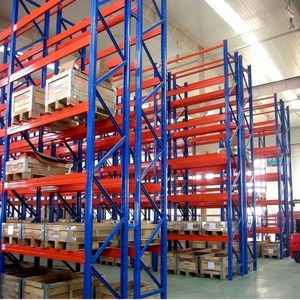
 Multi-Tier Storage
Heavy-Duty Warehouse Solutions
Precision-Engineered Industrial Pallet & Shelving Systems
Manufactured using certified high-strength cold-rolled steel (Q235B / Q355B) under strict ISO 9001:2015 and European CE EN 15512 standards. Select an engineered configuration below or consult our design engineers for customized bay layout blueprints.
Multi-Tier Storage
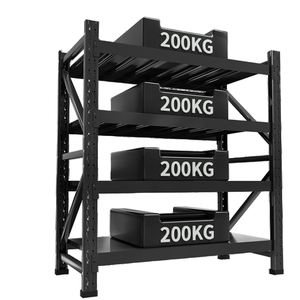 Long Span Modular
250KG Iron Adjustable Boltless Pallet Racking Long Span 5-Layer Light Duty Storage Shelving Units Garage Metal Stacking Steel
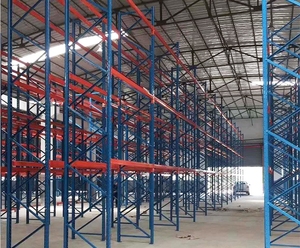 Automated AS/RS
New Steel Warehouse Automated Stacker Crane Storage Retrieval Racking System For Manufacturing Plant And Home Use
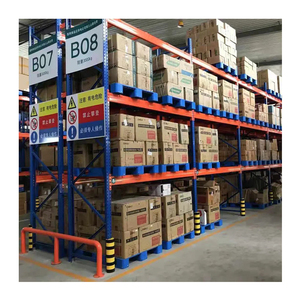 Heavy Duty 5-Ton
Heavy Duty Selective Pallet Rack 5 Ton Capacity Industrial Warehouse Storage Shelving System Adjustable Steel Rack
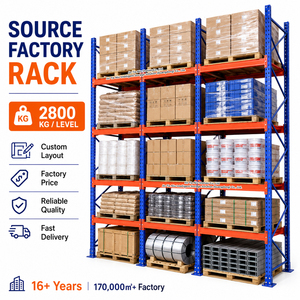 High Bay Racking
2800KG 5 Levels High Bay Industrial Pallet Racking Heavy Duty Warehouse Rack System
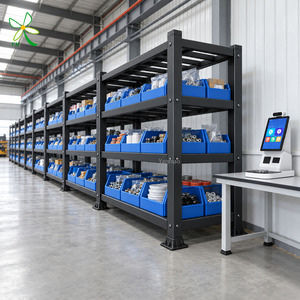 Corrosion Defense
Global Export Corrosion Protection Lightweight Stackable Production Area 1200mm Storage Shelving FRP Storage Rack Warehouse Rack
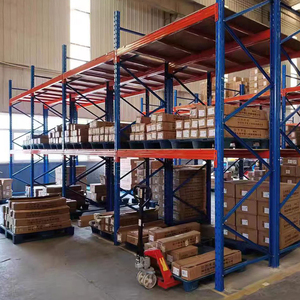 Cold-Rolled Steel
High Grade Cold Rolled Steel Warehouse Racking System Heavy Adjustable Durable Multi-Layer Shelf Storage Rack for Garages Wooden
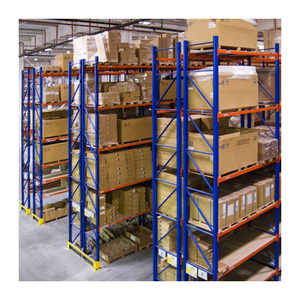 Custom OEM Racking
China Rack Factory Manufacturer Custom Warehouse Heavy Duty Pallet Racking Storage Shelf
Technical Whitepaper Deep Dive
Engineering Fundamentals of Drive-In Pallet Racking Architecture
How high-density accumulative storage eliminates operating aisles to achieve up to 80% cube utilization while maintaining structural equilibrium under dynamic cantilever loads.
In contemporary industrial logistics and cold-chain cold-storage engineering, the Drive-In Pallet Racking System represents the premier high-density accumulative storage configuration. Unlike conventional selective pallet racking—where every pallet position requires an adjacent operating aisle consuming upwards of 60% of gross floor footprint—the drive-in topology allows material handling equipment (such as counterbalance or reach forklifts) to enter the internal storage lanes directly. Storage lanes can span from 2 to over 10 pallets deep and up to 4 to 6 tiers high, operating primarily under the FILO (First-In, Last-Out) inventory management principle, or FIFO (First-In, First-Out) when engineered as a Drive-Through system with dual-access entry and exit corridors.
From an applied structural mechanics perspective, eliminating horizontal intermediate load-supporting crossbeams introduces profound structural challenges. In a drive-in system, continuous load beams are replaced by cold-formed structural cantilever support arms and longitudinal pallet rails. This leaves the upright portal frames unsupported in the cross-aisle direction at load levels, transforming the system into an unbraced frame subjected to complex torsional stresses, horizontal forklift impact forces, and vertical eccentric compressive loads. Achieving structural compliance with international standards such as EN 15512:2020, ANSI/RMI MH16.1, and AS 4084:2023 requires rigorous finite element analysis (FEA), second-order P-Delta moment evaluations, and specialized overhead cross-aisle stabilizing frameworks.
Continuous Pallet Rails & Support Arms
Engineered from heavy-gauge Q355B high-tensile steel, our pallet rails feature a cold-rolled, tapered guide profile that self-centers pallet skids during forklift placement. Heavy-duty single-sided arms on outer perimeter uprights and double-sided arms on interior upright columns transfer continuous dynamic moments directly to the vertical posts via multi-tooth welded connector brackets, resisting severe point-load deflection.
Top & Back Structural Cross-Bracing
Because intermediate support beams are absent along operating lanes, structural stability is maintained by overhead horizontal tie beams and heavy-gauge X-bracing truss networks mounted along the top plane. In standard Drive-In configurations, full-height vertical X-bracing along the rear back plane prevents longitudinal sway, stabilizing the frame against seismic forces and operational impact vectors.
Impact Mitigation & Guide Railing
Given the close clearances between forklift chassis, masts, and upright profiles, our systems incorporate floor-mounted heavy structural steel angle guide rails or inverted channel tracks (typically 100×75×8mm). Reinforced wrap-around column protectors, bull-nose floor anchors, and rubberized entry funnel buffers deflect inadvertent forklift wheel strikes away from structural upright bases.
Comparative Storage Density & Performance Matrix
| Storage System Type | Floor Space Utilization (%) | SKU Selectivity Index | Stock Rotation Logic | Capital Cost / Pallet Position | Cold-Store Suitability |
|---|---|---|---|---|---|
| Drive-In Pallet Racking | 75% – 85% | Low (Homogeneous batches) | FILO (First-In, Last-Out) | Low – Moderate ($45 - $80) | Exceptional (Maximum volume density) |
| Selective Pallet Racking | 35% – 45% | 100% Immediate Direct Access | FIFO (First-In, First-Out) | Lowest ($30 - $55) | Poor (High thermal volume waste) |
| Radio Shuttle Automation | 80% – 90% | Moderate (By individual lane) | FIFO or FILO Configurable | Moderate – High ($110 - $190) | Exceptional (Eliminates forklift cold entry) |
| Push Back Pallet Rack | 65% – 75% | Moderate (2 to 6 pallets deep) | FILO (Gravity cart return) | Moderate ($90 - $140) | Good (Reduced aisle footprint) |
| Gravity Pallet Flow Rack | 80% – 88% | Moderate (Strict lane separation) | Strict FIFO (Roller bed gradient) | High ($160 - $280) | Excellent (Strict expiry date rotation) |
Factory Direct Infrastructure
Guangzhou HEDA Shelves: Tier-1 Chinese Manufacturing Prowess
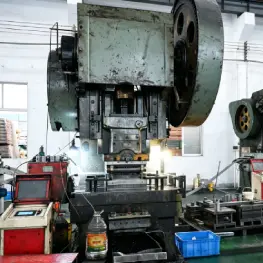
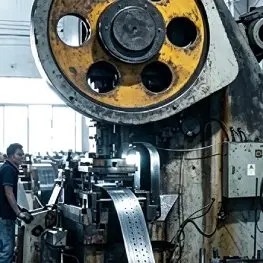
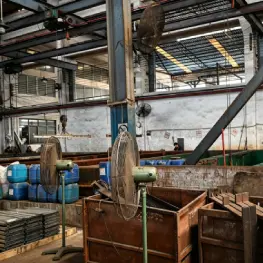
Since 2001, Guangzhou Heda Shelves Co., Ltd. has delivered turnkey engineering, structural calculation, precision roll forming, and automated powder coating from our 30,000 square meter intelligent manufacturing base.
Free 3D CAD & FEA Calculations
Before metal is cut, our structural engineering department produces full 2D architectural DWG layouts, dynamic 3D virtual renderings, and finite element stress verification reports to confirm aisle clearances, forklift turning radiuses, and slab floor load bearing.
Certified Quality Systems
Fully compliant with international safety and quality standards, holding European CE Factory Production Control (FPC) Certification (No. 2435-CPR-8605159), ISO 9001:2015 Quality Management System Certification (No. 18624Q00169R0M), and comprehensive RoHS environmental certification.
30,000 Tons Monthly Output
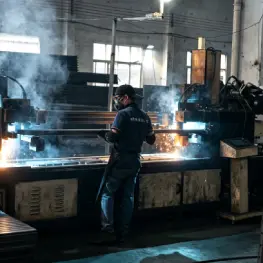
Equipped with 22 automated continuous roll-forming lines, computerized multi-station CNC punching presses, and robotic dual-torch welding stations, our production complex maintains an immense 30,000-ton monthly fabrication throughput with 100% on-time container delivery.
Global Engineering Footprint
With more than 10,000 completed logistics projects across 120+ countries—spanning the GCC region (UAE, Saudi Arabia, Qatar, Oman), Southeast Asia, Africa, Europe, and the Americas—our export packaging is tailored for ocean freight with anti-scratch wrapping and color-coded bundle indexing.
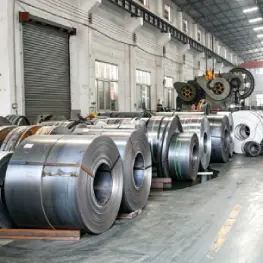
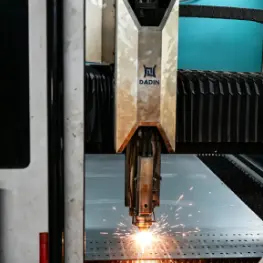
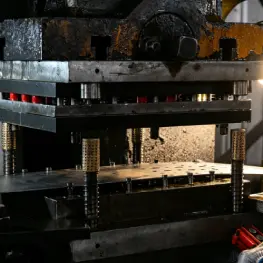
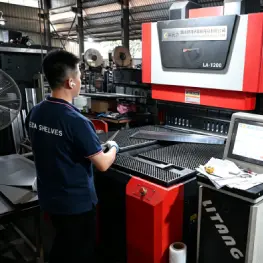
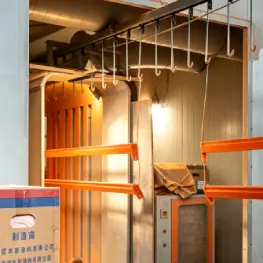
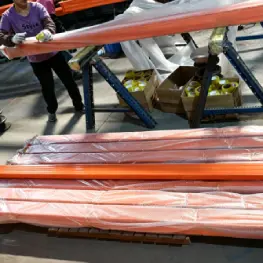
Our Proprietary 10-Step Production & Surface Treatment Workflow
Every component is manufactured from certified high-tensile hot-rolled steel strip, cold-formed with sub-millimeter tolerances under one integrated roof.
Industry Foresight 2026–2035
Technological Evolution & Future Engineering Trends in Drive-In Storage
How automation, high-performance micro-alloyed metallurgy, and thermal optimization are transforming high-density static racking into dynamic logistics assets.
1. Transition to Hybrid Radio Shuttle Systems
While traditional drive-in racking delivers exceptional volumetric density, it requires forklift operators to navigate deep into internal aisles, introducing operational cycle bottlenecks and risk of mast impact. Forward-thinking enterprise distribution centers are increasingly retrofitting drive-in structures with continuous shuttle rails. Autonomous battery-powered 2D pallet runners enter the racking depth, retrieving and depositing loads while the operator remains outside the rack lane. This hybrid modernization reduces pallet handling cycle times by over 40% and virtually eliminates column collision damage.
2. Micro-Alloyed High-Tensile Steel Profiles
The global racking manufacturing sector is shifting away from standard thick-walled Q235B carbon steel toward ultra-high-yield micro-alloyed steel grades such as Q355B, Q460, and automotive-grade high-strength strip. Utilizing precision computer-controlled roll-forming profiles with continuous multi-bend omega shapes allows upright columns and pallet rails to achieve greater structural section modulus (Z-axis and Y-axis moment of inertia) with a 15% reduction in dead steel mass, substantially lowering ocean freight shipping tonnage while enhancing buckling safety margins.
3. Cryogenic & Cold-Chain Thermal Dynamics
In sub-zero cold storage facilities operating between -20°C and -35°C (vital for dairy, seafood, and biopharmaceutical supply chains), standard cold-rolled steel faces embrittlement and thermal contraction stress concentrations. Future engineering trends demand micro-alloyed killed steels with validated Charpy V-notch impact toughness tested down to -40°C. Furthermore, thermosetting epoxy-polyester electrostatic powder formulations are engineered with elasticity modifiers to prevent micro-fracturing and subsequent subsurface corrosion under extreme thermal cycling.
4. IoT Dynamic Structural Health Monitoring
The integration of miniaturized, low-power industrial IoT strain sensors and 3-axis MEMS accelerometers directly onto critical drive-in upright columns is revolutionizing warehouse safety. These telemetry sensors measure cumulative forklift micro-impacts, ambient thermal expansion, and floor slab settling. By transmitting real-time strain data to warehouse management software (WMS), facility directors can instantly identify deflected columns exceeding European FEM 10.2.02 safety tolerances (1/200th deflection limit) before catastrophic progressive collapse occurs.
5. Non-Linear Seismic Isolation Engineering
Warehouses constructed across high-seismic zones (such as the Pacific Rim, Middle East fault lines, and Southern Europe) require advanced non-linear time-history structural modeling. High-density drive-in racking exhibits complex asymmetric behavior during seismic excitation due to the loose coupling between pallets and support rails. Next-generation Chinese manufacturers incorporate ductile baseplate energy-dissipating friction dampers and slotted splice connections, allowing controlled energy dissipation and preserving overall warehouse structural integrity.
6. NFPA 13 In-Rack Fire Sprinkler Integration
Due to the dense concentration of combustible goods and elimination of vertical open flue spaces in drive-in racking, fire marshals and municipal insurance underwriters require specialized fire suppression layouts. Modern drive-in engineering embeds pre-engineered horizontal piping chases and water sprinkler shield deflectors within the frame void profiles, guaranteeing direct coverage to every tier while shielding sprinkler heads from forklift mast strikes during pallet loading.
B2B Sourcing Strategy
Future Sourcing & Procurement Trends: Factory Direct vs. Intermediaries
Why multinational 3PL operators, food processors, and cold-chain conglomerates are circumventing local middleman markups to partner directly with Chinese manufacturing headquarters.
The global procurement framework for industrial warehousing logistics equipment has entered a major transition phase. Historically, corporate procurement directors relied on domestic distributors or regional system integrators to source warehouse racking. However, persistent global cost pressures, compressed project delivery schedules, and the sheer capital intensity of large-scale greenfield logistics developments have driven a decisive migration toward Direct-from-Manufacturer OEM/ODM Sourcing.
Working directly with tier-1 Chinese manufacturers like Guangzhou HEDA Shelves eliminates multi-tier distributor markups (typically 30% to 55%), but the strategic advantages extend far beyond unit price:
| Procurement Evaluation Vector | Direct Chinese Manufacturer (HEDA Shelves) | Local Domestic Intermediary / Reseller |
|---|---|---|
| Direct Capital Cost (CapEx) | Direct wholesale ex-factory price based on raw steel coil index. | 35% – 60% markup to cover intermediary warehousing and overhead. |
| Structural Customization Speed | Immediate CAD/FEA alterations via in-house structural engineers. | Protracted communication delays; reliant on third-party design teams. |
| Production Capacity & Scalability | 30,000 m² plant, 30,000 t/month; capable of simultaneous 200+ container runs. | Limited by allocation quotas from external subcontracted fabricators. |
| Certification & Traceability | Full material test certificates (MTC), mill certs, CE (EN 15512), ISO 9001. | Secondary repackaging often obscuring original steel origin and testing pedigree. |
| Container Ocean Packing Optimization | Custom nesting of uprights and rails to achieve 98% 40HQ volume utilization. | Standard domestic LTL pallet packaging causing high volumetric freight penalties. |
Furthermore, future procurement contracts are increasingly incorporating Dynamic Raw Material Indexation. In this model, high-tonnage rack purchasing agreements tie pricing directly to the Shanghai Steel Exchange hot-rolled steel coil benchmark, creating absolute price transparency. Coupled with optimized nested container staging where upright frames, pallet rails, and top ties are packaged in reverse-erection sequence, procurement teams save thousands of labor hours during port reception, cross-docking, and final facility assembly.
Expert Engineering Answers
Frequently Asked Questions: Industrial Drive-In Racking Procurement
Direct technical answers from our structural design engineering team regarding floor slab load capacities, forklift clearances, cold room corrosion resistance, and municipal safety approvals.
Q
What warehouse concrete slab specifications are required for heavy-duty drive-in systems?
Because drive-in racking concentrates extreme cumulative pallet loads across continuous vertical portal uprights with minimal cross-aisle redistribution, the concrete floor slab must be engineered to resist significant concentrated point loads (often exceeding 6,000 kg to 14,000 kg per baseplate). We generally specify an uncracked, steel-fiber or rebar-reinforced concrete slab conforming to DIN 18202 Table 3 Line 4 flatness tolerances, with a minimum compressive strength of C25/30 or C30/37 (30 to 37 MPa) and a minimum slab depth of 180mm to 250mm, depending on soil sub-base conditions.
Q
What clearance dimensions must be maintained between the forklift mast and drive-in uprights?
Per EN 15620 and ANSI/RMI MH16.1 guidelines, standard drive-in lane clear internal width is determined by taking the widest dimension (either the pallet width, load overhang, or the forklift carriage/outrigger width) and adding a minimum clearance of 75mm on each side (150mm total clear margin per lane). For high-bay installations exceeding 8 meters in height, this clearance is expanded to 100mm per side to account for forklift mast sway and operator visibility limits at upper tiers.
Q
How does HEDA ensure powder coating adhesion and rust prevention in cold stores and humid coastal ports?
All steel components pass through a thorough 4-stage automated surface pre-treatment line: high-pressure alkaline spray degreasing, hot water rinsing, acid pickling to eliminate scale, and microscopic zinc-iron phosphating. This establishes a crystalline molecular bonding substrate. We then electrostatically apply architectural-grade TGIC-free epoxy-polyester hybrid powder coats cured at 190°C–205°C, providing a durable 70–90 micron dry film thickness (DFT) certified to withstand 500+ hours of continuous salt-spray testing. For outdoor coastal or sub-zero environments, pre-galvanized or hot-dip galvanized (HDG) steel per ISO 1461 is available.
Q
Can your structural drawings and layout calculations support local Civil Defense and fire authority permits?
Yes. Our engineering division prepares complete project submittal documentation packages including 2D CAD layouts, structural elevation drawings, load sign calculations, and structural finite element stress checks based on European EN 15512 or American RMI standards. These drawings explicitly document clear aisle widths, longitudinal flue spaces, sprinkler clearance allowances, and emergency egress routes, which your local engineering consultant can submit directly to municipal planning departments, Civil Defense authorities, and property insurers.
Q
What is the standard production lead time and ocean container shipping schedule from China?
Standard manufacturing lead time for full container-load (FCL) wholesale projects is typically 18 to 28 days following structural drawing approval and deposit receipt. Shipping from Guangzhou, Shenzhen, or Foshan ports provides direct maritime transit times of 14–22 days to Middle Eastern ports (such as Jebel Ali, Dammam, and Jeddah), 22–32 days to European hubs (Rotterdam, Hamburg, Felixstowe), and 16–26 days to US West Coast ports. All components are packed in steel-strapped bundles with heavy waterproof film and labeled for sequential unloading.
Q
What are the maximum lane depth and tier height recommendations for drive-in racking?
While drive-in racking can technically be engineered up to 10–12 pallets deep, practical industrial engineering recommends limiting drive-in lanes to 4–7 pallets deep and 4–5 levels high (up to 10–12 meters total height). Exceeding these limits significantly increases forklift transit times inside the lane, heightens driver fatigue, and elevates the mathematical probability of upright collisions. For depths exceeding 8 pallets, we advise transitioning to our automated Radio Shuttle Racking configuration to maximize operational throughput.
Q
How are pallet rail cantilever arms designed to avoid catastrophic dynamic deflection?
Our pallet support arms are stamped and formed from thick-gauge structural plate (4.0mm to 6.0mm Q355B steel) with a tapered cantilever geometry that evenly distributes vertical shear forces into the upright column. The connector brackets feature heavy-duty multi-lug hooks that mechanically lock into the column perforations. A dedicated high-tensile locking safety bolt prevents upward dislodgement during forklift lifting operations. Under full maximum design load (typically up to 1,500 kg per pallet), our support arms maintain an elastic deflection well within the strict L/200 limit specified by FEM 10.2.02.
Q
What installation documentation and on-site assembly guidance do you supply to global project teams?
Every export shipment includes comprehensive component manifests and a step-by-step structural erection manual. Each pallet rail, upright frame, bracing strut, and tie beam is tagged with a distinct alphanumeric label corresponding directly to the 3D isometric CAD assembly blueprint. In addition to high-resolution technical drawings, we provide 3D step-by-step installation animations, video walkthroughs, and live remote video engineering support. For large-scale multi-tier or high-bay installations, HEDA can deploy certified installation supervisors on-site.
Request an Engineered Layout Blueprint & Factory Quote
Send our senior engineering team your warehouse architectural CAD drawing, pallet dimensions, forklift specifications, and throughput targets. We will furnish a complete 2D layout, 3D visualization, and detailed Bill of Materials (BOM) cost calculation within 24 hours.