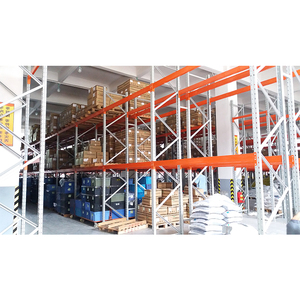
China Wholesale Pallet Racking Push Through Protection Factory & Exporter

Architectural warehouse engineering, anti-push-through safety stops, and heavy-duty industrial storage systems engineered to CE, ISO 9001, and EN 15512 global seismic standards.

Precision Engineered Systems

Featured Industrial Pallet Racking & Warehouse Infrastructure

Designed for heavy-bay stability, complete pallet depth safety control, and integrated operational efficiency across logistics distributions centers.
Factory Direct Authority

Guangzhou HEDA Shelves: Engineered Excellence Since 2001

Operating over 30,000 m² of specialized roll-forming and safety-barrier fabrication lines, exporting structural rack security worldwide.

2001
Year Founded
30,000 m²
In-House Manufacturing Area
30,000 t
Monthly Steel Capacity
120+
Global Export Territories
Direct Enterprise Credentials: Holding European CE certification (No. 2435-CPR-8605159), ISO 9001:2015 quality management systems certification (No. 18624Q00169R0M, valid to 2027), and RoHS testing guarantees, Guangzhou HEDA Shelves Co., Ltd. supplies structural push-through protection bars, wire mesh safety screens, and anti-fall backstops designed to survive the critical rigors of active logistics hubs, high-rack forklifts, and automated stacker operations.
Engineering Standard Whitepaper

Critical Mechanics of Pallet Racking Push-Through Safety Systems

Addressing secondary flue space obstruction, NFPA sprinkler compliance, and rack catastrophic collapse mitigation.

Flue Space Compliance & Fire Suppression

In modern racking bays, longitudinal flue spaces (typically 3" to 6" open clearance between back-to-back rack rows) are mandated by NFPA 13 and international fire safety codes. Without structural Pallet Racking Push Through Protection, material handlers loading pallets with counterbalanced or reach trucks consistently over-push pallets beyond rear load beams. This closes critical chimney airways needed by overhead ESFR sprinklers, increasing heat stratification and catastrophic fire risks.

Impact Kinetic Energy Absorption

Structural pallet push-through stops—fabricated as offset beam-mounted tubular stops, flush-mount Z-bars, or back-stop structural channels—must withstand repeated static and dynamic point loads. HEDA Shelves utilizes cold-formed Q235B high-tensile structural steel, finished with pickling, phosphating, and electrostatic polymer coating to absorb localized impact force from pallet placement without permanent deflection or beam shear.

Pedestrian & Pick-Tunnel Containment

Where single-entry pallet racks back onto active pedestrian routes, packing benches, or internal tunnel passages, accidental push-through failure carries severe life-safety implications. Back-of-rack protection nets, rigid framed mesh panels, and heavy-gauge mechanical stops prevent pallet spills, carton dislocation, and loose stock displacement from elevations surpassing 12 meters in high-bay distribution hubs.

Future Procurement Dynamics

Technological Evolution & Future Procurement Trends (2025–2030)

Strategic foresight into smart warehousing, global environmental mandates, and automation compatibility.

Automated Sensor-Integrated Backstops

As logistics facilities integrate Automated Guided Vehicles (AGVs) and Autonomous Mobile Robots (AMRs), physical pallet stops are transitioning from purely passive mechanical steel brackets to sensor-compatible smart barriers. Future procurement is trending toward integrated optical depth sensors, retro-reflective laser targets, and strain-gauge telemetry that immediately alerts Warehouse Management Systems (WMS) if a pallet exerts anomalous load against backstop barriers.

Low-Carbon EPD & Surface Metallurgy

Global supply chain developers (such as those across GCC free zones, North America, and the EU) enforce stringent ESG purchasing quotas. The requirement for Environmental Product Declarations (EPD) in steel manufacturing is driving Chinese direct factories to deploy high-efficiency cold-bending techniques, heavy metal-free powder coatings, and thin-film anti-corrosive pretreatments that withstand high-humidity, high-saline coastal storage zones without toxic effluents.

Modular Universal Retrofit Architectures

Rigid, site-welded backstops are being abandoned due to excessive field installation costs and structural recertification bottlenecks. Modern procurement prioritizes boltless, teardrop-compatible, box-beam clippable, and slotted-channel universal push-through assemblies. These modular units permit rapid readjustment during warehouse beam-level reconfigurations, eliminating hot-work permits and maintaining civil defense safety approvals seamlessly.

Certified Quality Control

Full-Cycle Precision Production Workflow

Every upright column, cross-beam, and push-through safety stop undergoes complete metallurgical tracking.

01

Raw Steel Ingot

Certified Q235B/Q355 hot-rolled steel strip verification.

02

CNC Slitting

High-precision dimensional tolerance steel cutting.

03

Auto Punching

Continuous 50mm/75mm pitch upright perforation.

04

Cold Roll-Forming

Gradual multiline rolling to prevent residual internal stress.

05

Beam Forming

Interlocking dual-C box profiles for anti-torsion strength.

06

Robotic Welding

Automated CO2 gas-shielded seam joining on connectors.

07

Surface Pre-Treatment

Full pickling, alkaline degreasing, and phosphating.

08

Powder Coating

Automated electrostatic polymer curing at 180°C - 200°C.

09

Stress & QC Audit

Deflection verification, load rating, and adhesion testing.

10

Export Packing

Steel strapped, bubble-wrapped, and container optimized.

Procurement Knowledge Base

Frequently Asked Questions for Global Procurement Directors

Addressing load limits, international safety compliance, customization, and factory-direct shipping logistics.

What is the primary function of a pallet push-through protector?
A push-through protector (also designated as a pallet stop, back-stop beam, or rack safety barrier) is a mechanical stop bar fastened to the rear of racking beams. Its primary role is to prevent forklift operators from accidentally pushing a pallet too far through the racking bay. This guarantees the preservation of required flue space for fire suppression systems (NFPA compliance) and stops pallets from falling into building walls or opposite working aisles.
What clearance distance should be preserved behind the pallet?
Standard design requires a pallet overhang of approximately 50mm to 75mm (2 to 3 inches) past the structural front and rear load beams. Back-stop bars are typically offset 75mm to 100mm from the face of the rear beam. This allows proper seating without structural interference while preventing the pallet from entering the mandatory 150mm (6-inch) longitudinal flue space.
Can HEDA push-through stops be retrofitted onto existing third-party racks?
Yes. We engineer universal bracket attachments, including teardrop slots, box-beam friction clamps, upright frame pass-through bolts, and structural structural-channel adaptors. Provide our engineering team with your current upright depth, beam width, and column profile, and we fabricate retrofit brackets matching your existing system.
How do the finishes endure high-humidity and corrosive environments?
Every steel component undergoes an automatic 5-stage pre-treatment line encompassing alkaline degreasing, acid pickling (to eradicate mill scale), rinsing, phosphating, and deionized passivation. Finally, an electrostatic epoxy-polyester powder coat is applied and heat-cured, providing outstanding corrosion, abrasion, and moisture resistance across coastal GCC, Southeast Asian, and maritime facilities.
What data is required to draft a 2D CAD layout and structural quotation?
To generate structural calculations and free layout designs, provide: (1) Warehouse floor plan showing building columns, clear ceiling heights, and dock doors; (2) Pallet dimensions (W x D x H) including overhang and gross load weight; (3) Forklift technical data including turning radius and maximum mast lift reach; (4) Local seismic acceleration parameters if applicable.
What are standard container loading quantities and factory lead times?
With our 30,000 t monthly fabrication capacity, standard projects ranging from 1 to 5 forty-foot high cube (40HQ) containers ship within 15–22 business days. Beams, upright frames, and push-through bars are strapped in custom numbered bundles corresponding strictly to CAD installation schematics, minimizing sorting delays upon arrival at destination ports.

Secure Your Warehouse Logistics with Certified Push-Through Protection

Connect directly with our structural engineering desk in Guangzhou. Receive free 2D/3D CAD layouts, load calculations, and competitive factory-direct wholesale pricing within 24 hours.

Get a Quote