Featured Industrial Warehouse Racking Systems
Direct factory-manufactured pallet, cantilever, vertical sheet, and automated handling solutions. Built to European FEM 10.2.02 and American RMI standards with heavy-gauge Q235B/Q355B structural steel.
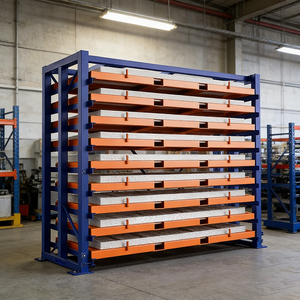
High-Capacity Vertical Sheet Metal Rack
Forklift-compatible roll-out tray infrastructure engineered for rapid vertical storage and safe extraction of heavy steel plates and dies.
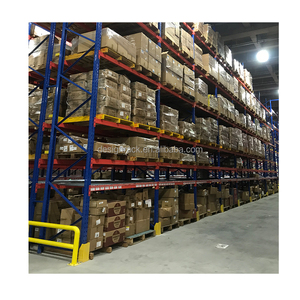
Space-Saving Double Deep Storage Rack
Two-pallet-deep configuration cutting aisle ratios by 50% for logistics hubs requiring rapid turnover and high volumetric footprint density.
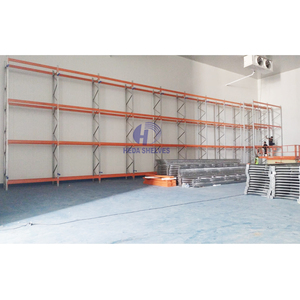
Double Deep Heavy-Duty Pallet Racking
Structural upright profile engineered for 1000kg to 3000kg per layer loading capacities across heavy industrial construction logistics.
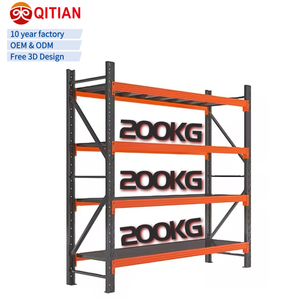
Customized Steel Light-Duty Shelving Rack
Precision modular 4-tier steel shelving with 200kg tier capacity, designed for manual picking, spare parts depots, and e-commerce sortation.
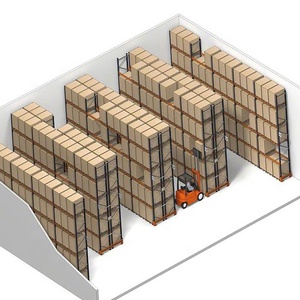
Heavy-Duty Pallet Beam Racking System
Industry standard box-beam selective racking ensuring 100% immediate pallet accessibility, adjustable pitch, and multi-tier adaptability.
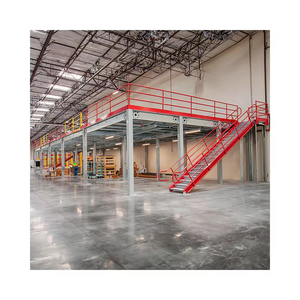
Industrial Steel Mezzanine Storage Platform
1000kg/m² structural mezzanine architecture maximizing cubic headroom for manufacturing, upper offices, and automated picking walkways.
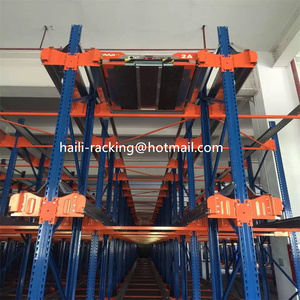
Smart Robot Automation & Shuttle Racking
Ultra-precise automated rail racking engineered for 4-way shuttles, AMR robotics, and smart warehouse management execution (WMS/WCS).
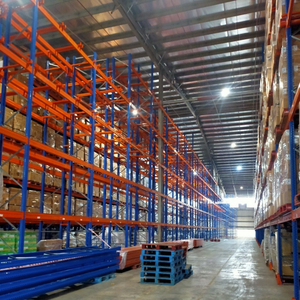
Corrosion-Resistant Heavy-Duty VNA Racking
Very Narrow Aisle (VNA) system with guide rail profiles and heavy anti-corrosion finishes, supporting heights over 15 meters for massive volume facilities.
Guangzhou HEDA Shelves: Direct OEM & ODM Factory Strengths
As a dedicated heavy-duty racking manufacturer operating since 2001, Guangzhou Heda Shelves Co., Ltd. controls the end-to-end metallurgical engineering process—from uncoiled raw structural strip steel to final computerized roll-forming and thermo-cured electrostatic powder finishing.
Rigorous International Certifications
We maintain certified compliance with CE Certification (No. 2435-CPR-8605159) and ISO 9001:2015 Quality Management (No. 18624Q00169R0M). Our structural steel systems conform strictly to European FEM 10.2.02, EN 15512, and American RMI standards, validating yield strengths, seismic moment-resisting capacities, and maximum deflection tolerances under full dynamic load testing.
Free Structural Calculation & 3D/CAD Layout
Our senior engineering department operates professional structural FEA (Finite Element Analysis) suites. Before any steel is punched or rolled, clients receive customized 2D CAD floorplans and photorealistic 3D layout renderings verifying forklift turning radius (Ast), flue space fire clearances, vertical beam levels, and compliance with civil defense guidelines and property insurance audits.
Extreme Climate & Coastal Pretreatment
Standard warehouse coatings peel under harsh humidity, marine salt spray, and extreme desert heat (45°C+). HEDA utilizes a proprietary 12-stage pickling and phosphating pre-wash followed by robotic electrostatic polyester powder coating cured at 200°C. For sub-zero cold rooms (-30°C) or outdoor yards, heavy-duty hot-dip galvanizing provides permanent sacrificial zinc barrier protection.
Request Custom Engineering Calculations & Factory-Direct Quotation
Share your facility dimensions, pallet footprints, and forklift model specifications. Our technical engineering team generates comprehensive CAD floorplans and bill-of-materials pricing within 24 hours.
Kinematics & Structural Architecture of Drive-In Racking
A deep dive into high-density pallet storage mechanics: eliminating operating aisles, cantilever rail support physics, portal frame stabilization, and mitigating progressive collapse risks.
1. Kinematics: LIFO vs. Drive-Through FIFO Operations
Drive-In racking functions on the Last-In, First-Out (LIFO) storage principle, where counterbalanced or reach forklifts drive physically into deep storage lanes to pick or deposit pallets on continuous steel support rails. By eliminating traditional operating aisles between each rack row, drive-in systems increase floor cube volumetric density by up to 75% to 85% compared to traditional selective racking.
When configured as Drive-Through racking, the lane features both a front loading face and a rear unloading face, enabling First-In, First-Out (FIFO) stock rotation. However, Drive-Through architectures forfeit rear vertical cross-bracing towers, necessitating significantly thicker upright column gauges (minimum 2.0mm to 2.5mm cold-formed omega steel) and overhead structural portal beams to resist lateral frame sway.
2. Structural Bracing Without Horizontal Cross Beams
In standard selective racking, horizontal load beams form rigid moment-resisting portal frames that stabilize the vertical uprights. Because Drive-In racking requires forklifts to enter unobstructed lanes, traditional horizontal beams cannot be placed across the storage bays. This makes the racking inherently prone to longitudinal drift and frame unbraced-length buckling.
To establish structural equilibrium under dynamic braking and pallet placement forces, HEDA engineers deploy:
• Top Horizontal Plan Bracing: Diagonal cross-ties linking the top row of uprights.
• Back Vertical Bracing Towers: Robust X-braced vertical frames installed at the closed rear of the drive-in lane.
• Overhead Tie Beams: Heavy rectangular box beams running transverse across the top portal frame to maintain lane dimensional tolerances under full asymmetrical loading.
| Engineering Parameter | Drive-In Pallet Racking (LIFO) | Double Deep Pallet Racking | Radio Shuttle Racking (Semi-Auto) | Standard Selective Racking |
|---|---|---|---|---|
| Cube Volume Utilization | 75% – 85% (Ultra High) | 60% – 65% (High) | 80% – 90% (Maximum) | 40% – 50% (Standard) |
| Pallet Selectivity | Batch / SKU Dedicated | 50% Immediate Access | Lane-Level Batch FIFO/LIFO | 100% Immediate Direct Access |
| Forklift Mast Exposure | High (Truck enters rack bay) | None (External scissor reach) | None (Shuttle carrier inside rail) | None (External access only) |
| Structural Bracing Method | Top portals & back cross-towers | Standard horizontal beam ties | Heavy box ties & guide-rail ties | Interlocking beam-to-frame hooks |
| Optimal Application Matrix | Cold storage, beverage, bulk seasonal | Logistics 3PL, FMCG distribution | Large-scale cold chain, fast batch | High-SKU distribution, e-commerce |
| Floor Guidance Requirement | Mandatory floor angle / rail guide | Optional visual floor markings | Not required (truck stays in aisle) | Not required |
Cantilever Pallet Support Arm Dynamics
Pallets inside a drive-in system rest on continuous profiled pallet support rails rather than transverse beams. These rails are borne by one-piece cold-stamped or welded cantilever support brackets bolted to the uprights. HEDA manufactures asymmetrical flared support brackets with heavy gusset plates that distribute eccentric vertical shear loads evenly across the upright column wall, preventing web-crippling failure.
Floor-Mounted Guidance Rail Protection
Because forklift clearances within a drive-in lane are typically constrained to 75mm–100mm per side, mast collisions represent the single greatest catastrophic failure hazard. HEDA mandates heavy structural steel ground guide rails (100×50×5mm cold-formed channel or structural angle) anchored into the concrete slab via M16 high-tensile torque expansion anchors, guiding the truck's wheels mechanically down the bay centerline.
Slab Anchorage & Dynamic Impact Shear
Every upright baseplate is manufactured from 6mm–10mm structural plate steel featuring twin anchoring slots. In Drive-In systems, heavy upright impact protectors with internal rubber dampening rings wrap around the front portal uprights. This prevents impact forces from dislodging chemical or mechanical anchors from the concrete substrate during fast forklift shuttle cycles.
Future Warehouse Racking Procurement Trends
Global supply chain directors and enterprise warehouse procurement managers are shifting away from generic catalogue purchasing. Discover the technical macro-trends reshaping high-density steel racking investments through 2035.
Hybridization: Shuttle-Convertible Rails
Procurement teams are demanding future-proof infrastructure. Facilities are ordering convertible Drive-In racking where the roll-formed pallet runner rails incorporate dual-purpose profiles capable of seating standard wooden pallets today, or accepting automated Radio Shuttle carriers in the future without disassembling or re-welding vertical steel uprights.
Cold-Chain Energy Density Optimization
With industrial electricity tariffs climbing, chilled and deep-freeze facilities (-25°C to -30°C) represent the highest operational cost per cubic meter. Buyers are replacing low-density selective racks with deep-lane Drive-In and 4-way automated pallet systems to minimize refrigerated room volume, reducing evaporator compressor tonnage and delivering direct ROI within 24 months.
BIM Digital Twin Structural Compliance
Enterprise procurement now mandates Level 2 and Level 3 Building Information Modeling (BIM) data drops. Factory suppliers must provide parametric Autodesk Revit / IFC families containing exact member physical properties, seismic moment loads, and anchor baseplate shear values to integrate directly with sprinkler heads, ESFR flue lines, and structural slab calculations.
Decarbonized Metallurgy & Circularity
Global carbon border adjustment mechanisms (such as EU CBAM) are compelling enterprise buyers to evaluate the Scope 1, 2, and 3 embodied carbon of structural racking. HEDA's continuous electric arc furnace (EAF) steel sourcing, low-VOC electro-powder curing ovens, and modular bolt-together structural reusability provide verified ESG compliance for green warehouse certifications (LEED & BREEAM).
Technological Innovations in Racking Production
Inside HEDA's 30,000 square meter intelligent manufacturing base: automated cold-roll profiling lines, CNC robotic welding workcells, and high-precision quality validation.
Automated Multi-Stage Continuous Roll-Forming Lines
Standard press-brake bent steel suffers from residual micro-cracking and erratic flange angles that degrade vertical column load capacity. HEDA utilizes advanced 24-station continuous roll-forming production lines that shape certified Q235B and Q355B high-tensile structural coil into multi-faceted Omega (Ω) upright profiles. Computerized in-line punching maintains a pitch accuracy of ±0.5mm over 12-meter continuous column lengths, guaranteeing seamless bracket drop-in fitment and zero field re-drilling.
Robotic Laser Cutting & Pulse-Shielded Welding Cells
Drive-in pallet support brackets and heavy upright baseplates experience intense cyclic shock loads during routine daily pallet drops. All connector collars, bracket gussets, and floor base shoes are cut using high-precision 10kW fiber lasers, followed by continuous gas-shielded (Ar/CO₂) robotic pulse welding. This guarantees full metallurgical penetration and eliminates porosity defects, exceeding AWS D1.1 and EN 1090 welding code benchmarks.
Spectrometry & Tensile Testing
Every incoming steel coil is subjected to optical emission spectrometry to verify carbon-manganese-silicon metallurgical chemistry, followed by physical yield/tensile pull testing.
In-Line CNC Multi-Punching
High-speed hydraulic punch presses stamp drop-shaped, butterfly, or diamond pitch holes simultaneously across three profile planes before roll forming to prevent flange warping.
12-Stage Acid Pickling Prewash
Components undergo comprehensive degreasing, ultrasonic rust deoxidation, zinc phosphating, and deionized water rinsing to ensure 100% molecular bonding of surface powder.
Thermoset Powder Polymerization
Automated reciprocator spray guns deposit 60–90 microns of non-toxic polyester resin powder, cured through a 40-meter radiant infrared baking oven at precisely 200°C.
Frequently Asked Engineering Questions
Authoritative, clear answers to technical questions raised by warehouse developers, 3PL consultants, EPC contractors, and procurement executives.
What specific warehouse operational profiles benefit most from Drive-In racking compared to Selective or Double Deep systems? +
Drive-In racking is engineered specifically for facilities handling large pallet volumes of identical Stock Keeping Units (SKUs) with moderate-to-low item selectivity requirements. The ideal operational profile features fewer than 50 distinct SKUs, where entire lanes (ranging from 4 to 12 pallets deep) can be dedicated to a single production batch or shipment lot. Typical industries include cold storage and frozen meat/vegetable distribution, bottled water and carbonated beverage manufacturing, chemical raw material staging, seasonal agricultural packing (such as date and fruit processing), and building materials.
Conversely, if your warehouse operates an e-commerce fulfillment or retail distribution model requiring immediate, direct pick access to thousands of discrete individual SKUs, standard Selective Pallet Racking or Very Narrow Aisle (VNA) racking is technically superior. Double Deep racking serves as an intermediate hybrid, reducing aisles by 50% while maintaining 50% immediate pallet selectivity using pantograph reach trucks.
How does HEDA prevent progressive collapse and racking sway in deep Drive-In systems lacking beam moment frames? +
Progressive collapse prevention in Drive-In engineering relies on creating an integrated three-dimensional structural diaphragm. Because the interior lanes must remain open for forklift access, traditional front-to-back crossbeams are omitted. HEDA mitigates longitudinal and lateral frame buckling through a three-tier reinforcement strategy:
1. Top Horizontal Plan Bracing: Heavy diagonal steel angles form a continuous horizontal truss network across the entire ceiling plane of the racking block, transferring lateral racking loads directly to the outer perimeter frames.
2. Rear Vertical Tower Bracing: The back of each bay is reinforced with heavy vertical cross-tension rods and structural steel channels, forming a rigid spine that anchors the entire block against forklift thrust loads.
3. Heavy-Duty Front Leg Column Guards: Structural wrap-around floor bull-nose protectors (12mm steel) are bolted independently to the concrete floor slab with elastomeric dampening pads. This isolates the vertical column from impact shocks caused by forklift wheels or pallet corners entering the lane.
What are the exact dimensional tolerances, pallet clearances, and forklift mast guidelines required for Drive-In bays? +
Precise clearance calculations are critical to prevent pallets from dislodging or catching on upright flanges. Standard design guidelines adhering to FEM 10.2.02 and RMI standards specify:
• Pallet Overhang & Seat: The pallet must bear continuously on the support rail with a minimum bearing width of 50mm to 65mm per side. For standard 1200×1000mm pallets, the nominal lane clear entry dimension between rail lips is typically engineered at 1050mm–1100mm.
• Vertical Tier Clearance: A minimum clearance of 100mm to 150mm must be maintained between the top of the loaded pallet unit (including stretch wrap bulge) and the underside of the support bracket above it to allow easy lifting and extraction.
• Forklift Dimensions: The maximum overall width of the forklift truck (including outriggers and cab guards) must be at least 150mm to 200mm narrower than the clear width between the floor guide rails. Counterbalanced forklifts, articulated reach trucks, and stand-on reach trucks must be specified with narrow-chassis configurations and mast profiles that do not flare past the outer chassis line.
How do HEDA Drive-In systems comply with Middle East Civil Defense, ESFR fire sprinklers, and seismic building codes? +
Warehouses across the Gulf region (UAE, Saudi Arabia, Qatar, Kuwait, Bahrain, Oman) enforce strict municipal Civil Defense fire codes and seismic regulations. HEDA’s design engineering team prepares full technical calculation submittal dossiers that address these requirements directly:
• ESFR Sprinkler Clearance: Our 3D CAD layouts ensure that upper storage tiers maintain a continuous unhindered clearance of at least 900mm to 1000mm below the lower chord of structural roof trusses and ESFR sprinkler deflector heads.
• Transverse Flue Spaces: In long drive-in runs, we incorporate dedicated 150mm–300mm longitudinal flue spaces and vertical ventilation gaps to allow radiant heat to rise freely to activate thermal bulb sprinklers and facilitate rapid fire suppression.
• Seismic Ground Acceleration: In accordance with local building codes, structural upright profiles, baseplate surface areas, and anchor bolt embedment depths are calculated against horizontal seismic coefficient forces ($S_s$ and $S_1$) to prevent anchor pullout or frame plastic hinge failure during earth tremor events.
What surface treatment should be specified for sub-zero cold storage versus coastal desert ambient conditions? +
Environmental conditions dictate metallurgical coating longevity:
• Sub-Zero Cold Storage (-25°C to -30°C): While humidity inside steady freezing rooms is low, rapid condensation and thermal shock occur during system defrosts and near air-curtain loading doors. HEDA utilizes a high-adhesion pure polyester electrostatic powder coating (80–100μm) pre-treated with zinc phosphating to prevent micro-blistering. In ultra-humid blast freezers or wet meat-processing environments, we recommend Hot-Dip Galvanizing (HDG) to EN ISO 1461, providing a sacrificial zinc layer of 60–85μm that resists rust even if physically scored by pallet corners.
• Coastal Desert Conditions (Jebel Ali, Dammam, Jeddah): High ambient temperatures combined with high saline sea air rapidly degrade standard industrial paints. Our 12-stage automated pre-treatment line completely strips mill-scale and oil, applying an inorganic conversion coating that prevents rust undercutting, validated by standard 500-hour ASTM B117 salt spray testing.
What is the standard factory lead time, sea freight container packing protocol, and overseas installation support? +
Typical factory production lead time is 15 to 25 business days from final CAD layout sign-off and structural approval. For project logistics, our factory implements rigorous container packing protocols: upright frames are nested with wooden dunnage dividers and heavy steel strapping to prevent in-transit maritime chafing; beams and rails are packaged in color-coded, labeled bundles that match the project's erection drawings.
Every shipment includes detailed 3D step-by-step assembly blueprints, torque specification charts, and parts lists. HEDA provides comprehensive remote video engineering supervision for your local installation crews, and can dispatch dedicated bilingual site engineers for on-site structural erection supervision on large multi-tier projects.
What is "honeycombing" loss in Drive-In racking, and when should a facility upgrade to a Radio Shuttle system? +
Honeycombing refers to the unoccupied void spaces that occur inside a deep drive-in lane when pallets from that lane have been partially dispatched. Because a LIFO lane can only store one SKU, you cannot place a different product in front of an existing SKU without completely blocking access. In real-world multi-SKU operations, honeycombing frequently reduces effective theoretical storage capacity by 20% to 35%.
If your operation experiences high inventory velocity where individual lanes cannot be rapidly cleared and replenished as complete batches, or if forklift travel times deep into lanes create operational bottlenecks, upgrading to a Radio Shuttle Racking System is highly cost-effective. Shuttle systems operate at lane-level FIFO or LIFO without the forklift ever entering the rack bay, slashing cycle times by up to 50% and completely eliminating structural upright collision risks.
Turnkey OEM/ODM Engineering & Global Delivery Model
From initial site survey to container discharge at your local port, HEDA's structured four-stage engineering methodology guarantees structural reliability and on-schedule warehouse commissioning.
Phase 1: Engineering Discovery
We analyze facility architectural drawings, clear headroom under roof beams, column spacing grids, concrete slab PSI load ratings, pallet footprints, and forklift lift heights.
Phase 2: 3D CAD & FEA Modeling
Our engineers produce optimized floor plans, calculate structural beam moment loads, simulate seismic and dynamic live loads, and deliver full 3D layout renderings for stakeholder sign-off.
Phase 3: Automated Fabrication
Precision roll-forming, computerized in-line punching, robotic welding, 12-stage pre-treatment, and electrostatic powder coating with continuous QC testing at our Guangzhou campus.
Phase 4: Export Packing & Support
Standard export dunnage packing in dedicated sea containers, shipped directly to global commercial ports, complete with detailed assembly drawings and remote/on-site erection supervision.
Proven Industrial Installations Across Global Hubs

High-Density Cold Storage Installation
GCC Regional Logistics Hub · 12,000 Pallet Positions
Custom heavy-duty Drive-In system operating at continuous -25°C. Engineered with reinforced flared guide shoes, galvanized baseplates, and high-tensile cold-room structural steel.
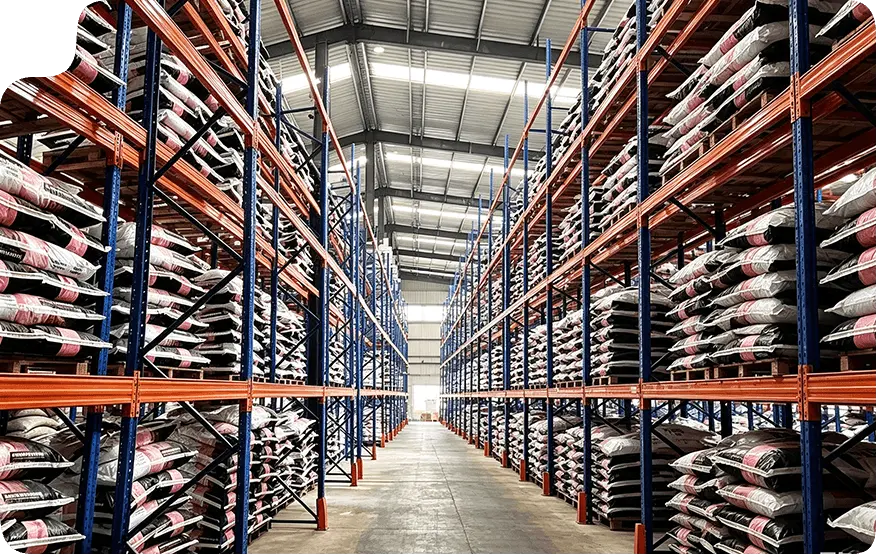
Building Supplies & Pipe Depot
Southeast Asia Mega-Project · Heavy Duty Cantilever & Beam
Combination of heavy cantilever arms (3,000kg/tier) and high-density pallet drive-ins for structural steel, conduit pipes, and bulk cement storage.
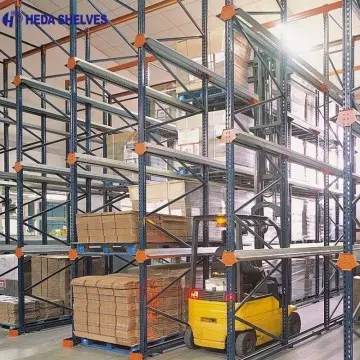
FMCG & Paper Packaging Facility
Turnkey 6-Tier High-Bay Drive-In Storage
Optimized for single-SKU corrugated paper reels and heavy packaging batches, increasing warehouse capacity by 82% over previous floor-stacking practices.
Equip Your Warehouse with Direct-from-Factory Racking Systems
Get in touch directly with our structural engineering team. We review your warehouse CAD layouts, load requirements, and turnaround schedules to provide an engineered storage solution with competitive factory-direct pricing.