ISO 9001:2015 & CE Certified Intralogistics Factory Direct
OEM/ODM Very Narrow Aisle Pallet Racking Factory & Exporter
Precision-engineered high-density storage frameworks designed to FEM 10.2.02 and EN 15620 standards. Sourced directly from our 30,000 m² automated production facility for global supply chain deployments.
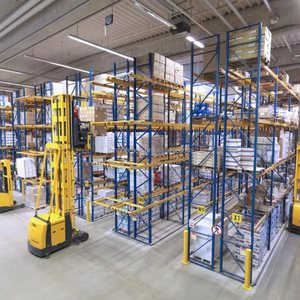
From ultra-dense VNA systems operating at 18-meter roof beam heights to automated sheet metal cantilevers, discover factory-certified storage modules fabricated to exact project tolerances.
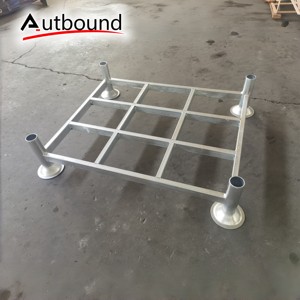
Portable post pallets crafted from certified Q235B cold-rolled steel. Collapsible and nesting geometry designed for seasonal overflow and flexible marshalling.
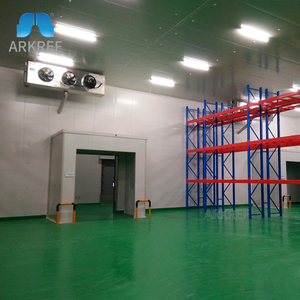
Engineered for sub-zero (-30°C) cryogenic logistics and R744 CO2 refrigerated environments with embrittlement-resistant steel metallurgy and zinc coating.
Rating: Down to -30°CR744 Refrigerant ReadyAnti-Embrittlement
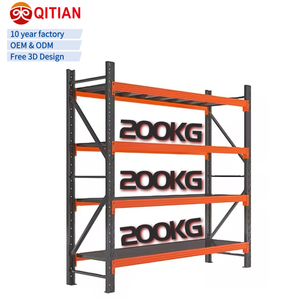
Heavy-duty multi-tier selective pallet framework built with continuous roll-formed step beams and dual-locking safety connector pins for high-throughput hubs.
1. Technical Engineering Principles of Very Narrow Aisle (VNA) Systems
Modern distribution complexes, regional logistics hubs, and cold storage facilities face surging industrial real estate costs. Conventional selective pallet racking systems require working transfer aisles spanning 3,200 mm to 3,800 mm to accommodate counterbalanced reach forklifts. This layout leaves upwards of 60% of usable building cube dedicated entirely to truck travel pathways rather than revenue-generating cargo positions.
As an authoritative OEM/ODM manufacturer, Guangzhou Heda Shelves Co., Ltd. (HEDA Shelves) re-engineers warehouse volume using Very Narrow Aisle (VNA) architecture. By compressing the net clear aisle dimension down to 1,500 mm – 1,800 mm—governed by the precise chassis width of swing-mast turret trucks (VNA Man-Up or Man-Down) and automated guided vehicles (AGVs)—VNA systems expand vertical cubic storage capacity by 40% to 50% while preserving 100% individual pallet selectivity.
Kinematic Floor Flatness Tolerances: DIN 18202, EN 15620 & TR34
In high-bay VNA installations rising between 12 meters and 18 meters, floor levelness ceases to be an aesthetic factor and becomes a non-negotiable structural constraint. Because turret trucks operate with rigid masts extending up to 18,000 mm, microscopic floor variations amplify dynamically at the rack interface:
Superflat Slab Criteria: Installations must conform strictly to DIN 18202 Table 3 Group 4, EN 15620 (Class 300 / 400), or the UK Concrete Society's TR34 (Category DM1 / DM2) specifications. A transversal floor deviation of merely 2 mm at the wheel contact patch will generate a dynamic mast deflection exceeding 35 mm at top tier levels, provoking critical collision risks with beam faces.
Dynamic Sway Control: HEDA Shelves engineers our upright frames with specific cross-sectional moment of inertia ($I_x, I_y$) using 13-fold omega ($\Omega$) profile continuous roll forming. This structural geometry dampens harmonic oscillations transmitted through the slab during turret truck high-speed deceleration.
Mechanical Guide Rails
Continuous hot-rolled angle steel (L100×75×8 or L125×80×10) anchored with high-shear chemical capsule anchors at 800mm intervals to physically constrain truck wheels.
Heavy-duty interlocking connectors with 3-claw or 4-claw cold-stamped rivets and visual safety pins preventing unseating during dynamic vertical extraction.
Run-End Heavy Protectors
Massive 12mm thick carbon-steel omega perimeter deflectors protecting exposed rack row extremities from lateral turning collision by fast-cycling MHE.
Determining the optimal intralogistics system requires calculating the volumetric utilization ratio, pick cycle speed, floor infrastructure investment, and fleet capital expenditure. Below is a comprehensive engineering comparison between Very Narrow Aisle (VNA) systems, standard selective systems, drive-in systems, and unit-load AS/RS:
In high-bay VNA applications, horizontal sway under maximum dynamic load must not exceed H/500, and vertical beam deflection under certified safe working load (SWL) must remain within L/200. Sub-standard designs risk severe mast jamming or catastrophic racking unseating when handling top-bay pallet transfers.
3. Material Science, Metallurgy & Harsh Climate Surface Engineering
As an internationally accredited OEM/ODM manufacturer holding CE Certification (No. 2435-CPR-8605159) and ISO 9001:2015 (No. 18624Q00169R0M), HEDA Shelves enforces structural steel traceability on all raw coils:
High-Yield Steel Formulations: S355 vs Q235B
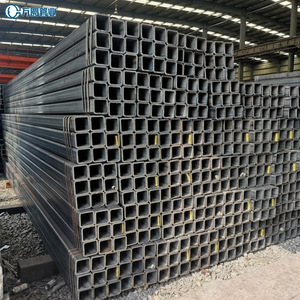
For standard lower-height structures, hot-rolled carbon steel Q235B delivers dependable yield strength ($f_y \ge 235 \text{ N/mm}^2$). However, for tall VNA upright profiles and extended span load beams (up to 3,900 mm for triple Euro-pallet bays), our factory specifies Q355B / S355J0H (EN 10219 / EN 10025) steel. With a certified yield point ($f_y \ge 355 \text{ N/mm}^2$) and minimum elongation of 22%, S355 cold-formed uprights allow reduced cross-sectional deadweight while raising axial compressive load safety factors beyond 2.0.
Warehouses located across the Middle East (UAE, Saudi Arabia, Qatar, Oman), Southeast Asia, and maritime coastal zones face extreme humidity, severe sand dust, and ambient temperatures exceeding 48°C. Our automated in-house finishing process utilizes ten controlled stages to ensure corrosion immunity:
Pretreatment: Immersion pickling in acid baths to strip mill scale, industrial alkaline degreasing, and multiple high-pressure deionized water rinses.
Chemical Conversion: Zinc-manganese phosphating that bonds a dense microscopic crystal layer onto raw steel, enhancing powder coat adhesion and inhibiting underfilm oxidation.
Thermosetting Polymer Deposition: Electrostatic spray deposition of lead-free, RoHS-compliant polyester resin powders cured through continuous gas-fired baking tunnels at 190°C – 205°C for 20 minutes.
Performance Testing: The resulting 70–90 $\mu$m dry film thickness (DFT) exceeds ASTM B117 salt spray testing beyond 500 hours without blistering or rust creep. For sub-zero cryogenic facilities running natural R744 refrigerants at -30°C, our specialized formulations prevent low-temperature polymer embrittlement and micro-fissuring.
4. Future Procurement & Technological Trends in VNA Intralogistics
Procurement directors and intralogistics engineers are navigating several macro-industry shifts impacting VNA rack sourcing through 2035:
Hybrid VNA-AMR Automation
Integration of driverless narrow-aisle AGVs and autonomous mobile robots (AMRs). Racking specifications now require high-precision visual target barcodes and RFID beam tagging.
Super-Height Verticals (>18m)
Rising land costs are driving demand for self-supporting rack-clad buildings, where VNA rack uprights serve simultaneously as the structural framework for warehouse roof and wall cladding.
Smart Structural Health Monitoring
IoT displacement sensors and strain gauges embedded directly into critical upright baseplates to provide real-time telemetry on mechanical impact and seismic settling.
Decarbonized EPD Steel
Global EPC contracts increasingly require verified Environmental Product Declarations (EPD) and low-carbon scrap-recycled electric arc furnace (EAF) steel certification.
Procuring heavy-duty warehouse racking directly from the manufacturer eliminates intermediary markup and establishes direct communication with structural engineers. Founded in 2001, HEDA Shelves provides end-to-end intralogistics manufacturing from our headquarters in Guangzhou, China:
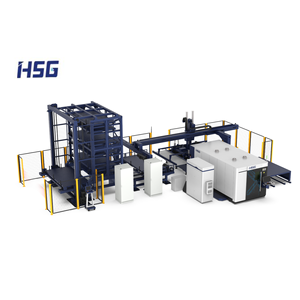
In-House Manufacturing Scale: Our 30,000 m² plant features multiple high-speed continuous roll-forming lines, automated CNC laser profiling centers, and robotic welding stations producing up to 30,000 tons per month.
Engineering & BIM Layout Deliverables: We provide complimentary structural engineering consultation, 2D AutoCAD floor plans, dynamic 3D warehouse renderings, and finite element analysis (FEA) deflection calculations before manufacturing commences.
Civil Defense & Code Compliance: Our engineering drawings incorporate required egress widths, transverse and longitudinal flue spaces (typically 150mm), and ESFR in-rack sprinkler pipe clearance lines, assisting contractors in obtaining local authority approvals (e.g., Civil Defense, NFPA 13 compliance).
Heavy Export Packing Logistics: Standard ocean cargo packaging often suffers damage in transit. HEDA Shelves bundles upright columns and beams with perimeter steel strapping, anti-friction timber bearers, waterproof plastic shrink wrapping, and coded tags matching erection schematics for seamless on-site unloading at global ports.
6. Frequently Asked Questions by Engineering & Procurement Teams
Direct technical answers to common queries evaluated by supply chain consultants, EPC contractors, and warehouse operations executives during the tender phase:
What minimum floor flatness tolerance is required for a 15m VNA system?
For top beam elevations exceeding 12,000 mm, the warehouse concrete slab must strictly conform to TR34 Category DM1 or EN 15620 Class 300. Floor elevation across the truck track must not exceed 1.5 mm to prevent mast sway and beam collisions.
How does HEDA Shelves address seismic design loads (FEM 10.2.08 / RMI)?
Our structural calculation software factors in ground acceleration parameters ($a_g$), subsoil geotechnical classes, and seismic ductility factors. We engineer widened, heavy-gauge baseplates (12mm–20mm thick) secured with paired anchor studs to transfer seismic moments directly into the footing.
Can VNA racks be reconfigured if pallet profile sizes change?
Yes. Upright frames feature continuous CNC punching on a 50mm or 75mm pitch. Load beams can be easily unclipped and repositioned vertically without hot works or structural re-welding, provided maximum bay loads are respected.
What is the typical production lead time for 5,000 to 20,000 pallet positions?
Standard fabrication schedules range from 20 to 35 calendar days following technical drawing sign-off and material approval. Fast-track container scheduling routes directly through Guangzhou or Shenzhen ports.
How are in-rack fire sprinkler networks accommodated in VNA bays?
HEDA Shelves incorporates a dedicated 150 mm longitudinal flue space between back-to-back rows, allowing vertical riser drops and horizontal sprinkler branch pipes to run clear of pallet overhangs in accordance with NFPA 13 standards.
Do you supply installation supervision teams internationally?
Yes. In addition to delivering detailed step-by-step 3D assembly manuals and structural component part lists, HEDA Shelves deploys experienced installation engineers globally to supervise local contractor teams and ensure alignment tolerances.
Plan Your Warehouse with HEDA Engineering Specialists
Submit your facility architectural drawings (.DWG CAD or PDF) along with pallet specifications, clear ceiling height, and floor slab details. Our technical team will return a customized 2D/3D layout, rack capacity calculation, and detailed factory-direct quotation within 24 hours.