Engineered High-Capacity Heavy Duty Pallet Racking Systems
Evaluated under strict ISO 9001:2015, FEM 10.2.02, and EN 15512 static/dynamic structural standards. Fabricated from certified Q235B / Q355B high-tensile cold-rolled steel coils, finished with 9-stage pickling, phosphating, and electrostatically applied thermo-hardened epoxy powder coating.
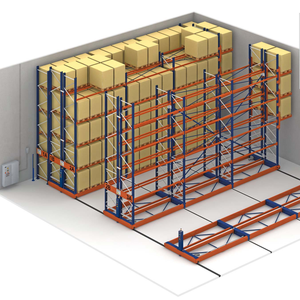
Material Rack Automated Storage Electric Mobile Warehouse Racking
Heavy-duty motor-driven floor track mobile racking maximizing volumetric storage by up to 85% by opening a single dynamic working aisle for high-tonnage cold storage and raw materials.
- Load Capacity: Up to 24,000 kg / Bay
- Aisle Utilization: Reduces dead aisles by 80%
- Safety Protocols: Dual Infrared & Mechanical Buffers
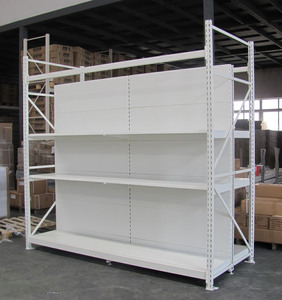
Integrated Hypermarket Modular Display Shelving & Racking
Structural hybrid racking engineered for cash-and-carry hypermarkets, combining ground-level commercial display shelving with high-bay pallet racking storage directly above.
- Display Level Load: 300 – 600 kg / Shelf
- Pallet Level Load: 1,500 – 3,000 kg / Level
- Modularity: 50mm/75mm Pitch Pitch Adjustment
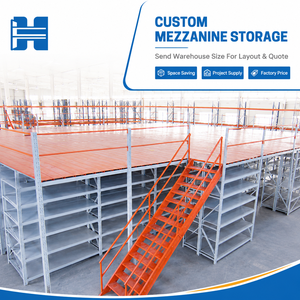
Customized Rack-Supported Mezzanine Floor Platform System
Multi-tier structural rack platform doubling or tripling clear vertical height usage. Ideal for high-density e-commerce picking, manual assembly zones, and oversized spare parts.
- Deck Capacity: 300 – 1,200 kg / m²
- Decking Medium: Perforated Steel, Bar Grating, Plywood
- Vertical Height: Up to 12m Multi-Tier
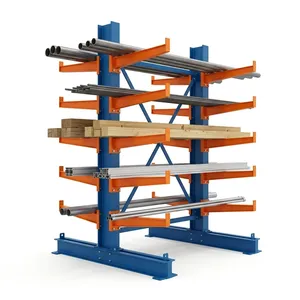
Heavy Duty Industrial Adjustable Cantilever Racking System
Unobstructed open-face structural column racking engineered specifically for extra-long extrusions, structural steel tubes, timber packs, and PVC conduits without front column interference.
- Arm Capacity: 500 – 1,800 kg / Arm
- Column Section: H-Section Structural Steel
- Configuration: Single / Double Sided Profiles
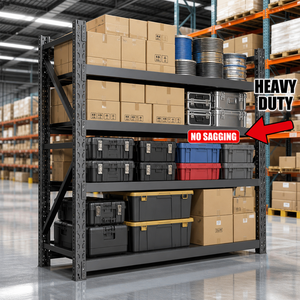
Heavy-Duty Boltless Teardrop Steel Shelving & Racking
Precision-punched teardrop locking system enabling fast, boltless erection and reconfiguration. Designed for high-turnover industrial distribution, workshop staging, and carton storage.
- Tier Rating: 500 – 1,000 kg / Shelf
- Locking Standard: Universal Teardrop / Rivet
- Finish: Anti-Scratch Heavy Powder Coat
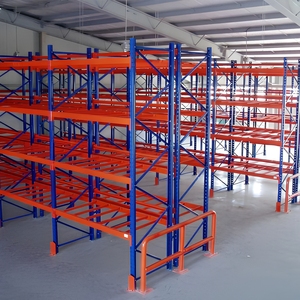
Adjustable Anti-Rust Conventional Heavy Duty Pallet Racking
The global standard in warehouse logistics offering 100% selective pallet accessibility, multi-tier reach up to 14 meters, and beam safety pins to prevent dislodgement under high forklift throughput.
- Pallet Rating: 1,000 – 4,500 kg / Level
- Upright Profile: 80/90/100/120/140 Omega Sections
- Corrosion Proof: Pretreated ISO 9227 Salt Spray
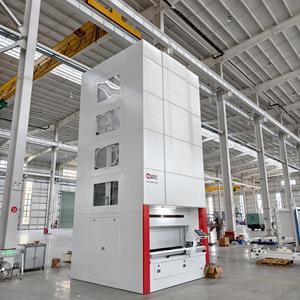
Automated Vertical Lift Module (VLM) & Automated Pallet System
Enclosed computer-controlled goods-to-person dynamic vertical storage system. Reduces footprint by 90% while integrating directly with warehouse ERP/WMS platforms for zero-error fulfillment.
- Tray Payload: Up to 1,000 kg / Tray
- Height Envelope: Up to 24m Vertical Tower
- Software Interface: Automated WMS / Barcode Picking
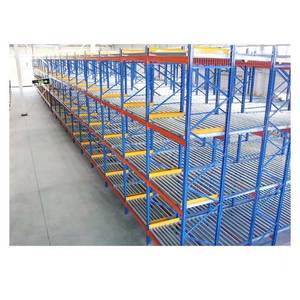
CE Certified Heavy Duty Gravity Roller Flow Pallet Racking
Continuous gravity-driven roller lanes operating on strict First-In-First-Out (FIFO) principles with integrated centrifugal speed controller brakes and entry/exit separators for perishable inventory.
- Lane Capacity: 2,000 kg / Pallet Position
- Roller System: High-Wear Heavy Galvanized Steel
- Certification: CE 2435-CPR-8605159 Compliant
Top 10 HD Pallet Racking Factory & Exporter Evaluation Matrix
In modern logistics engineering, qualifying a tier-one heavy-duty pallet racking exporter requires auditing beyond commercial pricing. Top-tier industrial buyers, EPC contractors, and global logistics REITs evaluate suppliers against ten critical structural and supply-chain benchmarks.
Metallurgical Quality & Raw Material Traceability
Premium manufacturers do not procure recycled or uncertified scrap steel. Uprights and roll-formed box beams must strictly derive from premier steel mills utilizing primary Q235B or Q355B (equivalent to ASTM A36 and S355JR) continuous-cast coils with verified mill test certificates (MTC).
- Tensile yield verification (≥ 235 MPa to ≥ 355 MPa)
- Chemical uniformity minimizing phosphorus and sulfur embrittlement
- Full heat number traceability to primary coil batches
Continuous Cold Roll-Forming Precision
A top-tier factory operates automated multi-station cold-roll forming production lines. High-precision column profiling guarantees uniform wall thickness along complex Omega profiles, eliminating micro-cracking at bend radiuses.
- 16 to 24 continuous rolling station assemblies
- Hole punching tolerances within ±0.1mm along a 12m upright
- Elimination of residual internal torsional stress
Structural Compliance (FEM, EN, RMI, AS4084)
Export authority is cemented by multi-jurisdictional compliance. Pallet racking must calculate finite element deflection, seismic baseplate anchoring, and vertical buckling ratios according to international regional structural codes.
- European FEM 10.2.02 & EN 15512 safety factor thresholds
- American RMI (MH16.1) industrial steel racking standards
- Australian AS 4084-2023 certified deflection limits
Surface Pre-treatment & Coating Integrity
Maritime export exposure and humid distribution centers accelerate oxidation. Industry-leading factories employ an exhaustive multi-stage pre-treatment line prior to automated electrostatic powder application.
- Automated 9-stage degreasing, acid pickling, and phosphating
- Thermo-hardened epoxy-polyester coating thickness 60–90 μm
- ISO 9227 / ASTM B117 salt spray endurance exceeding 500 hours
Seismic & High-Bay Dynamic Engineering
Modern distribution hubs reach heights from 12 to over 30 meters. Suppliers must possess in-house FEA (Finite Element Analysis) capabilities to calculate dynamic seismic response spectra and frame ductility.
- Seismic baseplate dissipation anchoring designs
- Horizontal and vertical cross-bracing structural computation
- Safe operational tolerances under ground acceleration factors
Rigorous In-House Load Testing Labs
Top-ten exporters maintain permanent testing facilities featuring hydraulic cyclic actuators to verify beam end-connector stiffness, upright stub column crushing limits, and joint looseness.
- Beam deflection limits restricted to L/200, L/250, or L/300
- Beam connector reverse moment & cyclical load evaluation
- Non-destructive weld testing across all beam end-plates
Containerization & Export Packaging Engineering
Severe physical damage during ocean transit is a frequent failure point for low-tier vendors. Elite exporters employ standardized, palletized, color-coded, and shrink-wrapped component bundling.
- Steel dunnage runners and heavy corner protector strapping
- Desiccant charging inside enclosed 40HQ ocean containers
- Detailed container load distribution software matching erection steps
Custom OEM/ODM & Turnkey Solution Agility
No two warehouse footprints are identical. World-class factories provide turnkey agility—customizing upright perforations (teardrop, diamond, hexagon, oval), bespoke step beams, and structural platform integration.
- Free 2D CAD floor plans and photorealistic 3D structural rendering
- Tailored pitch spacing accommodating bespoke material handling units
- Fast-track prototype fabrication within 7–10 days
Automated Integration & Industry 4.0 Compatibility
As conventional warehousing migrates toward automated material handling, top exporters produce high-precision rollings designed to interface seamlessly with AS/RS cranes, shuttles, and AGVs.
- Millimeter-level straightness tolerances along 20-meter vertical spans
- Automated guide-rail integrations for radio shuttle carriers
- Precision sensor mounting fixtures and wire chase cutouts
Global Traceability, Warranty & On-Site Support
A legitimate global exporter guarantees long-term operational peace of mind through documented serial numbers, stamped structural load plaques, comprehensive warranties, and dedicated field engineering supervision.
- Standard 5 to 10-year comprehensive structural warranty
- Digital component tracing for fast future expansion matching
- Global remote video installation guidance and flying field engineers
| Structural System | Primary Profile & Steel Grade | Standard Capacity Envelope | Aisle Requirement | Floor Utilization | Primary Application Profile |
|---|---|---|---|---|---|
| Selective Pallet Racking | Q235B / Q355B 80-140mm Omega Upright | 1,000 – 4,500 kg / level | 3.0m – 3.8m (Counterbalance / Reach) | 35% – 45% | Multi-SKU, 100% selective FMCG, retail & 3PL distribution |
| Double Deep Racking | Q355B Heavy Cold-Formed Upright | 1,500 – 3,200 kg / level | 3.2m – 3.5m (Specialized Deep Reach) | 50% – 60% | High-density secondary staging, mid-turnover homogenous inventory |
| Drive-In / Drive-Through | Q235B Continuous Roll-Formed Arm Rail | 1,000 – 1,800 kg / pallet | Direct drive-in access lane | 65% – 75% | Cold storage, raw ingredient staging, low-SKU beverage batches |
| Radio Shuttle System | Q355B High-Precision Shuttle Rail | 500 – 2,000 kg / pallet | Single operating face access | 75% – 85% | Deep-lane high-turnover FMCG, chilled foods, high-throughput depots |
| Heavy Cantilever Racks | Hot-rolled H-Beam or Structural Upright | 500 – 1,800 kg / cantilever arm | Variable depending on load length | 40% – 50% | Structural steel, copper tubing, timber packs, sheet goods |
| Rack Mezzanine Platform | Integrated Structural Beam & Upright | 300 – 1,200 kg / m² deck load | Stairway & internal picking aisles | 100% – 200% Gain | E-commerce fulfillment centers, automotive spare parts, assembly |
Future Procurement Trends in Industrial Pallet Racking
Supply chain executives and industrial warehouse developers must anticipate how automated technology, shifting geopolitical supply chains, and green infrastructure directives are transforming storage procurement through 2030.
1. Migration Toward Semi-Automated Shuttle Density
Skyrocketing land acquisition costs and industrial rent hikes are rapidly displacing traditional selective racking. Procurement is prioritizing semi-automated systems like 4-way radio shuttle racking and electric mobile racking, slashing required aisle footprints while reducing human forklift travel distances by over 60%.
2. Demand for High-Bay Automated AS/RS Integration
Clad-rack warehouses—where the structural racking itself forms the load-bearing framework of the building walls and roof—are experiencing exponential growth. Racking factories are now audited as structural building frame fabricators, requiring tolerances within 1.5mm across 35-meter elevations.
3. Low-Carbon Steel & Sustainable Coating Chemistry
Global environmental mandates and ESG compliance demand low-carbon embodied steel procurement. Tier-one buyers actively source from racking manufacturers that utilize zero-VOC electrostatic powder coatings, continuous wastewater recycling closed loops, and EPD (Environmental Product Declaration) verifiable steels.
4. Resilient Cold-Chain Logistics Infrastructure
The global surge in fresh food delivery, biologics, and pharmaceutical cold storage requires steel structures resilient to sub-zero embrittlement (-30°C). Structural specifications now mandate impact-tested low-temperature steels, specialized zinc-rich primers, and hot-dip galvanized components resistant to heavy thermal condensation cycles.
Technological & Structural Evolutionary Trends in HD Racking
How modern structural metallurgy, IoT sensor arrays, and advanced roll-forming algorithms are redefining safety margins, seismic dissipation, and real-time structural health monitoring in heavy industrial facilities.
Continuous Sensor-Embedded Structural Health Monitoring (SHM)
Leading-edge industrial installations are embedding micro-strain gauges, optical fiber deflection sensors, and 3-axis dynamic accelerometers directly into beam end-connectors and critical upright bases. This enables live cloud monitoring of structural overloading, seismic shifts, and unseen forklift impact deformities before catastrophic collapse occurs.
Advanced Non-Linear Buckling & Cold-Form Profile Optimization
Through computerized structural optimization algorithms, modern upright sections utilize complex multi-flange return bends (10 to 14 facet profiles). This achieves a 22% higher load-to-weight ratio compared to legacy channel designs, significantly cutting raw material tonnage without compromising vertical Euler buckling resistance.
Hysteretic Seismic Energy Dissipation Baseplates
In high-seismicity operational zones (such as coastal edges, active tectonic faults, and seismic zone 4 territories), rigid anchor bolts are superseded by engineered sacrificial ductile fuses and elastomeric damping baseplates. These dissipate lateral ground shock energy, safeguarding the warehouse foundation and inventory.
Why Global Procurement Trusts HEDA Shelves
Established in 2001, Guangzhou Heda Shelves Co., Ltd. operates as a vertically integrated tier-one manufacturer of heavy-duty pallet racking, industrial shelving, and automated warehouse structural platforms. Serving EPC builders, distributors, and logistics operators across 120+ countries.
30,000 m² Integrated Factory
Full in-house fabrication infrastructure located in Guangzhou, China. Complete control across high-speed continuous roll-forming lines, automated laser profiling, robotic welding cells, and electrostatic powder coating plants.
Massive 30,000-Ton Monthly Output
Unrivaled production scalability capable of processing large-scale giga-project orders, state reserve depots, and international distribution hubs with guaranteed, strictly monitored factory lead times.
Verifiable International Certifications
Fully compliant with international safety and quality standards, holding accredited CE Certification (No. 2435-CPR-8605159), ISO 9001:2015 Quality Management (No. 18624Q00169R0M), and verified RoHS environmental compliance.
Turnkey Engineering & Free 3D CAD
Our veteran engineering department evaluates floor slabs, column grids, and forklift kinematic requirements, delivering structural calculations, 2D AutoCAD equipment footprints, and 3D photorealistic renderings prior to production commitment.
Severe-Climate Surface Finishes
Engineered for high-heat, hyper-saline coastal ports and harsh desert conditions (Middle East, GCC, Southeast Asia). Comprehensive acid phosphating pre-treatment guarantees exceptional anti-corrosive adhesion.
Global Ocean Logistics Mastery
Decades of continuous container export mastery. Heavy steel-banded bundling, weatherproofing wraps, and custom erection sequence labeling simplify customs clearing and cut local installation durations in half.
Frequently Asked Questions by Industrial Sourcing Teams
Authoritative, technically grounded answers addressing slab tolerances, structural safety standards, local regulatory approvals, and ocean logistics.
What concrete floor slab specifications are required for heavy-duty pallet racking installations? +
Heavy-duty warehouse racking places concentrated point loads (ranging from 20 kN to upwards of 120 kN per upright baseplate) on the concrete slab. A standard industrial slab should feature a minimum compressive strength of 25 to 30 MPa (C25/30 or C30/37) with a reinforced slab depth of at least 150mm to 250mm, depending on total bay height and seismic zone rating.
Additionally, floor flatness must adhere to DIN 18202 or TR34 (Free Movement FM2 / Defined Movement DM2) standards, especially for high-reach Narrow Aisle (VNA) forklifts, to prevent excessive sway at upper beam elevations.
How does HEDA Shelves ensure coating longevity in coastal, desert, or high-humidity regions? +
Standard paint finishes rapidly fail in demanding climates such as the GCC (UAE, Saudi Arabia), tropical Southeast Asia, or coastal free zones. HEDA Shelves utilizes an exhaustive 9-stage automated chemical pre-treatment protocol consisting of alkaline degreasing, clean-water rinsing, industrial acid pickling (to eliminate microscopic scale and rust), and deep chemical zinc-iron phosphating.
This substrate is cured inside continuous baking tunnels before electrostatically receiving a 60 to 90 micron layer of thermo-hardened epoxy-polyester hybrid powder. This process achieves verified corrosion resistance exceeding 500 hours under ASTM B117 salt spray testing.
Can your structural layout drawings pass local Civil Defense, OSHA, and insurer safety inspections? +
Yes. Our engineering department develops all CAD and 3D layout submissions in rigorous alignment with international NFPA 13 sprinkler clearances, OSHA worker safety corridors, and European EN 15512 codes. All project submissions clearly detail:
- Flue space clearances (transverse and longitudinal minimum 75–150mm) for in-rack fire suppression sprinkler penetration.
- Exact egress path widths, aisle dimensions, forklift turning radii, and escape avenues.
- Engineered safety accessories: column post protectors, heavy tubular rack end crash barriers, drop-in wire mesh decks, and back-stop pallet retention beam stops.
- Certified load notice plaques identifying uniform distributed load (UDL) ratings per beam level and overall bay capacity.
What essential building and SKU parameters are needed to generate an exact CAD layout and structural quotation? +
To produce an optimized 2D layout and exact structural quotation, our engineering team requires:
- Architectural Floor Plan: Building CAD or dimensioned PDF showing overall interior perimeter, clear height under roof trusses, building column grid lines, dock doors, and fire exits.
- Pallet Load Metrics: Pallet dimension (e.g., Euro 1200x800mm, Standard Industrial 1200x1000mm, US 48x40"), maximum cargo height (including pallet base), and gross load weight.
- Forklift Specifications: Make, model, minimum working aisle width requirement (AST), mast lowered height, and maximum fork elevation reach.
- Environmental Factors: Ambient operating temperatures (ambient, air-conditioned, or sub-zero cold room) and regional seismic hazard coefficient.
How are heavy steel racking components protected from transit damage during long-haul sea freight? +
All upright frames, box beams, and cantilever columns are grouped on specialized heavy steel runners and bundled using automated steel strapping equipped with high-density edge-protector angles. All contact surfaces are wrapped in shock-absorbing multi-layer polyethylene stretch film and air-bubble sheets.
Small hardware accessories (safety beam locks, M12 anchor bolts, leveling shims, baseplates) are sealed inside heavy wooden cases and marked to match component part schedules. Container stuffing plans strictly enforce dynamic weight distribution to protect container flooring and guarantee zero structural distortion on arrival.
What is the standard production lead time for multi-container heavy racking export projects? +
Thanks to our self-owned 30,000 m² manufacturing plant and 30,000-ton monthly capacity, our standard fabrication timeline for typical export volumes (2 to 10 ocean containers) ranges between 15 to 25 business days from approved CAD shop drawings. For ultra-large enterprise projects exceeding 50+ containers, we orchestrate staggered rolling shipments according to the general contractor's project installation schedule.
Transform Your Warehouse Volumetric Storage & Efficiency
Consult directly with HEDA Shelves structural racking engineers. Submit your warehouse floor plan today for a free custom 2D AutoCAD layout, 3D structural simulation, finite element calculation, and competitive factory-direct export proposal.