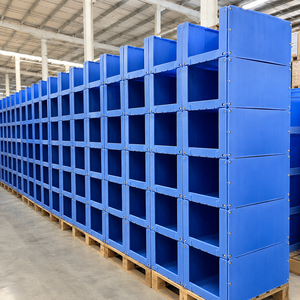
PP Corrugated Plastic Stackable Picking Bins Front Opening Warehouse Shelf Storage for Industrial Parts
Ultra-durable polypropylene corrugated bins with front hopper openings for seamless picking of small hardware, fittings, and accessories.
Comprehensive portfolio manufactured to ISO 9001 and CE-certified structural standards, engineered for extreme load parameters and rapid fulfillment cycles.
Ultra-durable polypropylene corrugated bins with front hopper openings for seamless picking of small hardware, fittings, and accessories.
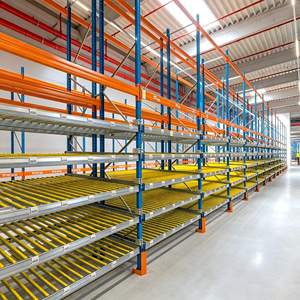
Continuous dynamic FIFO roller tracks maximize picking lanes, compress handling distances, and enhance inventory throughput in e-commerce fulfillment.
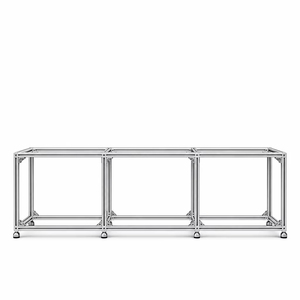
Industrial aluminum structure fitted with reinforced marine-grade decking and swivel castors for agile workshop mobility and dynamic storage.
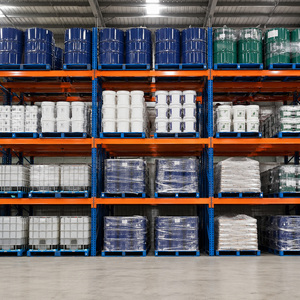
Engineered from premium Q235B cold-rolled steel, calibrated for heavy automotive components and high-turnover cross-dock operations.
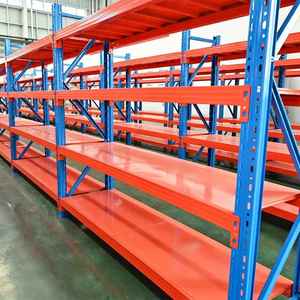
Robust interlocking beam architecture with electrostatically coated steel panels, providing dual utility for bulk pallets and split-case picking.
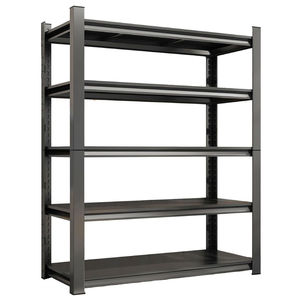
Configurable pitch pitch adjustments allow seamless reconfiguration of bay levels to match volatile SKU dimensions and seasonal inventory shifts.
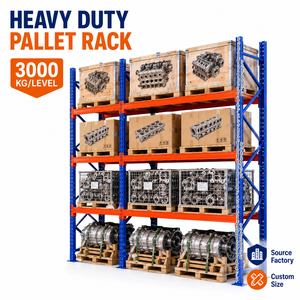
Ultra-high load capacity engineering rated up to 3,000 kg per beam level, featuring certified anti-deflection structural brace reinforcement.
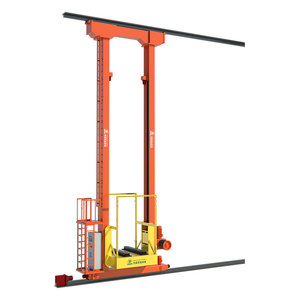
Fully integrated ASRS high-bay racking built for precise stacker crane tolerances, advanced WMS interoperability, and dark warehouse automation.
A rigorous review of structural calculations, load dynamics, deflection tolerances, and safety mechanisms required by enterprise distribution centers.
Cantilever towers undergo intense eccentric bending moments. Chinese premier factories fabricate uprights from both hot-rolled H-beams (HEA/HEB profiles) and heavy roll-formed profiles using certified structural steel (Q235B & Q355B). Heavy-gauge base plates are precision-welded with internal gussets to secure anchoring into C25/C30 industrial concrete slabs via mechanical or chemical anchors, mitigating overturning risks under uneven dynamic loads.
Cantilever arms must adapt as profile sizes change. Premium manufacturers use multi-hole pitch columns (typically 100mm, 125mm, or 140mm spacing). Arms attach through heavy-duty clevis pins, specialized wedge clamps, or multi-bolt grade 8.8/10.9 shear joints. Integrated incline angles (1° to 2°) counteract natural load sag, guaranteeing stored pipes, steel tubes, or extrusions do not roll forward off the rack face during seismic or forklift vibration.
Unlike traditional pallet racking, cantilever structures possess no frontal upright connectors. Longitudinal structural integrity relies entirely on rigid horizontal spacing bars and high-tensile steel diagonal X-bracing networks. Tensioned via adjustable turnbuckles, this system distributes lateral acceleration loads across adjacent bays, fulfilling EN 15512, RMI, and AS 4084 building compliance across earthquake-prone regions.
| Structural Parameter | Roll-Formed Light/Medium Cantilever | Hot-Rolled Structural Heavy-Duty Cantilever |
|---|---|---|
| Primary Steel Grade | Q235B Cold-Formed Steel Coil (High Tensile) | Q355B Hot-Rolled I-Beam / HEA / HEB Profiles |
| Arm Capacity Range | 250 kg – 1,000 kg per arm (Uniformly Distributed) | 1,000 kg – 3,500+ kg per arm (Point & Uniform Load) |
| Typical Column Height | 2,000 mm to 6,500 mm | 3,500 mm to 12,000+ mm (VNA/ASRS Compatible) |
| Application Sector | Light PVC pipes, aluminum trims, molding, light furniture | Heavy steel bars, timber packs, structural tubing, sheet coils |
| Impact Resistance | Moderate; requires base column post-protectors | Extremely high structural resilience to side-loader fork impacts |
How global supply chain leaders are re-evaluating B2B warehouse infrastructure procurement from Chinese tier-1 manufacturing hubs.
Global procurement teams are bypassing domestic trading middlemen to partner directly with Chinese manufacturers. Modern Chinese tier-1 factories offer integrated 3D CAD layout engineering, finite element analysis (FEA), and direct containerized logistics. Direct-to-factory communication shortens engineering feedback loops from months to hours, mitigating dimensional friction before steel coil unrolling commences.
With volatile maritime container freight rates, procurement success is dictated by packing density engineering. Modern Chinese export factories pre-bundle cantilever columns, modular arms, and bracing frames into custom nesting steel brackets with standardized wooden dunnage. This optimizes container filling rates up to 94% within 40HQ maritime containers, slashing per-ton landed freight tariffs.
Procurement directors are specifying long-life environmental surface treatments over cheap basic enamels. Advanced continuous multi-stage pre-treatment (acid pickling, zinc-phosphating, zero-VOC electrostatic powder curing) combined with hot-dip galvanization options (ASTM A123) guarantees 25+ years of service life without rust degradation, even in harsh Middle Eastern desert dust or coastal high-salinity ports.
From static warehouse steel to smart, cyber-physical automated logistics nodes.
The traditional bottleneck of long-goods handling—slow manual sideloader travel—is being eliminated. Next-generation systems feature specialized automatic stacker cranes and telescopic fork extractors capable of retrieving 6-meter bundles of aluminum or steel directly from cantilever bays up to 24 meters high, fully integrated with enterprise WMS platforms.
Overloading and undetected forklift impact shocks present critical structural failure hazards. Future cantilever installations incorporate strain-gauge sensors and IoT vibration monitors embedded inside high-stress arm connections and base joints, broadcasting real-time structural health, deflection data, and fatigue warnings directly to warehouse safety controllers.
As cold-chain logistics expand to long frozen bakery profiles, pharmaceuticals, and specialized synthetic chemicals, cantilever steel must withstand thermal contraction cycles. Sub-zero metallurgical formulations prevent low-temperature steel embrittlement down to -30°C, while hydrophobic powder coatings inhibit ice bond buildup along adjustable arm pins.
Supplying world-class warehouse infrastructure since 2001 with relentless focus on structural integrity and global project delivery.
Operating continuously since 2001, executing over 10,000+ complex warehouse layouts across manufacturing, logistics, cold storage, and energy sectors.
Equipped with automated continuous roll-forming lines, laser profile cutting, robotic welding bays, and fully automated electrostatic coating tunnels.
Massive raw steel procurement scale and agile production lines secure competitive project pricing and dependable shipping lead times for mega-distribution hubs.
Complete quality validation through CE Certification (No. 2435-CPR-8605159), ISO 9001:2015 Quality Management, and strict RoHS non-toxic compliance.
Direct answers for logistics directors, structural engineering consultants, and commercial procurement managers.
Arm length must match or slightly exceed product depth to avoid unsupported overhang. The rated arm capacity assumes a Uniformly Distributed Load (UDL). If your products generate concentrated point loads or center-loaded pallets, the effective capacity drops by 30% to 50%, necessitating custom reinforced arm profiles and heavy web stiffeners.
Roll-formed cantilever uses cold-coiled steel (sheet thickness 2.5mm–4.0mm) shaped via rollers; it offers an economical choice for light-to-medium loads (up to 800kg/arm). Hot-rolled cantilever uses solid structural steel I-beams (HEA/HEB), engineered for harsh industrial environments, outdoors, and extreme loads up to 3,500kg per arm.
Yes. Outdoor installations require Hot-Dip Galvanization (HDG) per ASTM A123 / ISO 1461, achieving a minimum 85-micron zinc coating. In addition, our structural engineers integrate wind-load uplift calculations, seismic bracing, roof-canopy frames, and water-drainage arm pitches into the preliminary CAD designs.
To produce an authoritative structural layout, share your facility's architectural CAD floor plan (detailing clear ceiling heights, column grids, fire sprinkler drops, and floor expansion joints), exact SKU package dimensions (L x W x H, min/max weights), and your forklift model specifications (lift height, turning radius, aisle clearance requirements).
Every shipment is packaged per international export standards: upright towers and base feet are nested within custom heavy-gauge steel shipping racks; painted surfaces are shielded with multi-layer PE foam and moisture-proof plastic film; all hardware, clevis pins, and fasteners are crated in labelled steel-banded wooden boxes matching installation CAD blueprints.
Yes. Guangzhou HEDA Shelves provides comprehensive structural calculation documentation, steel mill material certificates, seismic performance verifications, and signed technical submittals, enabling your local engineering consultants to secure municipality fire, civil defense, and insurer approvals smoothly.
Speak directly with our senior structural racking engineers. Submit your site dimensions and inventory parameters to receive an end-to-end 2D floor plan, 3D photorealistic rendering, and factory-direct quotation within 24 hours.