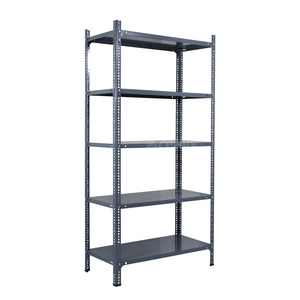
 Rapid Assembly
Light Duty Slotted Angle Metal Storage Shelving
Economical modular shelving system engineered with cold-punched perforated angle uprights for versatile manual picking, hardware stock, and archive storage.
Precision-manufactured utilizing high-yield cold-rolled steel coils, multi-stage corrosion protection, and strict deflection compliance under FEM 10.2.02 and EN 15512 international storage codes.
Rapid Assembly
Economical modular shelving system engineered with cold-punched perforated angle uprights for versatile manual picking, hardware stock, and archive storage.
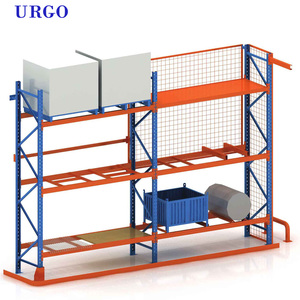 High Bay VNA
Engineered for clearance heights up to 16+ meters with minimized aisle widths (1.6m-1.8m). Accommodates guide rails and inductive wire-guided turret trucks for maximum cube utilization.
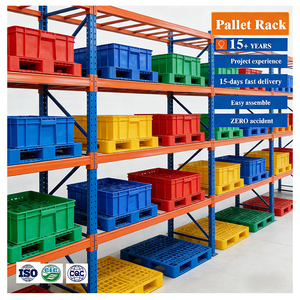 3000KG Extreme
Reinforced box-beam pallet storage architecture engineered with triple load-support crossbars per tier. Built specifically for dense palletized payloads, machinery components, and bulk raw materials.
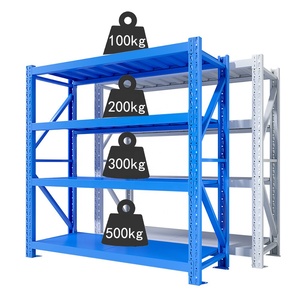 Longspan
Heavy-gauge step-beam construction equipped with steel decking plates. Ideal for manual distribution centers, automotive parts operations, and tiered mezzanine floors.
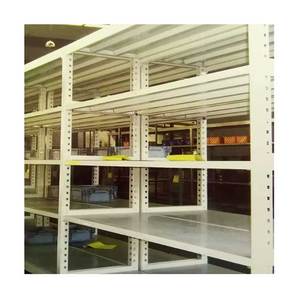 Specialized
Customized cradle beams and axle adapters designed specifically to store non-standard cylindrical geometries, including textile rolls, paper coils, and cable spools without point-load deformation.
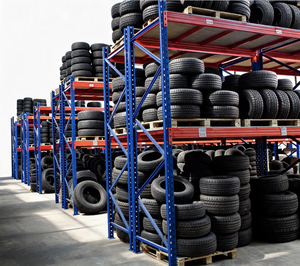 Anti-Corrosive
Manufactured with high-tensile cold-rolled steel profiles subjected to chemical pickling and electrostatic thermosetting epoxy coating. Superior endurance across high-humidity coastal and chemical logistics.
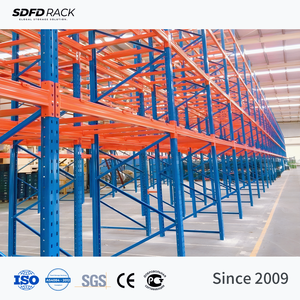 Selective Pro
The gold standard for standard forklift operations. Certified load capabilities of 800kg to 2,000kg per pallet level with interlocking locking pins that eliminate accidental beam dislodgement.
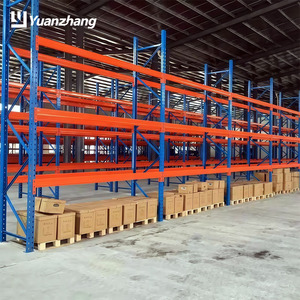 Multi-Tier Flex
High-rigidity cold-formed upright profiles combined with precision-punched structural braces. Engineered to transition seamlessly between pallet racking and shelf-supported multi-tier platforms.
A comprehensive technical analysis of structural tolerances, seismic compliance, and horizontal floor-level flatness criteria required for modern high-bay storage hubs.
As global supply chains navigate surging urban industrial real estate costs and heightened throughput expectations, the traditional low-rise logistics footprint is rapidly transitioning to verticalized High Bay Racking infrastructures. Modern high bay structures extend from 12 meters to upwards of 40 meters in rack-supported building configurations. At these vertical elevations, structural design is governed by nonlinear second-order P-Delta effects, structural sway deflection limits, strict dynamic forklift mast interactions, and seismic base shear dissipation rather than simple static loading.
In high bay installations exceeding 12 meters, component design ceases to be purely elastic. Systems designed by top Chinese exporters adhere strictly to European EN 15512:2020, American RMI (ANSI MH16.1), and FEM 10.2.02 guidelines. Structural calculation models execute non-linear elastoplastic global analysis, accounting for rotational spring stiffness ($C_d$) within beam-to-column beam end connectors, upright frame shear deformation, and foundation flexibility at anchor floor interface plates.
Under serviceability limit states (SLS), horizontal sway must be tightly controlled: beam deflection criteria typically mandate a threshold not exceeding $L/200$ (or $L/300$ for automated automated storage and retrieval system [AS/RS] interfaces), while frame verticality tolerances require deviation below $H/500$ across total upright height. Minimizing cumulative horizontal drift is vital; an unmitigated 0.5-degree plumb deflection at an elevation of 24 meters translates into an axle lateral displacement exceeding 200 mm, introducing severe collision threats between automated shuttle masts or VNA turret forks and stored pallet profiles.
High bay operations using Very Narrow Aisle (VNA) material handling equipment or shuttle cranes require specialized floor tolerances. Because standard industrial slabs contain micro-undulations, a forklift operating at a 15-meter lift elevation magnifies floor irregularities linearly. Consequently, facilities deploying VNA racking must construct superflat slabs conforming to DIN 18202 Table 3 Group 4 or VDMA 4398 Guideline Level Fmin 100.
To distribute severe concentrated point loads from high-density upright columns—which frequently exert bearing pressures exceeding 150 kN to 250 kN per baseplate—Chinese high-bay structural engineers implement widened heavy-duty baseplates forged from Q355B low-alloy steel. Baseplates incorporate high-tensile wedge anchors (Class 8.8 or 10.9) and high-strength non-shrink cementitious grouting beds (minimum compressive strength 60 MPa) to guarantee rigid load transfer into the substructure slab.
| Storage Architecture | Max Operational Height | Aisle Width (Clearance) | Floor Flatness Class | Volumetric Cube Utilization | Forklift / Carrier Kinematics |
|---|---|---|---|---|---|
| Standard Selective Racking | 10 - 12 Meters | 3.0 - 3.8 Meters | Standard Flat (DIN 18202 Gr. 3) | 35% - 40% | Counterbalance / Reach Trucks |
| Very Narrow Aisle (VNA) | 14 - 18 Meters | 1.5 - 1.8 Meters | Superflat (VDMA 4398 / Fmin 100) | 60% - 70% | Man-Up / Man-Down Turret Trucks |
| Radio Shuttle High-Density | 12 - 20 Meters | 3.0m (Access Face Only) | Industrial Level (DIN 18202 Gr. 3) | 75% - 85% | Reach Truck + Semi-Auto Shuttles |
| AS/RS Clad-Rack High Bay | 24 - 40+ Meters | 1.3 - 1.6 Meters | Ultra-Flat Concrete Runways | 85% - 92% | Automated Stacker Cranes (SRM) |
Fabricated using Q235B and high-yield Q355B (equivalent to EN 10025 S355JR) structural steel. Continuous automated roll-forming cold-works the steel profiles, enhancing yield strength and torsional moment capacity without deadweight penalty.
Engineered to satisfy NFPA 13 sprinkler penetration standards. Structural bays incorporate continuous longitudinal and transverse flue spaces (minimum 75mm to 150mm) to allow high-density early-suppression fast-response (ESFR) in-rack sprinkler coverage.
Multi-claw locking connectors welded using robotic CO2 gas-shielded processes. Incorporates heavy-gauge spring safety pins with shear ratings exceeding 10 kN to eliminate beam release during high-speed vertical pallet insertions.
How Tier-1 industrial buyers, EPC contractors, and logistics REITs are mitigating supply chain volatility and future-proofing warehouse storage assets.
The global industrial racking procurement landscape is undergoing significant transformation. Procurement directors are shifting from evaluating simple "cost per metric ton of steel" toward calculating the Total Cost of Ownership (TCO) across an asset lifecycle of 20 to 25 years. This shift is driven by four primary procurement vectors:
Procurement teams are decreasing their investments in standard static drive-in systems in favor of semi-automated Radio Shuttle and 4D Shuttle Racking Systems. Radio shuttle designs eliminate the requirement for forklifts to drive inside storage lanes, directly lowering structural upright impact damage by over 80%. When procuring systems today, logistics operators specify beam profiles that include integrated guide-track flanges and optical reflector mounting locations. This ensures a facility can transition from manual reach-truck loading to fully autonomous mobile robot (AMR) shuttle handling without replacing structural steelwork.
Logistics mega-hubs in the Middle East (such as Saudi Arabia's Vision 2030 industrial clusters in Riyadh, Jeddah, and King Salman Energy Park, alongside Dubai's Jebel Ali Free Zone) demand surface finishes capable of surviving extreme atmospheric stress. These installations endure ambient summer temperatures surpassing 48°C, abrasive silica dust infiltration, and coastal air salinity. Procurement contracts increasingly mandate an upgrade from standard direct-to-metal paint systems to automated 10-stage pre-treatment chemical pickling and silane-phosphating, capped with thermosetting polyester-epoxy powder coatings with minimum thicknesses of 60 to 80 microns. In cold chain facilities down to -30°C, cold-drawn micro-alloyed steels with verified Charpy V-notch impact toughness values at sub-zero temperatures are becoming standard contractual prerequisites.
Large-scale EPC engineering contracts now regularly demand Building Information Modeling (BIM) files delivered at Level of Development (LOD) 400. Structural components are supplied with complete geometric and behavioral metadata, allowing direct clash detection with HVAC, mechanical ducts, conveyor runs, and high-expansion foam fire suppression lines. Furthermore, future-oriented procurement programs are piloting fiber-optic structural health monitoring (SHM) embedded within critical bottom uprights to log real-time deformation and accidental forklift impacts directly to warehouse management dashboards.
For buildings taller than 30 meters, the procurement paradigm is shifting toward Rack-Supported Buildings (Clad-Rack Architecture). In a clad-rack project, the storage racking itself forms the primary load-bearing structural frame of the entire building, supporting roof trusses and exterior insulated sandwich wall cladding directly. This procurement method eliminates the redundant capital cost of independent structural steel building columns, compresses construction schedules by 4 to 6 months, and lowers overall civil expenditures by up to 25%.
Delivering end-to-end structural engineering, automated roll forming, robotic welding, and direct global container dispatch since 2001.
Certified prime cold-rolled steel coils with mill test certificates (Q235B/Q355B).
CNC slitting lines ensure coil width tolerances within ±0.1mm for roll tooling.
Automated multi-point hydraulic punching tracks 50mm/75mm upright pitch centers.
Multi-stand continuous cold roll-forming lines generate precise omega profile sections.
Roll-forming of interlocking box beams, step beams, and heavy tie channels.
Shot-blasting and mechanical surface finishing eliminate spatter, scale, and burrs.
Automatic CO2 gas-shielded robotic arms fuse beam end connectors and heavy baseplates.
Multi-stage chemical pre-treatment baths strip oil and apply anti-corrosive phosphate.
Electrostatic spray guns apply uniform thermoset powder with 200°C curing ovens.
Ultrasonic weld tests, dimensional audits, and steel-banded bundle palletization.


Comprehensive answers addressing structural certification, civil defense approvals, sea container loading, and site assembly economics.
Connect with our Guangzhou engineering headquarters today. Receive custom 2D CAD layouts, structural calculations, and a comprehensive project budget estimation within 24 to 48 hours.