Featured Industrial Pallet Racking & Multi-Tier Platforms
Direct from our 30,000 m² Guangzhou production complex. Engineered in compliance with FEM 10.2.02, EN 15512, AS4084-2012, and RMI standards to withstand intense operational throughput and complex environmental criteria.
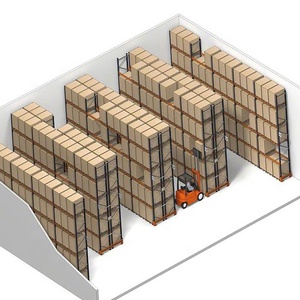
Heavy Duty Pallet Beam Racking Industrial Warehouse Storage Shelf Rack
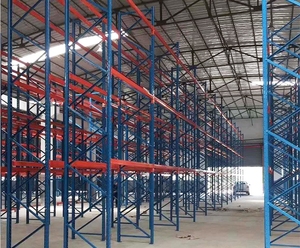
Automated Stacker Crane Storage Retrieval Racking System AS/RS
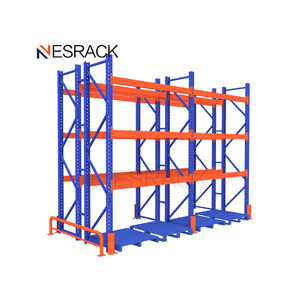
Heavy Duty Steel Warehouse 4-Layer Pallet Storage Racking System
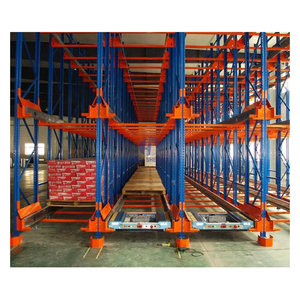
Customized Heavy Duty Automatic Storage Shuttle Pallet Rack System
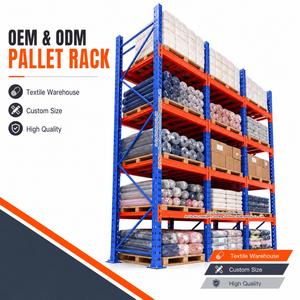
4-Level Heavy Duty Industrial Warehouse Pallet Shelving System
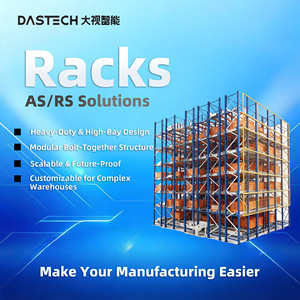
Intelligent Warehouse Multiple Pallet Steel Production-Linked Rack
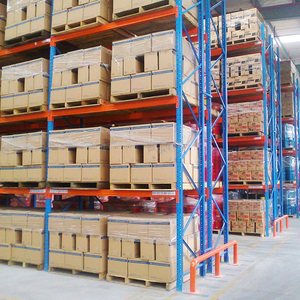
Combined Load-Row Connected Industrial Pallet Racking System 2000kg
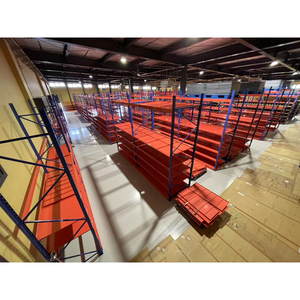
Selective Pallet Rack High-Density Warehouse Storage Solutions
Architecting Vertical Volume: The China Sourcing Advantage
Industrial supply chain economics have shifted permanently. Sourcing pallet racking and structural mezzanine platforms from top Chinese manufacturers provides unprecedented vertical cubic space utilization, combining advanced steel chemistry, automated continuous cold-roll forming lines, and rigorous finite element analysis (FEA).
Structural Steel vs. Roll-Formed Platforms
Understanding when to employ hot-rolled heavy H-beam/I-beam structural mezzanine platforms versus cold-formed rack-supported mezzanine systems dictates your total capital efficiency. Structural steel platforms accommodate wide column spans (up to 8–10 meters) suitable for heavy sorting machines and dynamic forklift traffic (UDL: 500–1,500 kg/m²). In contrast, rack-supported multi-tier mezzanines utilize high-tensile cold-formed uprights (e.g., Q355B steel) to integrate high-density inventory racking directly into the walkway supports, dropping total steel consumption per square meter by 32–45%.
Supply Chain Economics & Freight Optimization
The fundamental differentiator in international pallet racking export lies in nestable bundle engineering and volumetric container stuffing. Cold-rolled omega (Ω) upright profiles and stepped box beams manufactured in Guangzhou are bundled using precision-engineered CNC automated strapping, timber Dunnage dampening, and waterproof multi-layer wrapping. By optimizing bundling pitch to mirror the interior dimensions of standard 40-foot High Cube (40HQ) maritime containers, Chinese exporters achieve up to 26–28 metric tons per container, directly decreasing ocean shipping freight per pallet position by 28%.
Seismic Engineering & Global Standards Compliance
Exported racks must strictly comply with regional seismic coefficients ($S_s, S_1$) dictated by Eurocode 3, AS4084-2012, or US RMI MH16.1. Top China exporters integrate ANSYS and STAAD.Pro finite element modeling to analyze frame sway, second-order $P$-$\Delta$ effects, and beam-to-column connector semi-rigidity. Custom-designed oversized baseplates with chemical anchor dowels (e.g., M12–M16 anchor bolts) disperse intense cyclic ground accelerations safely into the warehouse concrete slab without risking local slab punching shear or brittle upright bucking.
Structural mezzanine joists and primary beams must satisfy stringent vertical deflection criteria under full Design Load: for heavy industrial platforms with AGVs or pallet jacks, maximum deflection $\delta \le L/360$; for light manual picking walkways, $\delta \le L/250$; and for automated shuttle guide beams, $\delta \le L/500$. Beam profile wall thicknesses must never be compromised below certified tolerance limits ($t \pm 0.05\text{ mm}$).
| System Architecture | Primary Steel Profile | Typical Load Limits | Span Capability | Primary Applications | Fire / Sprinkler Integration |
|---|---|---|---|---|---|
| Selective Pallet Beam Rack | Cold-rolled Omega Upright (Q235B/Q355B) + Box Beam | 1,000 – 4,500 kg per beam level | Standard 2,300 – 3,900 mm | FMCG, 3PL logistics, general bonded warehousing | 6-inch transverse & longitudinal flue spaces |
| Rack-Supported Mezzanine | Roll-formed Upright columns + Secondary C/Z Purlins | Floor UDL: 300 – 800 kg/m² | Grid column span: 2,000 – 3,500 mm | E-commerce manual picking, garment sorting, parts distribution | Integrated in-rack drop sprinklers per level |
| Structural Steel Mezzanine | Hot-Rolled H-Beam columns, Primary I-Beams | Floor UDL: 500 – 1,500 kg/m² | Wide clear bay: 4,000 – 9,000 mm | Automated conveyor sorters, heavy machinery, office decks | Perforated steel grating (>50% water penetration) |
| Radio Shuttle Racking | Specialized cold-formed shuttle guide rails + heavy uprights | 1,500 kg/pallet lane, unlimited depth | Continuous rail lanes up to 60m | Cold storage, beverage manufacturing, buffer distribution | Flue breaks integrated every 25 pallet positions |
| Automated Crane AS/RS | Ultra-tight tolerance cold-rolled structural steel towers | Up to 3,000 kg/pallet, height to 30m | Clad-rack or freestanding building bays | High-throughput automotive, electronics, pharmaceutical | Integrated vertical ESFR deluge fire suppression |
Future Procurement Trends in Industrial Storage Systems (2025–2030)
Procurement leaders are navigating radical transformations in global logistics architecture. Here are the core technical and economic purchasing trends shaping warehouse infrastructure procurement over the next five years.
1. Convergence of Pallet Racking with AMRs & Robotic Automation
Procurement teams are no longer sourcing static steel storage frames in isolation. The modern warehouse specification requires pallet racking and mezzanine platforms to natively interface with Autonomous Mobile Robots (AMRs), Automated Guided Vehicles (AGVs), and vertical reciprocating conveyors (VRCs). This demands precision tolerances under millimeter scales ($\pm 1.5\text{ mm}$ beam deflection), specialized floor deck leveling plates, and magnetic guidance strip integration beneath decking boards.
2. Modular Demountability & Circular Asset Reusability
Shortening commercial lease lengths and rapidly changing SKU profiles have rendered welded, permanent mezzanine structures commercially obsolete. Global enterprise buyers prioritize 100% bolted, demountable mezzanine and racking structures. Standardized 50mm and 75mm pitch perforations allow beams, columns, and staircase modules to be disassembled, palletized, and reinstalled in alternate facilities with near-zero steel scrap value loss, slashing capital amortization cycles.
3. Environmental Product Declarations (EPD) & Low-Carbon Steel
Multinational logistics brands in Europe and North America now demand verifiable Environmental Product Declarations (EPDs) from Chinese exporters. Forward-thinking manufacturers are transitioning from high-emission coal blast furnaces to scrap-fed Electric Arc Furnace (EAF) primary steel coils, while adopting solvent-free thermosetting electrostatic powder coatings. This reduces the embodied carbon footprint per stored metric ton by 25–40%, ensuring compliance with international green building standards such as LEED and BREEAM.
4. Total Cost of Ownership (TCO) Sourcing Metrics
Procurement decisions have evolved beyond pure FOB initial price per kilogram. Total Cost of Ownership (TCO) models evaluate upfront fabrication precision against long-term operational resilience: upright impact resistance, cost of beam replacement clips, floor coating abrasion resistance against constant pallet friction, and ease of anchor bolt torque recertification. Chinese manufacturers providing certified structural documentation and pre-labeled sub-assemblies consistently reduce total installation labor hours by 30%.
Technological Breakthroughs in Modern Mezzanine & Racking Production
The transformation from conventional manual metalworking to fully automated cyber-physical roll-forming systems ensures unprecedented structural consistency and metallurgical integrity.
Cold-Formed High-Tensile Micro-Alloy Steels
The traditional reliance on thick, heavy Q235B hot-rolled angles has been superseded by specialized cold-rolled Q355B (yield strength $\ge 355\text{ MPa}$) and high-strength micro-alloyed steel coils. Advanced cold roll-forming machines utilize 18 to 24 progressive roller passes to create complex multi-bend stiffeners along the upright flange edges. This geometric stiffening counters torsional-flexural buckling while eliminating up to 15% of dead weight without sacrificing axial load-bearing capacity.
Electrostatic Nanotechnology Surface Treatment
Corrosion failure remains the leading cause of structural decommissioning in coastal regions and non-climate-controlled storage. Leading Chinese manufacturers operate closed-loop automated finishing lines featuring a 10-stage chemical bath: alkaline degreasing, twin water rinses, acid pickling rust stripping, nano-ceramic zirconium phosphate conversion coating, and passivation. This is followed by automated electrostatic spray booths applying 60–90 microns of thermosetting epoxy-polyester powder baked at 200°C, passing 500+ hours of continuous ASTM B117 salt spray testing.
Engineered Fire Protection & Flue Mechanics
Modern high-bay warehouse approvals under NFPA 13, FM Global, or local Civil Defense fire codes require strictly maintained flue space geometries. Chinese engineering blueprints now mandate welded back-to-back row spacers and pallet backstops that preserve a minimum 152mm (6-inch) clear longitudinal flue space and transverse flue channels between adjacent pallet loads. This prevents smoke channeling and guarantees immediate thermal activation of Ceiling Early Suppression Fast Response (ESFR) sprinkler heads.
Why Global Buyers Partner with Guangzhou HEDA Shelves Co., Ltd.
Founded in 2001, Guangzhou Heda Shelves Co., Ltd. has grown from a specialized metal fabrication workshop into one of China's premier heavy-duty pallet racking and warehouse mezzanine manufacturers, delivering turnkey storage solutions to over 120 countries worldwide.
Integrated Engineering, Fabrication, and Direct Export
With more than two decades of dedicated industrial manufacturing experience and a technical team of 300+ structural engineers, precision machinists, and international logistics coordinators, HEDA Shelves controls the entire value chain in-house. We do not outsource production; our Guangzhou factory houses automated precision steel slitting lines, CNC continuous column punch presses, robotic welding cells, and high-capacity automated electrostatic coating lines.
Whether designing a heavy structural steel mezzanine floor for a manufacturing plant in Saudi Arabia, high-bay automated racking for a 3PL logistics hub in Dubai's Jebel Ali, or cold-storage drive-in racks for a seafood processor in Southeast Asia, our team delivers custom 2D layout blueprints and 3D realistic BIM renderings within 24 to 48 hours.
- CE Certified Factory: Certificate No. 2435-CPR-8605159
- ISO 9001:2015 Quality Management: Certificate No. 18624Q00169R0M
- Environmental & Safety Compliance: Full RoHS certified surface coatings
- Comprehensive Global Port Delivery: Regular container direct sailings to Jebel Ali, Dammam, Jeddah, Hamad, Sohar, Shuwaikh, Singapore, Rotterdam, Los Angeles, and beyond.
Full Lifecycle Engineering Quality Gates
Every production batch undergoes strict quality control inspections prior to container stuffing:
The HEDA Shelves 10-Step Precision Fabrication Chain
Traceable quality control under one roof from virgin steel coils to sealed export shipping containers.
Frequently Asked Questions by Industrial Warehouse Buyers
Detailed technical answers addressing structural calculation, local regulatory approvals, container packing, and floor loading criteria for global project teams.
What engineering data is required to generate a certified 2D CAD layout and structural load calculation?
How do rack-supported mezzanines compare to structural steel mezzanines in capital expenditure (CapEx)?
What floor decking options are available for mezzanine floors, and how do they impact fire sprinkler codes?
Can your engineering blueprints support local municipality, Civil Defense, and building permit approvals?
How are components packaged for international sea freight to prevent shipping damage and rust?
What is the recommended maintenance schedule and deflection limit for warehouse racking?
What steel grades and mill certifications do you provide with shipments?
How do you provide installation support for overseas projects in the Middle East, Europe, or the Americas?
Request Your Free Warehouse 3D Layout & Engineering Quotation
Transform your unused vertical warehouse height into productive, revenue-generating inventory capacity. Share your building CAD file or sketch, and our structural engineering team in Guangzhou will deliver a comprehensive 2D layout, 3D visualization, and structural quote within 24 to 48 hours.
- Free 2D CAD & 3D Rendering within 48 Hours
- Direct Factory Pricing from 30,000 m² Facility
- CE & ISO 9001 Certified Structural Integrity