2000kg Heavy Duty
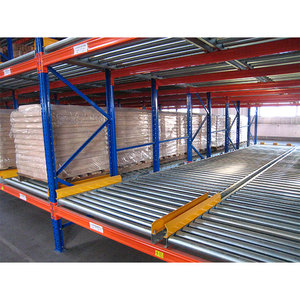
Q235 Steel 2000kg Capacity FIFO High Density Industrial Warehouse Storage Gravity Pallet Flow Rack System
FIFO Rotation
2000kg / Bay
Speed Controllers
Discover our high-density gravity feed pallet configurations, custom manufactured with premium Q235B high-tensile steel, centrifugal brake rollers, and dynamic separators for fail-safe FIFO warehouse logistics.
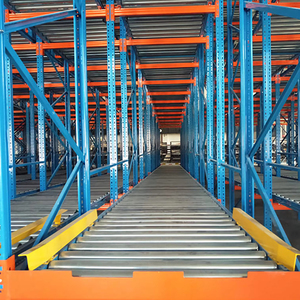
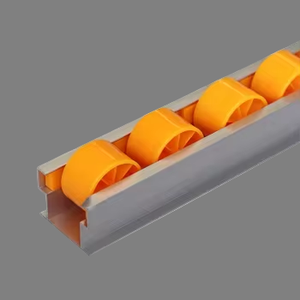
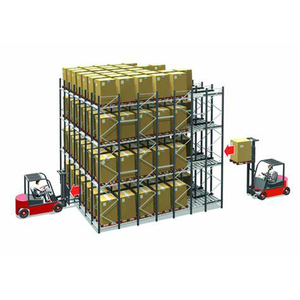
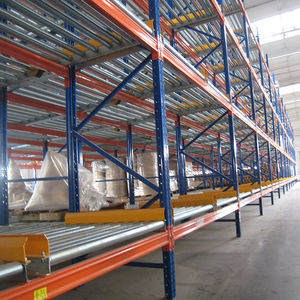
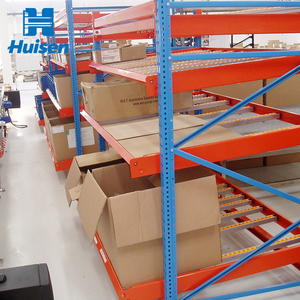
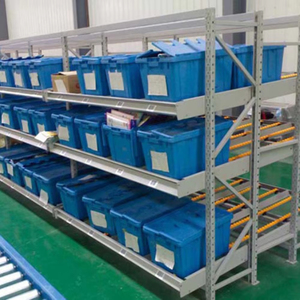
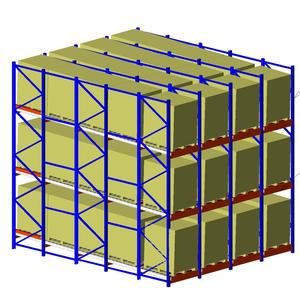
Gravity Feed Pallet Racking, universally recognized across modern material handling as Pallet Flow Racking or Live Dynamic Storage, operates on an unpowered, kinetic slope framework designed to maximize volumetric efficiency. Operating on slopes precisely engineered between 2.5% to 4% (approx. 1.5° to 2.3°), standard pallet loads glide along graduated roller beds using gravity. Unlike static selective racking that demands up to 60% of floor space dedicated strictly to vehicular access aisles, gravity flow installations cut aisle requirements down to just two: one rear loading face and one front retrieval face.
At Guangzhou Heda Shelves Co., Ltd., our engineering protocol incorporates heavy-duty centrifugal brake rollers that dynamically engage proportional resistance as rotation speed accelerates. Additionally, high-torque pallet separation devices isolate the lead pallet at the picking face from upstream line pressure. This mechanism disengages backpressure entirely, ensuring that when a forklift driver lifts the discharge pallet, zero horizontal pressure transmits to the mast or safety cage.
| Storage Architecture | Floor Space Utilization | Inventory Logic | Forklift Operating Travel | Risk of Rack Impact |
|---|---|---|---|---|
| Gravity Pallet Flow | Up to 85% Active Volume | Strict FIFO (First-In, First-Out) | Low (Confined to Perimeters) | Minimal (No Bay Entry) |
| Standard Selective | 35% - 40% Floor Footprint | Mixed / Random Access | Extremely High Across Every Aisle | High (Frequent Upright Contact) |
| Drive-In Racking | 65% - 75% Volume | LIFO (Last-In, First-Out) | Moderate (Deep In-Bay Driving) | Very High (Internal Structural Collisions) |
| Push-Back Systems | 60% - 70% Volume | Strict LIFO (Up to 5 deep) | Moderate (Front-Aisle Concentrated) | Moderate |
Industrial logistics procurement is undergoing a generational shift. With warehousing real estate costs climbing at an annual compound rate of 8.4% globally, enterprise facilities can no longer afford wide, underutilized transit lanes. Furthermore, stringent traceability directives across pharmaceuticals (such as FDA 21 CFR Part 11 and EU GMP Annex 1) and cold-chain perishables have transformed FIFO (First-In, First-Out) compliance from a operational recommendation into a non-negotiable regulatory mandate.
Procurement directors in Europe, North America, and the GCC region increasingly specify factory-prefabricated modular roller assemblies rather than field-welded frameworks. Pre-drilled cold-rolled uprights with a 50mm or 75mm pitch offer instant adaptability for shifting pallet geometries, changing packaging types (from CHEP wooden blocks to hygiene-grade HDPE plastic skids), and rapid facility reconfiguration.
Explore how advanced metallurgy, kinetic telemetry, and automated guided vehicles (AGVs) are revolutionizing unpowered dynamic storage systems.
Emerging sensor arrays capture micro-rotational kinetic energy directly from gravity roller spindles to transmit real-time lane occupancy, ambient temperatures, and pallet dwell times directly to warehouse management systems (WMS) without onboard battery replacements.
Next-generation pallet flow picking faces feature magnetic optical alignment brackets and dynamic mechanical locks that stabilize pallets precisely for robotic end-effectors, autonomous counterbalanced trucks, and AMR replenishment systems without manual touchpoints.
Advancements in polymer and polyurethane-coated carbon steel rollers eliminate surface wear and reduce operational decibels by 18dB. These composite surfaces resist crystallization and brittleness even in deep-freeze cold storage facilities down to -30°C.
Delivering heavy-duty structural warehouse equipment since 2001 with fully integrated in-house manufacturing, CE compliance, and global logistical execution.
Equipped with fully automated high-precision roll forming lines, robotic laser beam cutting stations, and heavy automated punching machinery in Guangzhou, China.
Every structural profile is strictly vetted against international safety standards, backed by CE Certification (No. 2435-CPR-8605159) and ISO 9001:2015 Quality Management audits.
Rigorous multi-stage pickling, phosphating, and electrostatic powder coating deliver durable corrosion protection against humidity, dust, and corrosive industrial atmospheres.
Our veteran design engineers deliver complete 2D layout plans, 3D parametric renderings, and seismic load calculations before commercial commitments.
As a recognized premier global exporter, HEDA Shelves supports international engineering compliance across European FEM 10.2.02 codes, American RMI guidelines, and local Civil Defense fire-suppression flue space standards. Our turnkey logistical export packaging incorporates custom steel-strapped bundles, water-tight wrapping, and clearly numbered component manifests corresponding with installation assembly blueprints for seamless port customs clearance and site erection.
Direct technical answers addressing system design, pallet specifications, brake mechanisms, and international freight requirements.
Consult with Guangzhou Heda Shelves engineering specialists. Obtain custom 2D/3D layout schematics, certified load calculation blueprints, and direct container export quotes tailored to your logistical facility.
Send an Inquiry