Featured Industrial Pallet Racking & Unit Load Solutions
Explore our factory-direct, heavy-duty structural steel handling units. Engineered for intense throughput, high-bay verticality, and aggressive operating environments across global warehousing terminals.
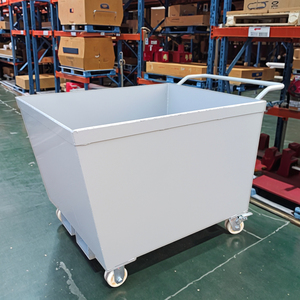
CASE CARTER OEM Foldable Stack Wire Mesh Steel Pallet Storage Container
Explore Engineering Specs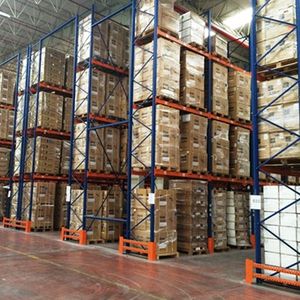
Industrial Steel Heavy Duty Corrosion Protection Stacking Pallet Rack System
Explore Engineering Specs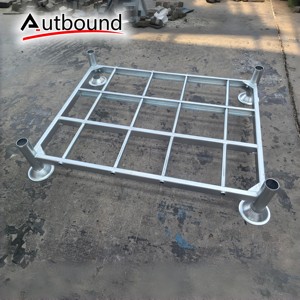
Heavy Duty Q235 Steel Post Pallet Storage Racks Hot-Dip Galvanized
Explore Engineering Specs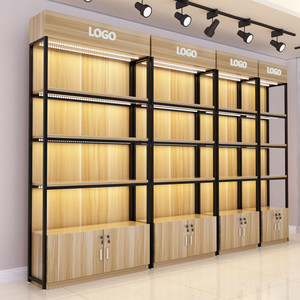
Customized Heavy Commercial Display Rack Single & Double Sided Modular
Explore Engineering Specs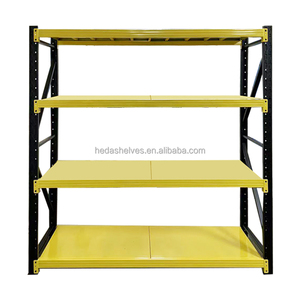
Adjustable Steel Long Span Industrial Warehouse Racks & Shelving
Explore Engineering Specs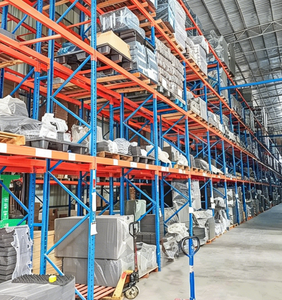
Heavy Duty 1,500kg Modular Stacking Racks for Bulky Material Logistics
Explore Engineering Specs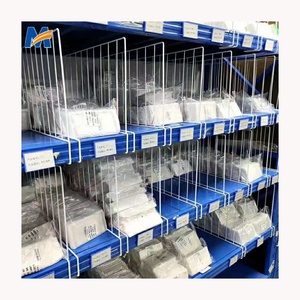
Custom Welded Wire Mesh Shelf Dividers & Flue Safety Partitions
Explore Engineering Specs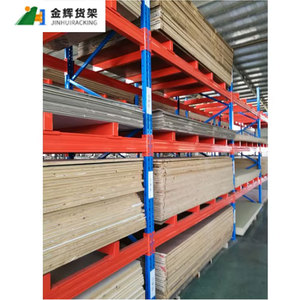
Heavy Duty Industrial Pallet Rack Storage System & Beam Modular Units
Explore Engineering SpecsWhy Enterprise Supply Chains Rely on HEDA Shelves
Founded in 2001, Guangzhou Heda Shelves Co., Ltd. has evolved into an international engineering benchmark for heavy-duty structural racking, automated material handling frameworks, and mezzanine infrastructure.
25+ Years Industrial Heritage
Two and a half decades of relentless roll-forming refinement, FEA load calculation development, and successful project deliveries across high-complexity warehousing architectures globally.
30,000 m² Mega Facility
Equipped with continuous automated roll-forming lines, computerized multi-punch column tooling, automated robotic welding cells, and eco-friendly electrostatic powder-coating tunnels.
30,000 Tons Monthly Output
Massive raw coil processing capacity ensuring prompt production schedules, stable material batch quality, and rapid export turnaround times for multi-thousand pallet location contracts.
120+ Countries & GCC Focus
Deep export compliance serving premier maritime gateways including Jebel Ali & Khalifa (UAE), Dammam & Jeddah (KSA), Hamad (Qatar), Sohar (Oman), and Shuwaikh (Kuwait).
CE Certified Execution
Conforms to EU Construction Products Regulation (No. 2435-CPR-8605159). Fully certified dynamic and static structural engineering for seismic, wind-load, and heavy dead-weight performance.
ISO 9001:2015 Management
Certified Quality Management System (Certificate No. 18624Q00169R0M, valid through 2027-06). Multi-stage QA/QC audits from raw structural coil inspection to final packaged container loading.
RoHS & Green Compliant
Non-toxic, heavy-metal-free thermoset polyester electrostatic powder coating. Guarantees safety for pharmaceutical facilities, agricultural packing, cold food storage, and cleanroom environments.
Engineering Principles of Modern Heavy Duty Pallet Racking
An analytical overview of structural steel mechanics, second-order $P$-$\Delta$ effects, cold-formed section optimization, and international compliance criteria (ANSI/RMI MH16.1, EN 15512, and AS 4084).
1. Metallurgical Selection: Q235B vs. Q355B Yield Dynamics
In industrial pallet racking design, structural reliability hinges on the ductility, yield point ($\sigma_y$), and ultimate tensile capacity of cold-rolled coil steel. High-density rack uprights and heavily loaded box beams rely on precision low-carbon micro-alloyed structural steel grades: Q235B (yield strength $\ge 235 \text{ MPa}$) and high-stress Q355B (yield strength $\ge 355 \text{ MPa}$). Selecting between these grades dictates not only the steel mass required per bay but also the profile's resilience against rotational torsional-flexural buckling under non-uniform pallet placements.
| Mechanical Characteristic | Q235B Structural Grade | Q355B High-Yield Grade | Engineering Implication in Racking |
|---|---|---|---|
| Yield Strength ($f_y$) | $\ge 235\text{ N/mm}^2$ | $\ge 355\text{ N/mm}^2$ | Higher yield allows slender upright profiles with higher capacity-to-weight ratios in high-bay ASRS. |
| Tensile Strength ($f_u$) | $370\text{--}500\text{ N/mm}^2$ | $470\text{--}630\text{ N/mm}^2$ | Guarantees extensive plastic deformation buffer before ultimate beam-end connector shearing. |
| Elongation ($\delta_5$) | $\ge 26\%$ | $\ge 21\%$ | Critical for energy dissipation during seismic ground acceleration and forklift guide impact forces. |
| Modulus of Elasticity ($E$) | $2.06 \times 10^5\text{ MPa}$ | $2.06 \times 10^5\text{ MPa}$ | Deflection limitations govern beam span sizing regardless of steel grade ($L/200$ standard vs. $L/300$ VNA). |
2. Beam Deflection Criteria & Moment Resistance Connectors
Horizontal load-bearing pairs are engineered as twin-C interlocking box beams or step beams continuously MIG-welded to multi-claw end connectors (typically 3, 4, or 5-claw configurations). Under uniformly distributed loads (UDL), the maximum allowable deflection is stringently bounded by the $L/200$ formula under FEM 10.2.02 and RMI specifications, where $L$ represents the clear entry span between adjacent frame uprights. For automated crane-access systems (ASRS) and Very Narrow Aisle (VNA) applications, deflection constraints tighten to $L/300$ or a strict absolute threshold of 10 mm to prevent laser transit sensor misalignment on automated guided vehicles (AGVs).
3. Surface Engineering for Harsh GCC and High-Humidity Climates
Standard liquid industrial paints fail rapidly in maritime trade zones such as Dubai, Jeddah, Dammam, and coastal logistics nodes where summer temperatures surpass 45°C alongside relative humidity exceeding 85%. Guangzhou Heda Shelves applies a rigorous industrial pre-treatment and finishing regimen:
Acid Pickling & Degreasing
Chemical dip removal of hot-roll mill scale and oil films, followed by industrial deionized water rinsing to establish pristine raw steel substrate energy.
Zinc Phosphating Layer
Creation of a continuous micro-crystalline zinc phosphate conversion coating, significantly inhibiting galvanic corrosion spread if the topcoat suffers mechanical impacts.
Thermoset Powder Coating
Electrostatic application of cross-linked polyester resin powder cured at 180°C–200°C to achieve a durable dry film thickness (DFT) of 80 to 120 microns.
Future Procurement Trends in Heavy-Duty Warehousing
How global supply chain volatility, omnichannel e-commerce fulfillment, cold-chain expansion, and autonomous mobile robot (AMR) fleets are reshaping racking procurement worldwide.
1. Total Cost of Ownership (TCO) Over Initial CapEx
Global procurement directors are transitioning from evaluating upfront steel cost per ton to holistic Life-Cycle TCO. Frequent beam replacements from forklift impacts, floor anchoring failures on low-strength concrete, and localized corrosion lead to catastrophic rack collapses. Procurement contracts now mandate hot-dip galvanization on baseplates, impact-tested column protectors, and structural steel channels (C-sections) for high-traffic aisle entry corners.
2. Accelerated High-Density Cold Chain Racking
Global food security initiatives—such as Saudi Vision 2030 and UAE National Food Security Strategy—have spurred massive investments in temperature-controlled facilities. Because cubic-meter refrigeration is energy-intensive, conventional selective racking with 3.5-meter aisles is being phased out in favor of automated 4-way radio shuttle systems and drive-in configurations, unlocking up to 85% volumetric space utilization.
3. Hybrid Mezzanine & Micro-Fulfillment Integrations
With urban industrial real estate prices climbing globally, logistics operators are erecting multi-tier rack-supported mezzanines directly above pallet staging bays. These systems combine automated conveyor take-offs, carton-flow picking levels, and heavy structural ground-floor pallet staging within a unified engineering matrix, multiplying net pick-face density without expanding the building foundation footprint.
Technological Developments in Industrial Storage Systems
Discover how intelligent sensors, high-strength cold-formed profiles, and automation-interfacing hardware are transforming static metal racks into dynamic, data-driven supply chain assets.
Embedded Structural Health Monitoring (SHM)
Next-generation upright posts are now manufactured to integrate solid-state triaxial accelerometer nodes and optical strain gauges. These IoT nodes track micro-deflections and impact shocks from handling machinery, relaying telemetry in real time to the warehouse management system (WMS) to prevent progressive collapse before structural fatigue occurs.
Supercapacitor Radio Shuttle Automation
Traditional lead-acid or bulky lithium battery shuttles are giving way to ultracapacitor-driven pallet carriers. These carriers recharge in 15 seconds at the lane face, operate seamlessly down to -30°C in deep-freeze cold storage, and communicate over wireless mesh protocols to execute FIFO/LIFO batch sequencing autonomously.
Advanced Roll-Forming Precision Tooling
Our 30,000 m² factory employs computerized roll-forming lines with continuous optical laser alignment, producing upright frame profiles up to 18 meters without splice joints. Precision tolerance control ($\pm 0.5\text{ mm}$ over total length) ensures compatibility with driverless VNA turret trucks and automated stacker cranes.
End-to-End Precision Manufacturing Protocol
From prime steel coil sourcing to export container packaging, every racking member is manufactured under stringent ISO 9001:2015 quality control checks.
Raw Coil QC
Spectrometric & tensile verification of certified Q235B/Q355B coils.
Laser Slitting
High-speed precision steel slitting to strict profile width tolerances.
Auto Punching
Multi-punch computerized tooling for 50mm/75mm upright pitch accuracy.
Roll Forming
Continuous 24-station cold-roll forming to create reinforced profile ribs.
Robotic Welding
Multi-axis automated MIG welding of end connectors and structural braces.
Shot Blasting
Surface finishing to Sa 2.5 standard for optimal chemical adhesion.
Phosphating
Chemical pickling and multi-stage zinc phosphating pre-treatment.
Powder Coating
Automated electrostatic application of durable thermoset resin powder.
Curing Oven
200°C thermal curing ensuring scratch-resistant 80–120μm dry film thickness.
Export Bundling
Steel-banded, foam-protected packaging labeled to match installation plans.
Frequently Asked Questions for Warehouse Logistics Teams
Definitive engineering and commercial answers to help procurement executives, warehouse managers, and EPC contractors source heavy-duty pallet racking systems with confidence.
What key technical data are required to design an optimized warehouse layout?
To deliver an accurate 2D CAD architectural plan and 3D FEA structural model, our engineering office requires: (1) Building architectural CAD files displaying column grids, fire riser placements, and clear height under the roof joist; (2) Pallet specifications (width, depth, overall height including cargo overhang, and maximum pallet gross weight); (3) Handling equipment parameters (reach truck or counterbalanced forklift turning radius, mast lowered and maximum elevated fork heights); and (4) Throughput requirements and FIFO or LIFO inventory turnover rules.
How do you guarantee rack safety and Civil Defense / NFPA compliance?
All racking geometries are detailed with designated transverse flue spaces (minimum 75 mm to 150 mm between back-to-back bays) and longitudinal flue corridors strictly conforming to NFPA 13 early suppression fast response (ESFR) ceiling-level sprinkler discharge cones. Layout drawings explicitly designate escape egress widths, column perimeter protections, aisle load signs, and baseplate anchoring depth calculations (incorporating Hilti anchor pull-out parameters) to streamline local civil defense and third-party insurer audits.
What structural safety factors are applied to heavy-duty uprights and beams?
Our engineering standards conform to both European EN 15512:2020 and American ANSI/RMI MH16.1 specifications. We implement a minimum structural safety factor of 1.5 to 1.65 for cold-formed steel uprights under combined axial compression and bending, alongside a 1.5 safety factor for beam-end connector shearing and lock-pin dislodgement resistance (resisting a minimum 5 kN upward accidental forklift shock load).
How do your coating systems withstand hot, humid, and coastal GCC conditions?
Components undergo an automated multi-stage pre-treatment wash including hot alkaline degreasing, acid rust pickling, and zinc phosphating before electrostatic application of cross-linked thermoset polyester powder coating. The resulting finish delivers over 500 hours of continuous salt-spray resistance under ASTM B117 standards. For outdoor yard operations, chemical plants, or marine terminals, we offer continuous hot-dip galvanization (HDG) per ISO 1461, achieving a minimum zinc coating thickness of 65–85 microns.
Can HEDA Shelves manufacture custom OEM & ODM racking specifications?
Yes. With in-house roll-forming tooling, custom cold-bending presses, and CNC punching dies, we regularly manufacture bespoke upright profiles, specialized beam step profiles for drop-in wire mesh decking, custom column pitches (50mm, 75mm, or 76.2mm), bespoke rack colorways (RAL matching for brand corporate identity), and tailored cantilever systems configured for non-standard, long-span structural materials.
What export documentation and shipping support do you provide?
We handle full-container (FCL) packing optimized for 40ft High Cube (40HC) ocean containers. Structural components are bundled using reinforced steel strapping with edge protectors, waterproof plastic wrapping, and color-coded tags correlating with container loading lists and installation assembly schematics. We furnish comprehensive documentation including Mill Test Certificates (MTC), Certificate of Origin (COO), Commercial Invoices, Packing Lists, and CE/ISO declarations for customs clearance.
Scale Your Warehouse Storage Infrastructure Today
Connect with HEDA Shelves' technical sales and structural engineering team. We deliver custom 2D layout plans, full 3D rendering perspectives, and comprehensive structural FEA calculations tailored to your logistics facility within 24 to 48 hours.