Engineered High-Bay Pallet Racking & Gravity Dynamic Systems
Explore our precision-roll-formed storage architectures engineered for high-throughput fulfillment hubs, high-cube cold stores, and automated distribution centres across the GCC, Africa, and North America.
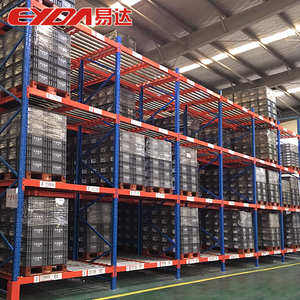
5 Layer Metal Pallet Flow Rack Gravity Storage Racks
- Dynamic FIFO Rotation Gradient
- High-Density Braking Rollers
- Multi-Level Heavy Loading
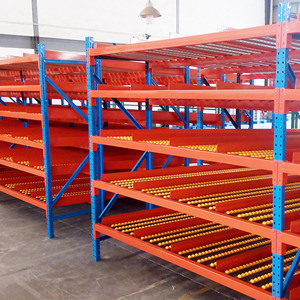
Industrial Carton Flow Roller Shelving Systems
- Ergonomic Split-Case Picking
- Aluminum Roller Track Bed
- Adjustable Guide Lanes
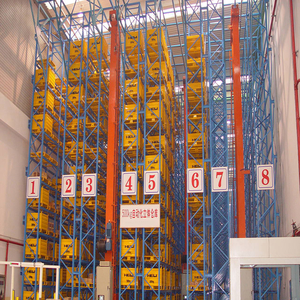
ASRS High-Bay Automated Pallet Racking
- Heights Exceeding 30+ Meters
- Tight Deflection Tolerance
- Stacker Crane Optimized
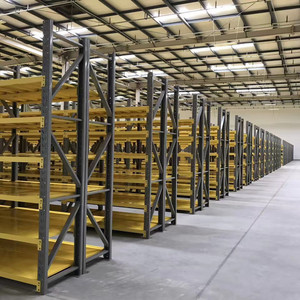
5-Layer Adjustable Long-Span Heavy Steel Shelving
- Boltless Modular Pitch
- Up to 1,000 kg Tier Rating
- Electrostatic Powder Coated
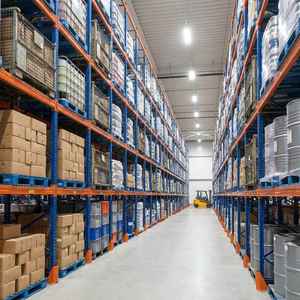
Heavy-Duty Selective Tall Pallet Racking System
- 100% Pallet Selectivity
- Reinforced Omega Uprights
- Seismic Footplate Anchoring
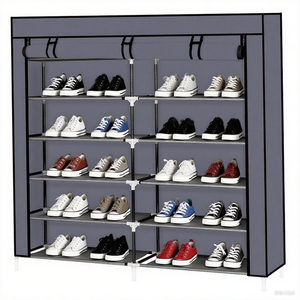
Multilayer Folding Rapid-Deployment Storage Rack
- Collapsible Steel Frame
- Compact Return Logistics
- Modular Accessory Matching
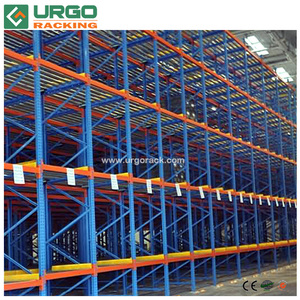
Stainless Steel Industrial Rolling Carton Flow Racks
- Corrosion-Resistant SS304
- Cleanroom / Pharma Grade
- Smooth Bearing Poly Wheels
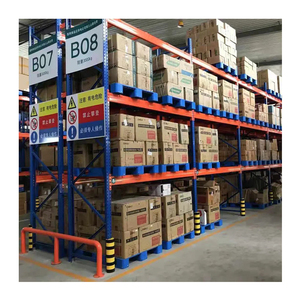
Heavy Duty Tall Industrial Rack 5-Ton Level Capacity
- 5,000 kg Beam Level Rating
- Continuous Box Beam Profile
- Heavy Industrial Structural Base
Architectural & Engineering Paradigms of Tall Pallet Racking
A granular examination of second-order P-Delta structural dynamics, cold-formed steel metallurgy, and seismic design rules for vertical storage infrastructures reaching up to 40 meters.
Euler Buckling & P-Delta Analysis
When upright verticality extends beyond 12 meters, axial compressive forces generate significant secondary bending moments. Our engineering team conducts non-linear 3D finite element analyses (FEA) to verify global stability, taking into account second-order (P-Δ and P-δ) structural effects, shear bracing stiffness, and the semi-rigid rotational stiffness (Cb) of beam-to-column locking connectors under full dead and live loading states.
High-Strength Cold-Formed Steel
Fabricated exclusively from premium certified Q235B and high-yield Q355B (equivalent to European S355JR / ASTM A572 Grade 50) structural coils. The 11 to 13-fold cold-roll-formed Omega upright profile features multiple stiffening ribs along the web and return lips, delivering an outstanding strength-to-weight ratio while resisting torsional warping under extreme unbraced lengths.
Seismic Dissipation & Base Anchorages
Conforming strictly to EN 16681, FEM 10.2.08, and ANSI/RMI MH16.1 codes, tall racking in active seismic zones (such as parts of the GCC or Pacific Rim) incorporates heavy-gauge ductile baseplates with dual concrete chemical expansion anchors. Footplate geometries are engineered to distribute combined uplift tension and vertical compression directly into the post-tensioned warehouse slab.
Global Sourcing & Procurement Trends (2025–2035)
Anticipate how supply chain automation, environmental footprint requirements, and digital logistics ecosystems are transforming racking equipment procurement specifications over the next decade.
Automation Readiness (ASRS & AMR Integration)
Modern procurement is moving away from static selective layouts toward automation-ready modular architectures. Warehouses are installing precision tall racking engineered to tight tolerances (EN 15620 Class 300/400), allowing seamless retrofitting of aisle-captive Automated Guided Vehicles (AGVs), Autonomous Mobile Robots (AMRs), and stacker cranes without structural re-engineering.
ESG-Driven Low-Carbon Steel & Finishes
Institutional procurement mandates now evaluate the embodied carbon footprint across the supply chain. HEDA Shelves addresses this by utilizing clean EAF (Electric Arc Furnace) continuous-cast coil steel and closed-loop, non-effluent electrostatic powder coating lines that eliminate volatile organic compounds (VOCs) and reduce chemical waste during phosphating pre-treatments.
Predictive IoT Structural Health Monitoring
The next generation of high-bay racking systems incorporates IoT-enabled load cell washers, fiber-optic strain sensors, and multi-axis impact loggers embedded at critical upright bases. These arrays stream real-time deflection telemetry directly to enterprise WMS and digital twin platforms, providing instant alerts for forklift impact damage and preventing progressive collapse.
Precision Manufacturing & Harsh Climate Surface Treatment
How our integrated factory controls component integrity from uncoiling to final curing, ensuring long service life in desert heat, high humidity, and cold-storage operations.
High-Speed Continuous Roll-Forming
Upright columns are cold-rolled on high-precision multi-stage automated lines with automated in-line hydraulic punching for 50mm and 75mm beam adjustment pitches. Rolling tolerances are kept within ±0.5mm across a 12-meter single-length component, guaranteeing absolute beam locking accuracy and structural symmetry.
Submerged Arc Robotic Beam Welding
Step beams and box beams are built using dual cold-formed C-profiles interlocking into enclosed tubular sections. Beam end connectors (featuring 3, 4, or 5 heavy-duty alloy claws) are joined via multi-axis Panasonic robotic MIG welding arms, ensuring deep weld penetration, zero spatter, and high fatigue resistance.
Chemical Pickling & Phosphating
Before coating, all components undergo a multi-stage immersion treatment: chemical alkaline degreasing, acid pickling to eliminate scale, and hot zinc phosphating. This chemically bonds a dense crystalline conversion layer onto the raw steel, providing long-term corrosion protection and superior powder adhesion.
Electrostatic Tribo-Powder Curing
Using Swiss Gema automated reciprocal electrostatic spray guns, an ultra-pure epoxy-polyester thermosetting powder is deposited evenly across all surfaces. The parts pass through a 200°C curing tunnel to achieve a hardened finish of 60–90 microns that resists scratching, chips, and chemical washdowns.
Galvanized Options for Coastal & Outdoor Yards
For outdoor open-air logistics yards, port facilities, and high-saline coastal climates (such as Dubai, Dammam, and Sohar), structural components can be hot-dip galvanized in accordance with ISO 1461. This yields a metallurgical zinc-iron alloy barrier exceeding 85 microns that resists salt spray and harsh sunlight.
Full Container Load Optimization & Labeling
Tall racking projects demand smart export packaging. Upright frames are systematically nested, banded with heavy steel strapping, and padded with protective edge-sleeves. All bundles carry barcode labels matching CAD erection drawings, enabling fast sorting at destination ports.
Direct Factory Engineering Authority: Guangzhou Heda Shelves Co., Ltd.
Founded in 2001, Guangzhou Heda Shelves Co., Ltd. has grown into a major manufacturer and exporter of heavy-duty industrial racking and warehouse automation structures. Operating from an advanced 30,000 square meter production complex staffed by over 300 experienced engineers, technicians, and project leads, our factory delivers a monthly capacity exceeding 30,000 metric tons of steel storage equipment.
We provide end-to-end project support: from building CAD analysis, 3D parametric modeling, and static/dynamic finite element load verification, to high-volume fabrication, quality control, export handling, and on-site or remote installation guidance.
Regular Global Logistics Sea Routes
We run frequent, containerized export shipments to major commercial shipping terminals worldwide. Our specialized shipping operations manage breakbulk and 40HQ container deliveries to primary global ports:
• UAE: Jebel Ali Port, Khalifa Port
• Saudi Arabia: Jeddah Islamic Port, King Abdulaziz Port Dammam
• Qatar & Oman: Hamad Port, Sohar Port
• Kuwait & Bahrain: Shuwaikh Port, Khalifa Bin Salman Port
• Plus regular scheduled lines across Southeast Asia, Europe, and the Americas.
Tall Pallet Racking Sourcing & Engineering FAQ
Clear, engineering-focused answers to the design, compliance, and shipping questions commonly raised by EPC contractors, industrial architects, and warehouse heads.
How do you verify structural safety against progressive collapse in tall racks exceeding 15 meters? +
Our engineering department carries out rigorous structural checks in accordance with European standard EN 15512 and RMI MH16.1 specifications. For tall installations, we conduct full second-order elastic analyses (P-Delta and P-delta effects), modeling column semi-rigidity and beam end connector stiffness test values. We also incorporate top-tie portal beams, back spine bracing frames, and heavy-gauge floor anchoring to dissipate wind and seismic loads, preventing progressive buckling across aisle bays.
What are the critical concrete slab parameters required for high-bay tall pallet installations? +
Tall pallet racks transfer high point loads through baseplates to the slab. Flooring must be designed as a fiber-reinforced or rebar-reinforced post-tensioned industrial slab conforming to DIN 18202 or TR34 (Class DM2 or FM2 for Very Narrow Aisle systems). Compressive strength should reach at least C28/35 or C30/37 (equivalent to 4,000+ PSI). Flatness and levelness are critical: even small deviations at floor level can create noticeable leans at a 15-meter reach height.
How do your storage layouts ensure compliance with local Civil Defense fire and life-safety codes? +
Our layout designs adhere strictly to NFPA 13 (Standard for the Installation of Sprinkler Systems) and regional Civil Defense authority mandates. We engineer systematic longitudinal and transverse flue spaces (typically 75mm to 150mm clearance between pallet backs and upright frames) to allow heat detection to rise unhindered and permit water from ESFR ceiling sprinklers to reach lower storage levels. For racks taller than 12m, our uprights are prepunched to support in-rack sprinkler pipework.
How does HEDA Shelves finish withstand extreme temperature swings and high coastal humidity? +
In hot desert or humid coastal zones like the Arabian Gulf, standard paint systems can degrade quickly. HEDA Shelves applies an automated nine-stage pre-treatment that includes pickling, acid descaling, and high-temperature zinc phosphating, followed by electrostatic thermosetting polyester powder coating baked at 200°C. This creates a resilient barrier that passes 500-hour ASTM B117 salt spray tests. For external yards and cold stores, hot-dip galvanization is also available.
What technical information is needed to receive a free, comprehensive 2D CAD and 3D layout proposal? +
To generate an accurate engineering layout and quote, we ask for: (1) Architectural drawings of the building showing column grids, building clearances, and door/dock positions; (2) Clear height beneath the roof trusses or overhead sprinkler heads; (3) Pallet specifications (width, depth, overall height including cargo overhang) and maximum gross pallet weight; (4) Forklift truck specifications (minimum aisle turning radius, maximum mast lift height); and (5) The operational SKU profile (FIFO vs. LIFO rotation rules).
How do you optimize export shipping containers to minimize freight costs and avoid freight damage? +
Our dedicated logistics team uses 3D cargo packing software to arrange every container efficiently, reaching up to 95%+ cube utilization. Heavy upright frames are nested flat with corrugated spacers and secured with heavy polyester or steel strapping. Beams are bundled with corner edge protectors, while small connection accessories, baseplates, and hardware are crated in seaworthy fumigated wooden boxes with clear itemized packing lists matching assembly drawings.
What structural installation support and quality certifications do you provide at project handover? +
Every project ships with step-by-step CAD installation drawings, component location schedules, and official load capacity plaques for each rack run. We supply copies of our CE Certificate (No. 2435-CPR-8605159), ISO 9001:2015 Quality Certificate (No. 18624Q00169R0M), mill test certificates for steel raw materials, and factory torque specifications. We provide live video engineering support for local erection crews and can deploy on-site installation supervisors for large projects.
Transform Your Vertical Warehouse Density With Master Structural Engineers
Whether you are developing a new high-cube distribution center in the GCC, upgrading an existing logistics facility, or procuring heavy-duty high-bay pallet racking systems for high-throughput fulfillment, our engineering team will build an optimized CAD and 3D architectural plan with complete structural calculations within 24 hours.