Seismic Engineering Standard
Structural Seismic Resistance Built to Chilean Building Codes
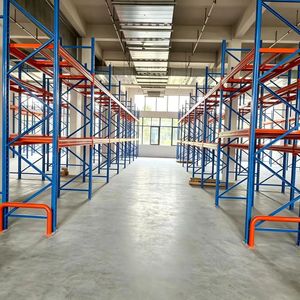
Chile presents one of the most demanding seismic environments globally for structural steel racking engineers. Unlike conventional static warehouse storage where design criteria hinge predominantly on gravity dead and live loads, installations in Chile must withstand major spectral ground accelerations. Standard pallet racks behave as flexible, multi-degree-of-freedom structures where structural mass is concentrated at high elevations. In Santiago (Seismic Zone 2) and coastal maritime ports such as Valparaíso, San Antonio, and Antofagasta (Seismic Zone 3), ground accelerations often exceed A0 = 0.40g.
To comply with NCh2369.Of2002 (Earthquake-resistant design of industrial structures and facilities) and international rack specifications (RMI ANSI MH16.1 and EN 15512), our engineering team utilizes finite element dynamic analysis. We calculate rotational stiffness at the beam-to-column connector, shear deformation in diagonal bracing trusses, and seismic base isolation behavior.
"In Chilean racking projects, failure modes rarely initiate from beam deflection under static loads. Instead, structural failure typically stems from torsional buckling of light uprights, brittle failure of floor anchor bolts in high-shear cycles, or localized pull-out at beam end connectors due to cyclic dynamic amplification."
Our factory integrates high-tensile cold-rolled steel coils (Q235B and Q355B), engineered with heavier column thicknesses (up to 2.5mm and 3.0mm) and high-ductility baseplates. This allows anchor bolts to distribute dynamic overturning moments directly into the structural slab without concrete spalling.
 Seismic Ready