Featured Warehouse Storage & Heavy-Duty Pallet Racking Systems
Factory-engineered in our 30,000 m² facility. From heavy industrial single/double selective lines to cantilever and high-rise VNA drive configurations, each component is audited under strict CE (No. 2435-CPR-8605159) and ISO 9001:2015 quality frameworks.
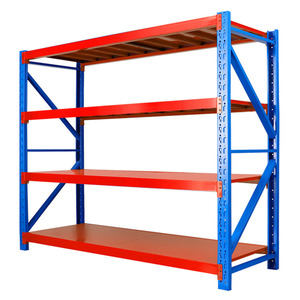 Heavy Industry
Medium/Heavy Duty Storage Equipment Warehouse Industrial Powder Coating Cargo Steel Iron Tool Supermarket Stacking Storage Racks
View Specifications →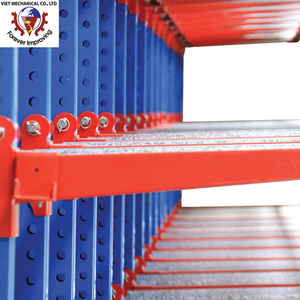 Cantilever Arm
Ready-to-Trade Heavy Duty Steel Cantilever Racking Warehouses Enhances Storage Efficiency Organized Accessible Multi-Level
View Specifications →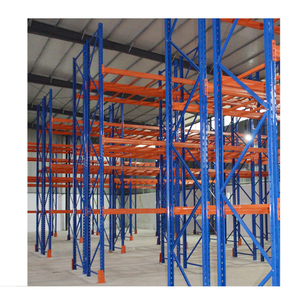 VNA Selective
Storage Shelf Warehouse Heavy Duty Industrial Pallet Racking Narrow Aisle Selective Warehouse Rack System
View Specifications →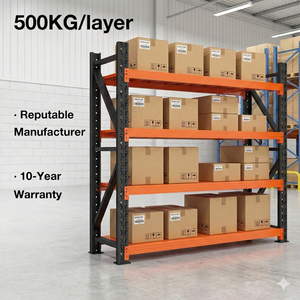 Modular Fast-Ship
Hot Sale Single-Sided Light Duty Pallet Racking System Garage & Warehouse Storage Rack Made of Durable Metallic Material
View Specifications →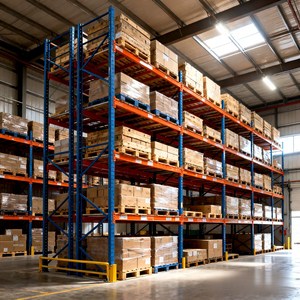 High-Bay 15M
High-Rise Heavy Duty Beam Racking 10-15m Tall Steel Storage Shelves for Large Logistics Center Palletized Cargo Stacking
View Specifications →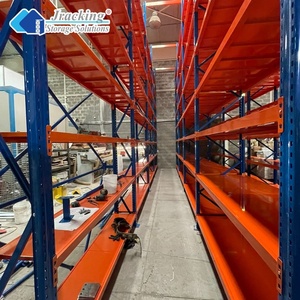 Cold Chain EU
Jracking Industrial Warehouse Racks Shelves EU Standard Pallet Rack System for Cold Room
View Specifications →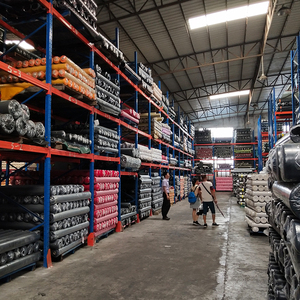 Engineered Load
Highly Customizable Free Design Storage Rack for Various Heavy Duty Storing 1000KG 2000KG 3000KG Pounds Tons
View Specifications →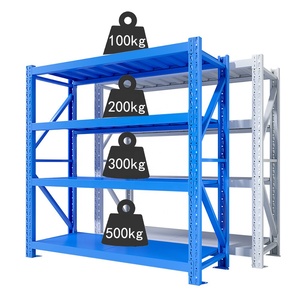 Medium Duty
Low Price Steel Adjustable Height Flexible Storage Medium Duty Industrial Shelving Rack System
View Specifications →Architectural White Paper: Engineering Principles of Drive-Through Racking Systems
In modern industrial logistics, volume utilization index (VUI) directly dictates warehouse return on investment (ROI). While standard selective pallet racking achieves roughly 35% to 42% cubic storage efficiency due to extensive forklift operating corridors, Drive Through Racking Systems (and their counterpart, Drive-In racks) compress aisle allocation down to single access arteries, propelling volumetric storage density up to 75% to 85%.
A true Drive Through system differs fundamentally from a Drive-In layout in its kinematic flow profile: Drive Through systems feature separate loading and retrieval access aisles on opposing sides. This allows counterbalance trucks, reach trucks, or articulated mast forklifts to enter from the loading face, deposit palletized stock along continuous horizontal support rails, and exit or allow retrieval vehicles to pick sequentially from the discharge face. This unlocks strict First-In, First-Out (FIFO) stock rotation—an absolute imperative for temperature-controlled cold chains, high-velocity food and beverage distribution, and batch-sensitive pharmaceutical manufacturing.
Cantilevered Pallet Rail Profiles
Continuous guide rails formed with 2.5mm–3.5mm high-tensile steel features an angled entry flare to self-center off-target pallets and mitigate high-impact dynamic snags.
- One-piece unpunched cold-rolled forming
- Deep flange support bearing up to 1,500kg/pallet
- Zinc-electroplated or heavy powder-coated finish
Floor-Anchored Heavy Guide Rails
Because the truck enters deep inside the racking bay, physical steel channel tracks (C-section or structural angles) isolate mast and chassis vibrations from upright impact.
- M16/M20 chemical floor anchors embedment
- Lead-in rounded bollards at entry portals
- High-visibility safety yellow electrostatic coat
Overhead Portal Bracing Networks
Since interior horizontal load beams are absent, lateral force equilibrium relies entirely on overhead top-tie beams and horizontal lattice bracing networks.
- Engineered deflection limit ≤ L/400 under full live load
- Seismic wind and ground acceleration rating
- Bolt-locked connectors with grade 8.8 tensile hardware
Comparative Engineering Matrix: Structural Storage Systems
Evaluating warehouse expansion capital requires precise matching of throughput dynamics, equipment wear, inventory holding time, and initial investment per pallet position.
| System Typology | Stock Rotation Logic | Floor Space Utilization | Direct Pallet Accessibility | Structural Load Rating | Certifications & Norms |
|---|---|---|---|---|---|
| Drive Through Racking | Strict FIFO | 75% – 85% Cubic Maximization | Lane-Selective / Bulk Batches | Up to 1,500 kg / Pallet | CE / ISO 9001 / EN 15512 |
| Drive-In Pallet Racking | LIFO Only | 70% – 80% High Density | Last Pallet Loaded First Picked | Up to 1,500 kg / Pallet | CE / ISO 9001 |
| Radio Shuttle Automation | FIFO & LIFO Hybrid | 85% – 90% Ultra High Density | Automated Lane Shuttle Dispatch | Up to 2,000 kg / Pallet | CE / RoHS / Machinery Dir. |
| Standard Selective Rack | 100% Random Access | 35% – 45% High Aisle Ratio | 100% Immediate Direct Access | Up to 4,500 kg / Beam Level | CE / FEM / RMI |
| Multi-Tier Mezzanine | Manual / SKU Sort | 200% – 300% Multiplied Footprint | Hand-Loaded Cartons & Bins | 300 – 1,000 kg / m² Floor Area | CE / EN 1090 Structural |
Sector-Specific Deployment Recommendations & Value Realization
Because Drive Through Racking merges extreme density with First-In, First-Out throughput, distinct industrial verticals capture asymmetrical cost benefits during warehouse modernization programs:
Refrigerated & Frozen Cold Chains (-30°C)
Cooled air volume represents an exponential operating expense. By grouping deep pallet lanes together, Drive Through structures minimize the refrigerated cubic footprint, preventing thermal loss pockets. Pre-treated epoxy coatings endure condensation cycles without embrittlement.
FMCG, Dairy & Beverage Bottling Plants
Bottlers running single-SKU beverage batches during seasonal consumption peaks require instant truck turnaround times. One aisle remains dedicated solely to production feed lines, while opposing lanes accommodate long-haul container pick-and-stage workflows.
Raw Materials, Grain & Polymer Resins
Bulk agricultural feed and bagged polymer pellets stored in massive pallet configurations require clear date-code isolation. FIFO flow ensures older compounds never become trapped behind incoming inventory batches, preventing resin degradation.
Strategic Procurement & Technological Evolution Trends (2026–2030)
Global supply chain volatility, land acquisition inflation, and regional regulatory pressures (e.g., GCC Vision 2030 logistics investments, EU Green Deal steel traceability) are reshaping how engineering managers evaluate Drive Through infrastructure:
1. Hybridization with Automated Guided Vehicles (AGVs) and Autonomous Forklifts (AMRs): While traditional drive-through setups rely on human forklift drivers entering tight pallet channels, next-generation layouts integrate laser-guided AMR counterbalanced stackers. These vehicles interact with optical reflectors or 3D SLAM sensors mounted on the guide rails, eliminating human collision damage, increasing travel velocity inside aisles by 35%, and operating reliably in complete blackout cold-storage conditions.
2. High-Strength Low-Alloy (HSLA) Metallurgy & Structural Optimization: Modern supply contracts increasingly mandate cold-formed Q355B or European equivalent S355 steel coils over standard Q235B. By raising yield strengths from 235 MPa to 355 MPa, upright cross-sectional profiles achieve higher load thresholds with a 15% reduction in dead-weight tonnage. This dramatically lowers intercontinental sea-freight emissions and container shipping costs to regional hub ports such as Jebel Ali (Dubai), King Abdulaziz Port (Dammam), Hamad Port (Qatar), and Rotterdam.
3. Advanced Anti-Corrosion Nanotechnology for Extreme Coastal Climates: Standard electrostatic powder paints frequently crack or bubble in high-temperature, saline coastal logistics zones (such as Jeddah or Dubai Industrial City). The future of heavy rack protection integrates 10-stage immersion pickling, micro-crystalline zinc phosphating, and thermo-cured hybrid polyester resin powders verified under 1,000-hour ASTM B117 salt spray endurance testing.
4. Digital Twin Simulation & Real-Time Deflection Monitoring: Progressive logistics operators are embedding strain-gauge IoT sensors within high-risk portal tie junctions. Connected to cloud warehouse management systems (WMS), structural engineering models track cumulative impact stress, alerting maintenance teams before an upright deflection exceeds allowable safety tolerances.
Enterprise Manufacturing Competence & Quality Assurances
Founded in 2001, Guangzhou HEDA Shelves Co., Ltd. has grown to become a benchmark supplier and exporter of heavy-duty pallet racking, dynamic storage channels, and structural mezzanines worldwide. Operating a modernized 30,000 m² automated manufacturing complex with a monthly production capacity surpassing 30,000 metric tons, we bridge the gap between design engineering and direct industrial export.
Full Traceable Certifications
Audited compliance with CE Marking (Certificate No. 2435-CPR-8605159), ISO 9001:2015 Quality Management (No. 18624Q00169R0M), and international RoHS directives.
Free 3D & CAD Layouts
Our in-house structural engineers furnish custom 2D warehouse CAD drawings and photorealistic 3D load simulation renderings within 24–48 hours for tender approvals.
10-Stage Precision Production
From automated column roll forming and precision stamping to automated pickling, phosphating, and powder curing, every component meets strict dimensional tolerances.
Export Pack & Port Delivery
Custom containerization packing with steel frame bundles protects finishes on trans-ocean voyages to the Middle East, Europe, Southeast Asia, and the Americas.
Engineering & Procurement FAQ for Logistics Directors
Critical questions answered for international engineering contractors, 3PL warehouse operators, and purchasing executives:
Request Your Custom Drive Through Warehouse Layout & Quotation
Connect directly with our senior application engineers. We provide free 2D CAD layout plans, comprehensive 3D warehouse renderings, and competitive factory-direct pricing for standard pallet or high-density drive-through installations worldwide.