Smart Storage
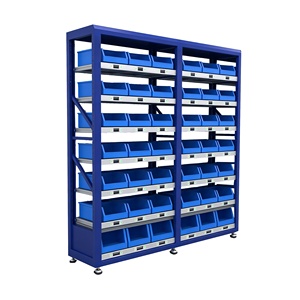
Smart Weighing Shelf Model ZSW-W01
Integrated load-cell SMT line-side cabinet with real-time inventory tracking, LED pick-to-light, and WMS cloud synchronization.
Explore our export-certified intralogistics portfolio. Every structure is modeled to FEM 10.2.02, EN 15512, and ANSI/RMI MH16.1 standards for optimal payload efficiency and seismic integrity.
Integrated load-cell SMT line-side cabinet with real-time inventory tracking, LED pick-to-light, and WMS cloud synchronization.
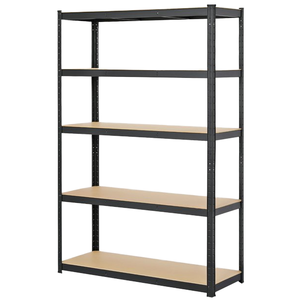
Cold-rolled modular retail and food distribution shelving engineered for rapid tool-free assembly and high static load resistance.
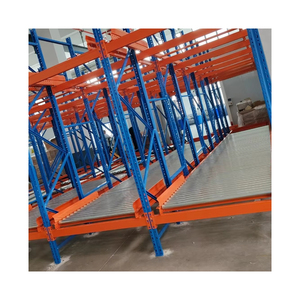
Continuous gravity-driven roller lanes with integrated centrifugal speed retarders and end-stop entry guides for strict batch rotation.
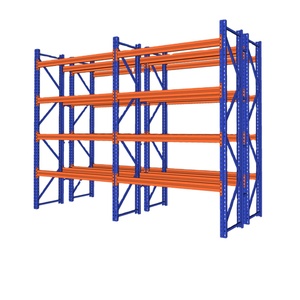
Engineered uprights fabricated from high-tensile Q235B/Q355B coil steel with 75mm beam adjustability and multi-ton bay capacities.
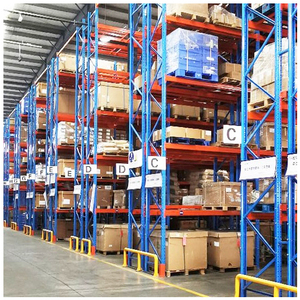
Multi-tier boltless longspan platform featuring corrosion-resistant electrostatic powder finish, suitable for heavy bulk stock.
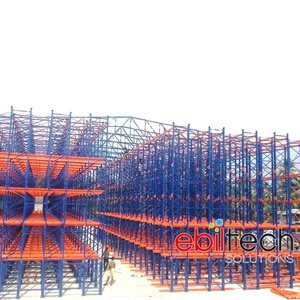
Structural building-integrated warehouse solution where racking uprights support the building envelope, maximizing vertical footprint.
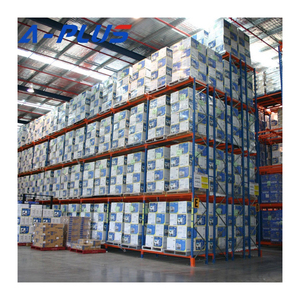
Two-pallet deep reach configurations providing 50% greater volumetric capacity than single selective racks for homogeneous SKUs.
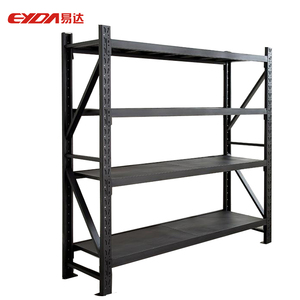
CE-certified corrosion-protected modular system designed for rapid assembly in commercial supermarkets and dispatch backrooms.
A comprehensive examination of dynamic storage kinematics, pallet separation safety, and flow bed engineering principles for procurement executives and chief logistics engineers.
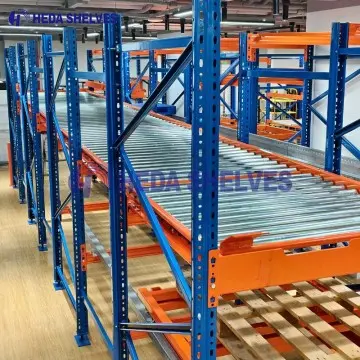
Pallet Flow Systems (also designated as Gravity Flow Racking) operate on an inclined wheel or roller track typically calibrated at a 3% to 4% gradient. Utilizing the force of natural gravity, palletized unit loads travel automatically from the loading face (rear) to the discharge face (front). This delivers an absolute First-In, First-Out (FIFO) replenishment inventory discipline that is non-negotiable for perishable food, pharmaceuticals, and fast-moving consumer goods (FMCG).
The core structural engineering challenge in gravity flow lies in arresting exponential acceleration. Without mechanical regulation, a 1,200 kg pallet traversing a 30-meter deep lane would reach catastrophic terminal velocities. Chinese top-tier manufacturers address this through calibrated magnetic or centrifugal speed controller rollers situated at deterministic pitch intervals.
| System Architecture | Inventory Logic | Floor Space Efficiency | Aisle Requirements | Throughput Rate | Standard Capital Cost |
|---|---|---|---|---|---|
| Pallet Flow (Gravity FIFO) | Strict FIFO | Up to 85% Volumetric Density | 2 (Dedicated Load / Pick) | Extreme (Continuous Gravitational) | Medium – High (Passive Dynamic) |
| Drive-In Racking | Strict LIFO | 65% - 75% Volumetric Density | 1 (Single Shared Entry) | Low (Forklift Enters Rack Bays) | Low (Static Structural Steel) |
| Radio Shuttle System | FIFO & LIFO | 80% - 88% Volumetric Density | 1 or 2 Depending on Layout | High (Battery Robotic Shuttle) | High (Semi-Automated Electromechanical) |
| Standard Selective Rack | Any Random Access | 35% - 45% Volumetric Density | Many (1 Aisle per 2 Racks) | Moderate (Forklift Travel Intensive) | Low (Base Commodity Level) |
Forged with precision ball bearings and hot-dip galvanized or zinc-plated steel casings, full-width rollers handle uneven timber bottom-boards, chemical plastic pallets, and metal skids without track derailment.
Engineered to contact the center of unit bottom runners, absorbing excessive dynamic kinetic energy. Continuous speed regulation prevents severe point-load impacts when stopping against the discharge buffer.
When the forklift lifts the lead pallet, the secondary mechanical trip latch activates, smoothly disengaging the rear accumulating queue and advancing the next unit forward without hazardous hydrodynamic line pressure.
Combining 25+ years of heavy structural manufacturing experience with vertically integrated fabrication facilities in Guangzhou, exporting to 120+ nations worldwide.
Guangzhou Heda Shelves Co., Ltd. (founded in 2001) has evolved into one of China's most trusted design and manufacturing bases for complex dynamic storage. Operating from a dedicated 30,000 square meter modernized manufacturing complex, HEDA boasts an unyielding monthly output capacity exceeding 30,000 tons of structural steel storage equipment.
Unlike trading brokers or fragmented subcontractors, HEDA owns each stage of cold-forming profile engineering, precision automated upright punching, robotic beam welding, continuous acid pickling & phosphating, and state-of-the-art electrostatic powder coating. This ensures complete metallurgical traceability from raw coil stock to site delivery.
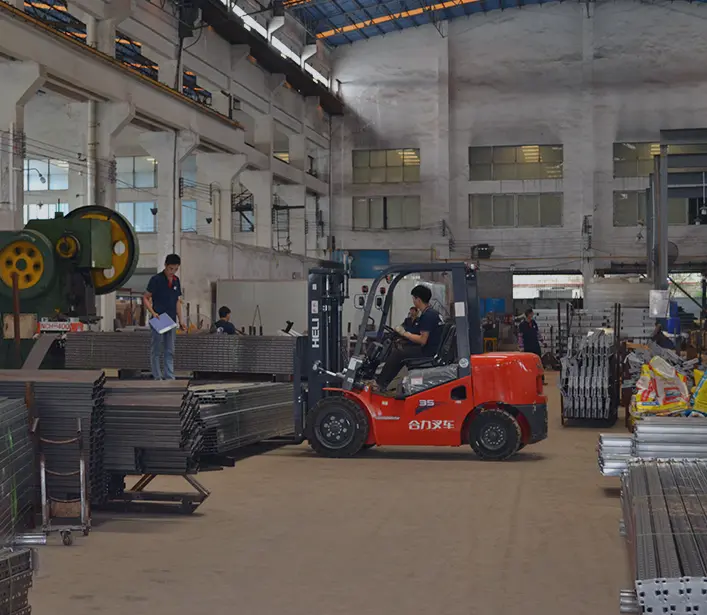
Over two decades of structural racking design solving complex operational warehouse challenges across GCC, Southeast Asia, Europe, and the Americas.
Receive comprehensive CAD aisle layouts, slab loading charts, and 3D architectural renders before commercial commitment to fast-track municipal approvals.
All load-bearing upright frames, box beams, and base plates are strictly manufactured from certified Q235B/Q355B structural steel with mill test certificates.
Custom track pitches, galvanized corrosion-resistant finishes for cold storage (-30°C), custom corporate color schemes, and export-secured bundling.
Stringent production controls guarantee mechanical endurance, beam deflection under L/200 limits, and durable surface adhesion under high-humidity and saline logistics conditions.
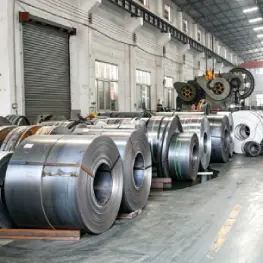
Spectroscopic chemistry analysis and tensile strength testing of hot-rolled Baosteel Q235B/Q355B coils.
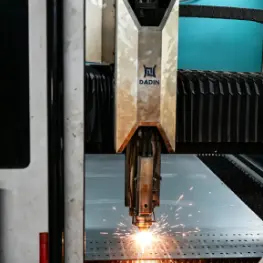
High-speed automated CNC decoiling and slitting to exact section widths within ±0.1mm dimensional tolerance.
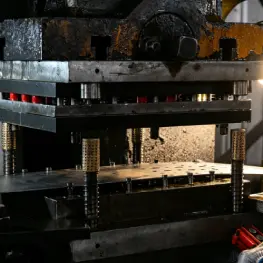
Continuous hydraulic stamping of teardrop or diamond 50mm/75mm pitch holes with zero mechanical burrs.
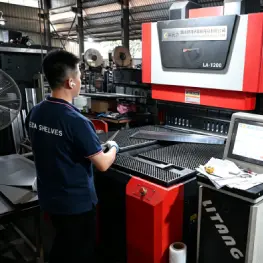
18-to-24 pass roll forming machines incrementally shape structural upright profiles with multi-rib stiffeners.
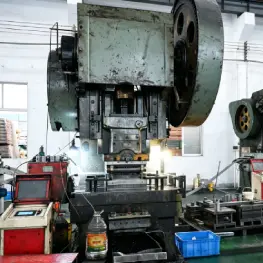
Continuous twin-C seam folding delivering maximum structural second-moment-of-area against lateral buckling.
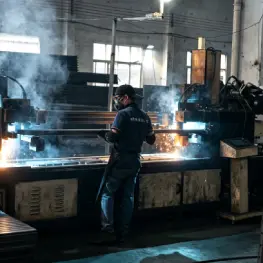
Multi-axis Panasonic CO2 shielded robotic welders fuse 3-prong and 4-prong heavy steel connectors seamlessly.
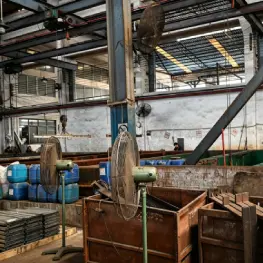
Full-immersion multi-bath de-greasing, acid de-rusting, and zinc-phosphate pretreatment for coating adhesion.
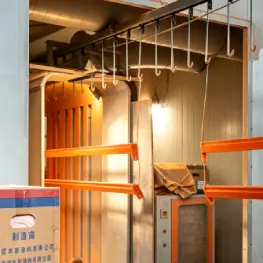
GEMA automatic spray booths apply 60-80 micron epoxy-polyester powder baked at 200°C for superior hardness.
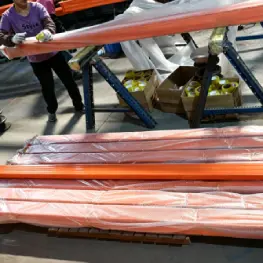
Deflection load proof testing, ultrasonic weld testing, and dry film thickness (DFT) verification before release.
How global supply chain pressures, automated robotic handling, and ESG carbon mandates are transforming gravity storage system procurement.
Modern flow lanes are abandoning pure forklift loading. High-speed counterbalance AMVs and automated guided vehicles (AGVs) require precision laser target reflectors, chamfered lane lead-in funnels, and optical lane occupancy sensors embedded in the loading rack structure.
With electrical cooling costs soaring across GCC and European cold hubs, gravity pallet flow delivers ultra-compact cube utilization without motorized drive consumption. Future procurement specifies low-temperature bearing lubricants rated down to -35°C without wax crystallization.
To eliminate bottom runner wood splintering and support plastic pallet runners with bottom perimeter base lip variations, multi-track split-roller beds with high-durometer polyurethane coatings are increasingly chosen over single steel rollers.
Next-generation pallet flow lanes incorporate passive RFID tag readers and non-powered piezo-electric impulse counters along the discharge stops, transmitting FIFO shelf dwell time and batch expiration alerts directly into Tier-1 Enterprise WMS systems.
In-depth engineering answers addressing seismic compliance, gradient tuning, cold chain specifications, and global logistics execution.
Gravity pallet flow systems demand consistent bottom runner continuity. Ideal pallets include standard GMA (48" x 40"), Euro EUR-1 (1200 x 800 mm), and Industrial (1200 x 1000 mm) full-perimeter wooden or runner-style plastic pallets. Bottom boards must run parallel to the direction of flow. Warped boards, protruding nails, or broken runners cause friction stalls. For operations utilizing mixed or low-grade skids, HEDA engineers recommend full-width steel rollers rather than twin-wheel tracks, paired with high-pitch speed retarders.
The standard incline slope is engineered between 3.5% and 4.0% (approximately 35mm to 40mm drop per linear meter of track). When lanes accommodate wide weight variances within the same SKU category, HEDA integrates self-adjusting eddy-current or centrifugal speed controller rollers spaced every 2 to 3 pallet positions. These mechanical retarders apply braking torque proportional to velocity squared—heavier pallets encounter significantly higher braking resistance, maintaining uniform velocity identical to lighter loads.
Yes. Cold chain storage is one of the highest-ROI use cases for pallet flow due to dense cubic refrigeration efficiency. For sub-zero operations, we utilize cold-resistant low-temperature synthetic lubricants inside the roller bearings, heavy-duty hot-dip galvanized or specialized corrosion-resistant pretreated powder coatings, and cold-form steel grades that maintain ductile fracture toughness below -20°C without risk of brittle failure.
Our engineering department develops full finite element stress calculations and 2D/3D structural layouts that clearly demarcate flue spaces (transverse and longitudinal), safe egress aisle clearances, sprinkler drop integration channels, and column baseplate anchoring calculations in accordance with local seismic acceleration coefficients (Ss and S1). These documents are ready for submission to regulatory bodies such as UAE Civil Defense, Saudi Civil Defense, NFPA 13 sprinkler auditors, and international property underwriters.
Standard fabrication lead time is 20 to 30 calendar days for 2 to 10 shipping containers. Structural uprights and beam components are nested on dedicated steel dunnage with protective corner protectors, cross-strapped with heavy-duty steel bands, and wrapped in moisture-resistant vapor barrier film. Roller tracks are crated in custom reinforced wooden cases with piece-marked labels corresponding directly to the provided assembly schematic drawings for rapid local sorting.
Because HEDA pallet flow lanes utilize passive gravitational mechanics, maintenance requirements are minimal. Quarterly preventative inspections include: visually checking roller free-spin, cleaning dust or pallet wood debris from track channels, testing separator foot pedal release spring tension, and verifying floor anchor torque. Centrifugal brake rollers are sealed-for-life units requiring no hydraulic fluid replenishment.
Collaborate directly with our senior intralogistics structural engineers. Provide your facility architectural CAD dimensions, pallet loads, and daily throughput requirements to receive a turnkey engineering design and competitive factory-direct quote within 24 to 48 hours.