Global Intralogistics Engineering Whitepaper

China Top Narrow Aisle Racking Suppliers & Exporters

High-Density Vertical Storage Systems, VNA Precision Structural Design, Seismic-Ductile Manufacturing & Global EPC Procurement Solutions

Enterprise Product Portfolio

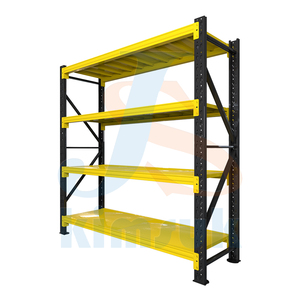
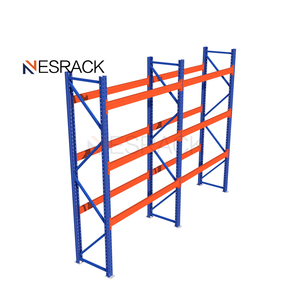
Featured Industrial Racking & High-Density Storage Solutions

Factory-direct structural steel configurations designed under strict FEM 10.2.02, EN 15512, and ANSI MH16.1 specifications, serving international supply chain operators with verified zero-defect deflection performance.

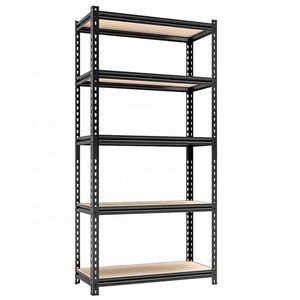
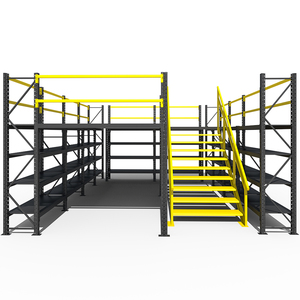
Custom multi level warehouse mezzanine rack Multi-Tier Pick

Customized Warehouse Multi-level Mezzanine Rack System

Multi-Story Flow Chute Integration Forklift Drop Gate
2001
Established Engineering Origin
30,000 m²
Modern Production Facility
30,000 t
Monthly Cold-Forming Capacity
120+
Global Export Sovereign Jurisdictions
Architectural Engineering Whitepaper

Engineering Principles of Very Narrow Aisle (VNA) Logistics Architectures

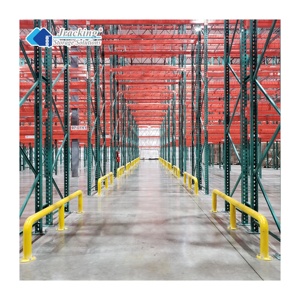
In modern industrial land economics, the escalating cost per square meter of industrial footprint dictates an urgent paradigm shift from conventional wide-aisle warehouse layouts toward high-bay, Very Narrow Aisle (VNA) racking systems. A standard selective racking configuration mandates aisle clear widths ranging from 3.2 to 3.8 meters to accommodate counterbalanced reach trucks. In stark contrast, an engineered VNA racking matrix contracts operating aisle widths down to 1,500 mm – 1,800 mm, unlocking up to 50% additional cubic storage density while retaining 100% individual pallet selectivity.

As one of the world's premier narrow aisle racking suppliers, our engineering division in Guangzhou combines continuous automated cold-roll forming with advanced finite element calculation models (ANSYS and RFEM). Designing a structurally stable VNA installation operating up to 18 meters in height requires addressing micro-dynamic forces. The interaction between man-up turret trucks, articulating swing-mast trucks, floor slab flatness, and structural upright deflection demands tolerances that general fabricators cannot reliably deliver.

VDMA 41453 Floor Interface

Super-flat warehouse slabs complying with DIN 18202 (Zeile 4) and VDMA 41453 guidelines ensure that high-reach turret masts do not induce destructive sway or collision dynamics during top-tier cycle travel.

Continuous Roll-Formed Uprights

Uprights are fabricated from high-yield Q355B and Q235B micro-alloy structural steel, featuring 13-fold profile cross-sections with continuous web bracing that maximizes torsional stiffness and axial load capacity.

Mechanical & Inductive Guidance

Seamless integration with either heavy-duty low-profile mechanical guide rails (angle profiles anchored to slab) or high-frequency inductive wire guidance buried into floor expansion slots for autonomous steering.

Racking Architecture Aisle Width Metric Clear Height Reach Volumetric Efficiency Selectivity Profile Material Handling Equipment
Standard Selective Rack 3,200 mm – 3,800 mm Up to 9,000 mm 40% – 45% Cube Use 100% Direct Access Counterbalance / Reach Truck
Very Narrow Aisle (VNA) 1,500 mm – 1,800 mm Up to 18,000 mm 75% – 85% Cube Use 100% Direct Access Man-Up / Man-Down Turret Truck
Double-Deep Pallet Rack 3,000 mm – 3,400 mm Up to 11,000 mm 55% – 60% Cube Use 50% Immediate (FILO) Pantograph Double-Reach Truck
Radio Shuttle Cart Matrix Variable Lane Depth Up to 15,000 mm 85% – 90% Cube Use Batch / SKU Channel Standard Forklift + Core Shuttle
Strategic Sourcing Intelligence

Future Procurement Trends in High-Density Narrow Aisle Logistics

Global procurement directors and supply chain engineers evaluating Chinese manufacturing partnerships in 2026 and beyond face evolving compliance and technical benchmarks. The historical approach of selecting pallet racks based merely on steel tonnage cost is obsolete. Today, enterprise buyers evaluate narrow aisle racking suppliers across five strategic procurement axes:

R&D Roadmap & Metallurgy

Structural Development Trends in Narrow Aisle Racking Systems

The structural evolution of VNA racking is driven by increasing building clear heights and the transition toward automated material handling. Key developments transforming narrow aisle engineering include:

1. High-Yield Advanced Cold-Forming Geometry: Using computer-simulated roll-tooling, upright column sections have advanced from simple C-channels to complex multi-bend omega shapes featuring up to 13 structural bends. This geometric stiffening reduces raw steel gauge thickness while elevating overall moment of inertia (Iy and Iz), mitigating elastic buckling risks under severe seismic ground acceleration.

2. Advanced Surface Pretreatment: To perform in demanding coastal environments, such as Dubai or Rotterdam, steel components undergo eight-stage pickling, automated phosphating, and electrostatic deposition of 80–120μm heavy-duty thermoset epoxy-polyester powder. This achieves salt-spray test endurance exceeding 500 hours without surface degradation.

3. Dynamic Shock Absorption & Flue-Space Safety: Integration of high-elasticity polyurethane-backed column protectors and laser-cut safety back-stops prevents pallets from intruding into required NFPA 13 longitudinal flue spaces.

Send an Inquiry
Manufacturing Competence

Guangzhou Heda Shelves Co., Ltd.

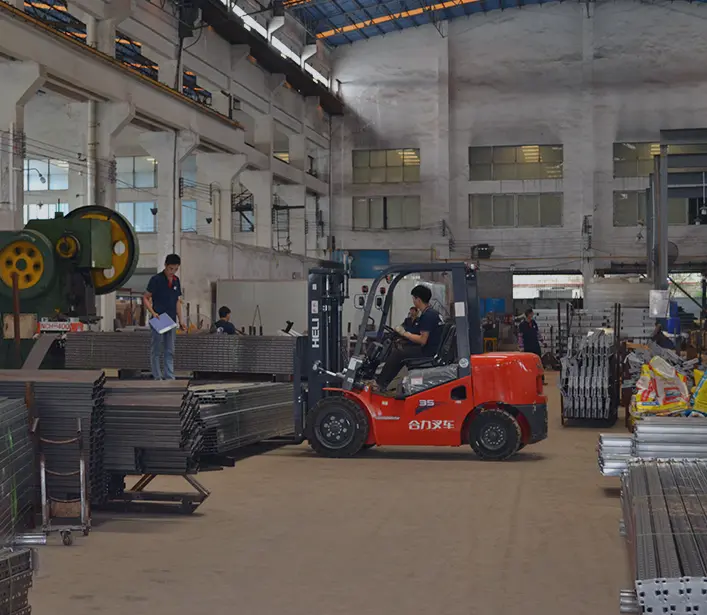
Founded in 2001, Guangzhou Heda Shelves Co., Ltd. operates a specialized 30,000 square meter intelligent manufacturing base in Guangzhou, China. Staffed by more than 300 experienced technical professionals, the company maintains a dedicated monthly roll-forming capacity exceeding 30,000 metric tons.

Our complete manufacturing pipeline features in-house precision steel slitting, high-speed automated column punch stamping lines, 24-station cold-bending forming machines, robotic beam-connector welding cells, and automated surface pretreatment lines. Every production batch undergoes strict tensile, shear, and chemical testing before shipping.

CE Certified (No. 2435-CPR-8605159)
ISO 9001:2015 Management
RoHS Compliant Finish
HEDA Shelves automated industrial racking manufacturing line
Technical Inquiry Center

Frequently Asked Questions: Narrow Aisle Racking Procurement

Direct answers to the most common questions raised by project engineers, structural consultants, and warehouse operations directors.

What floor flatness tolerances are required to install Very Narrow Aisle (VNA) racking? +

Because VNA turret trucks lift loads up to 15–18 meters, minor floor unevenness is amplified at the mast tip. Floors must strictly comply with DIN 18202 (Table 3, Line 4) or VDMA 41453 Category F_min / E_min standards. For installations above 12 meters, narrow-aisle floor grinding or superflat F-number classifications (F_min 75 to 100) are recommended to maintain truck stability and prevent column strikes.

How do mechanical guide rails compare with inductive wire guidance in VNA aisles? +

Mechanical Guide Rails (typically 100×50×5mm or 120×80×6mm structural angles anchored along aisle bases) offer rugged, physical crash protection and eliminate electronic maintenance. They are cost-effective for retrofits and require low-profile entry shoes at aisle entrances.

Inductive Wire Guidance utilizes a low-frequency cable embedded 15–20mm below the concrete surface. It eliminates floor-level obstructions, simplifies floor cleaning, and enables rapid travel transitions between aisles. However, it requires onboard sensors and specialized floor grooving.

Which international structural codes govern your rack designs? +

Our structural design calculations comply with European standards EN 15512:2020 (Steel static storage systems – Adjustable pallet racking systems – Principles for structural design) and EN 15620 (Tolerances, deformations and clearances), as well as American RMI (ANSI MH16.1) and Australian AS 4084:2023 standards. Full calculation reports, finite element node evaluations, and certified load capacity plaques are supplied with each project.

What parameters are required to generate a complimentary 2D CAD & 3D layout? +

To produce an optimized CAD proposal, our engineering team requires: (1) Architectural floor plan with column grid dimensions and clear height under roof beams; (2) Pallet specifications including width, depth, height, and maximum loaded weight; (3) Proposed forklift model, mast height, and collapsed profile; (4) Total SKU count, pick frequency, and rotation protocol (FIFO or LIFO); (5) Regional building code details, including seismic zone coefficients and in-rack sprinkler clearance requirements.

How are components protected against marine corrosion during ocean transit? +

Uprights and beams are bundled using non-marking PET strapping with heavy-duty edge protectors, wrapped in moisture-barrier film, and packed with silica desiccant inside 40ft High Cube containers. All bundles are clearly tagged with waterproof QR labels that correspond directly to project installation drawings, accelerating site assembly upon destination delivery.

What is the typical production and export lead time for high-bay VNA systems? +

Standard production cycles range from 15 to 25 days following engineering drawing sign-off and color approval. Our factory's location in Guangzhou offers direct access to key shipping hubs including Nansha, Shenzhen, and Hong Kong, allowing rapid container booking and steady global transit schedules.

Optimize Your Warehouse Density with HEDA Engineering

Share your warehouse floor plan, pallet dimensions, and storage targets. Our technical engineers will provide a complete 2D layout, 3D visualization, and structural calculation within 24 hours.

Send an Inquiry