Executive Whitepaper: Strategic Sourcing Paradigm for High-Density Warehouse Racking Systems
In the contemporary macro-logistics landscape, the convergence of skyrocketing real estate footprints, supply chain volatility, and automated material handling integration has radically rewritten warehouse engineering metrics. Warehouse operational performance is no longer evaluated merely by raw square meterage; it is governed by volumetric density, pallet turnover velocity, structural fatigue life, and compliance with strict seismic displacement boundaries. As premier global original design manufacturers (ODM) and original equipment manufacturers (OEM), premier Chinese warehouse racking factories provide enterprise supply chain directors with unprecedented economies of scale, precision roll-forming tolerances, and certified structural integrity.
Selecting a warehouse racking supplier in China requires a comprehensive engineering perspective that extends beyond unit price per ton. Industrial procurement specialists must audit structural steel chemistry, yield strength thresholds (specifically high-tensile Q235B vs. Q355B modified alloys), multi-stage anti-corrosion surface pretreatments, and adherence to international structural codices including European Racking Federation FEM 10.2.02, American ANSI/RMI MH16.1, and ISO 9001:2015 quality assurance frameworks. Guangzhou Heda Shelves Co., Ltd. (operating since 2001) represents the pinnacle of this integrated manufacturing philosophy, uniting in-house structural engineering, advanced automated fabrication, and turnkey export execution across more than 120 countries.
Structural Typology & Comparative Engineering Architecture
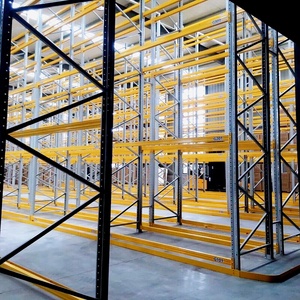
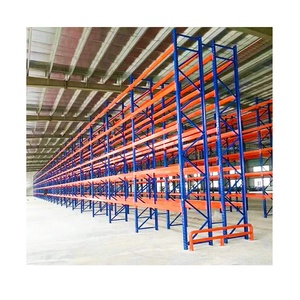
To maximize storage density, procurement teams must balance SKU selectivity against storage volume. Below is an engineering comparison matrix defining structural performance attributes across core industrial racking topologies manufactured in our Guangzhou production complex:
| Racking Architecture | Space Utilization | SKU Selectivity | Load Capacity (per Level) | Handling Equipment Required | Optimal Industry Application |
|---|---|---|---|---|---|
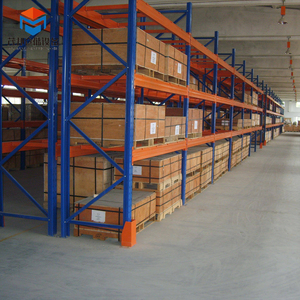
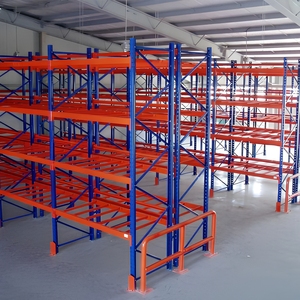
| Selective Pallet Racking | 40% - 50% | 100% (Direct Access) | 1,000 kg – 4,500 kg | Standard Counterbalance, Reach Truck | Fast-moving FMCG, 3PL logistics, retail distribution |
| Very Narrow Aisle (VNA) | 60% - 70% | 100% (Direct Access) | 1,500 kg – 4,000 kg | VNA Turret Truck, Wire-Guided Reach | High-bay warehouses, pharmaceutical, e-commerce hubs |
| Drive-In / Drive-Through | 70% - 80% | Low (LIFO / FIFO) | 1,000 kg – 2,000 kg/pallet | Standard Forklift (Drive-in entry) | Cold storage, bulk beverage, seasonal food manufacturing |
| Radio Shuttle Automation | 80% - 90% | Medium (Automated Lane) | 1,000 kg – 2,500 kg/pallet | Standard Forklift + Automated Shuttle Unit | Deep-lane cold store, mega FMCG hubs, raw ingredient staging |
| Push-Back Carts | 65% - 75% | Medium (LIFO by lane) | 1,000 kg – 1,800 kg/pallet | Standard Counterbalance Forklift | Moderate turnover buffers, print, manufacturing staging |
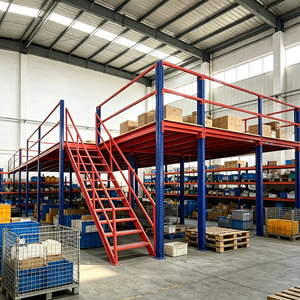
| Multi-Tier Mezzanine | 100% - 250% Gain | High (Piece/Box picking) | 300 kg – 1,200 kg/m² | Conveyors, Vertical Lifts, Hand Carts | Automotive spare parts, apparel e-fulfillment, archives |
Technological Innovations in Modern High-Density Racking Manufacturing
The transformation of Chinese steel fabrication factories into cutting-edge robotic facilities has ushered in structural advancements that yield higher strength-to-weight ratios, enhanced seismic ductility, and extended asset operational lifecycles.
1. Continuous Multi-Pass Cold Roll-Forming & Stress Relief
Traditional press brake bending creates residual internal tensile stresses along the bend radiuses of upright posts. In contrast, HEDA Shelves utilizes automated continuous cold roll-forming lines with up to 24 progressive roller stations. This progressive forming method smoothly transforms prime structural steel coils into multi-faceted omega profiles with integrated reinforcing returns. Continuous roll forming ensures uniform cross-sectional geometry, uniform thickness distributions, and superior torsional resistance against eccentric pallet loads.
2. Finite Element Analysis (FEA) & Dynamic Seismic Modeling
Modern engineering utilizes state-of-the-art computational simulation before a single beam is perforated. Using ANSYS and proprietary structural calculation engines, our engineering team subjects proposed 3D warehouse layouts to non-linear buckling simulations, horizontal beam deflection checks (restricted to L/200 or L/250 in compliance with FEM standard guidelines), and dynamic ground acceleration spectra matching specific regional seismic zones (Zone 2 through Zone 4).
3. Automated 10-Stage Surface Pretreatment & Electrostatic Polymer Coating
The structural integrity of steel is only as durable as its defensive barrier against environmental oxidation. Paint failures or micro-flaking allow moisture and corrosive agents to degrade load-bearing cold-formed steel sections. Our factory implements an industrial 10-stage immersion and spray pretreatment cycle before electrostatic powder coating, delivering superior salt-spray resistance and paint film adhesion.
Critical Procurement FAQ: Technical Specifications & Sourcing Guidelines
Clear, technically rigorous answers addressing the key questions warehouse designers, structural consultants, and corporate buyers ask when procuring heavy-duty high-density warehouse racking from China.
How does Q235B steel compare with structural grades specified in European (S235/S355) and US (ASTM A36/A1011) standards?
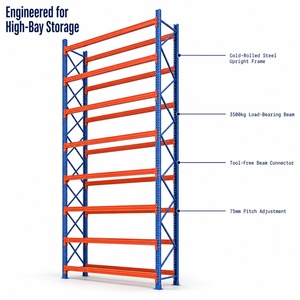
Q235B is the industrial standard structural carbon manganese steel utilized in Chinese cold-formed manufacturing, offering a minimum yield strength of 235 MPa and a tensile strength of 370–500 MPa with exceptional ductility and formability. In terms of mechanical chemistry and yield thresholds, Q235B directly correlates to European EN 10025 S235JR and American ASTM A36. For ultra-tall high-bay frames and elevated load applications exceeding 3,500 kg per level, HEDA Shelves routinely specifies high-tensile Q355B (equivalent to European S355 and ASTM A572 Grade 50), which yields minimum tensile ratings of 355 MPa, allowing for lighter component cross-sections while preserving required structural safety factors (typically 1.65 to 1.95 under load).
What concrete floor slab specifications are required to support high-density pallet racking?
High-density racking transfers significant point loads through the upright baseplates to the warehouse concrete floor slab. A standard industrial slab must be at least 150mm to 250mm thick with a compressive concrete strength between C25/30 and C30/37 (minimum 3,000 to 4,500 PSI), reinforced with rebar mesh or steel fibers. For dynamic or VNA operations reaching 10 to 14 meters in height, slab flatness must adhere to strict superflat classifications (such as DIN 18202 Table 3 Line 4 or TR34 FM2) to prevent excessive truck oscillation. Our engineering team calculates exact baseplate dimensions and anchor bolt embedding depths (using mechanical wedge or chemical epoxy anchors) to verify that floor slab punching shear limits are never exceeded.
How do you manage corrosion protection for cold storage and high-humidity desert regions?
Standard industrial storage environments utilize a 60–80 micron electrostatic epoxy-polyester thermosetting powder coat applied after a 10-stage immersion cleaning, pickling, and phosphating sequence. However, in cold storage facilities (-25°C to -30°C) with continuous condensation risks, or coastal logistics facilities throughout the Middle East, Southeast Asia, and Central America, HEDA Shelves provides two advanced protective options: (1) An enhanced zinc-rich primer basecoat covered by a 100-micron outdoor-rated polyester topcoat; or (2) Complete hot-dip galvanizing (HDG) in accordance with ISO 1461, yielding an 85+ micron zinc coating that bonds metallurgically to the steel and provides self-healing galvanic protection against moisture, aggressive chlorides, and sand abrasion.
What specific parameters are needed to generate an engineered 2D CAD and 3D warehouse layout?
To produce an optimized structural layout and bill of materials within 24 to 48 hours, our engineering office requires:
1. Architectural CAD drawings showing building length, width, column grid locations, dock door configurations, and clear roof beam height.
2. Unit load parameters: pallet dimensions (width × depth × height including cargo overhang) and maximum gross weight per pallet.
3. Handling equipment specifications: forklift make, model, mast collapsed height, maximum lift elevation, and manufacturer-recommended right-angle stacking aisle width (Ast).
4. Inventory characteristics: total SKU count, first-in first-out (FIFO) or first-in last-out (LIFO) rotation requirements, and target seismic zone codes.
How does direct factory shipping from China optimize sea freight container cubing?
Structural racking components are dense, heavy, and bulky. Unoptimized shipping can lead to wasted container volume or exceeded gross road weight limits. HEDA Shelves uses modular nesting software to build high-density export bundles. Upright frames are either flat-packed unbolted (shipped knock-down with field bolting assembly) or pre-assembled in calibrated staggered bundles depending on destination labor costs versus ocean container freight rates. Step beams are nested with custom interlocking dunnage to prevent transit rubbing, maximizing 40-foot High Cube (40HQ) container payloads up to 26–28 metric tons while protecting the factory-finished surfaces.
Can your engineering team support local building authority approvals (such as UAE Civil Defense, US IBC, or Australian AS4084)?
Yes. We routinely work alongside local structural engineering consultants and general contractors to provide certified structural calculation packages, load capacity rating plaques, baseplate anchor calculation models, and emergency exit clearance drawings. All designs incorporate mandatory longitudinal and transverse flue spaces (essential for in-rack ESFR fire sprinkler penetration) in full accordance with NFPA 13, European EN 15512, and Australian AS4084 standards.
Upgrade Your Industrial Storage Capacity With Factory-Direct Engineering
Connect directly with the structural engineering team at Guangzhou Heda Shelves Co., Ltd. Receive complete 2D layout drafting, 3D photorealistic renderings, structural steel calculations, and container-optimized FOB/CIF cost analyses tailored to your specific facility dimensions.
Get Catalog