Precision-Engineered Gravity Flow & Dynamic Live Storage Solutions
Explore our verified selection of custom-engineered carton and pallet flow systems. Designed with heavy-duty structural steel profiles, high-precision roller tracks, and automatic speed controllers to maximize cube utilization and reduce picking cycle times.
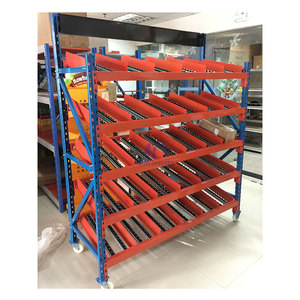 Lineside & FIFO
Customized Lineside Roller Flow Rack & Gravity Carton Flow Racking
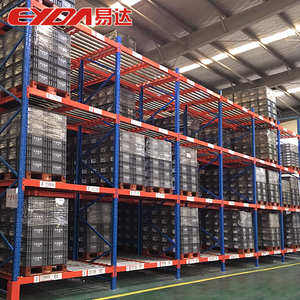 Heavy-Duty Multi-Tier
5-Layer Heavy Duty Industrial Metal Pallet Flow Gravity Storage Rack
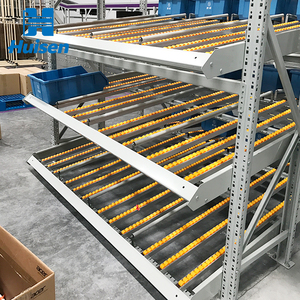 Anti-Corrosion Finish
High Density Steel Flow Rack System with Advanced Surface Protection
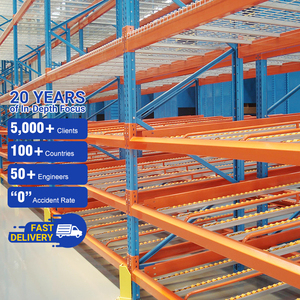 OEM/ODM Spec
Custom OEM/ODM Heavy Duty Gravity Flow Roller Storage System
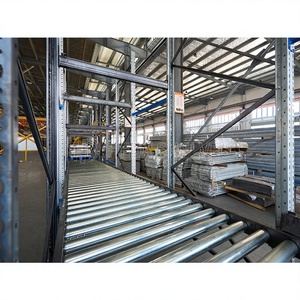 Fast Order Picking
Industrial Heavy Duty Dynamic Roller Carton Flow Rack System
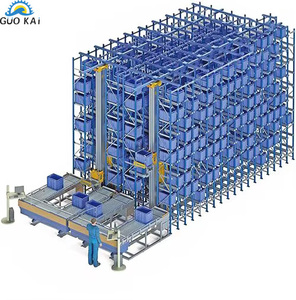 ASRS Integration
Automated High-Bay Storage & Retrieval System with Stacker Crane
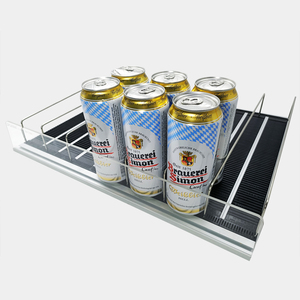 Cold Chain / Retail
FIFO Walk-In Cooler Gravity Flow Shelf & Self-Facing Pusher System
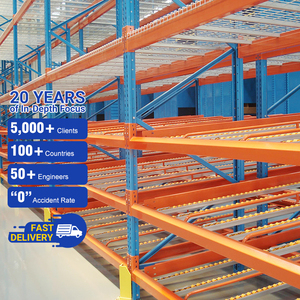 Dynamic Roller Shelf
Heavy Duty Warehouse Gravity Flow Racking with Sliding Roller Shelf
Mechanical Architecture and Kinematic Dynamics of Live Gravity Flow Racking
Gravity flow racking—commonly classified as dynamic live storage—utilizes gravitational potential energy to autonomously propel palletized cargo or carton containers along a calibrated, inclined roller plane. Unlike static selective racking systems, dynamic flow designs isolate restocking corridors from discharge pick faces, fundamentally driving First-In, First-Out (FIFO) stock rotation.
Gravitational Gradient Physics
The standard operating angle of incline in heavy-duty pallet flow lanes ranges between 1.5° to 3.5° (approx. 2.5% to 5.0% slope). Determining this angle is a meticulous kinematic equation governed by the coefficient of rolling friction between bottom runner slats (timber, HDPE, or pressed steel) and roller bearings.
- Optimal roll-off velocity maintained below 0.30 m/s
- Compensates for bottom-runner pallet deflection
- Zero power consumption, purely passive kinetic drive
Dynamic Speed Deceleration
In deep-lane configurations exceeding four pallet depths (up to 20+ positions), uncontrolled kinetic acceleration poses critical crushing hazards. Centrifugal internal-gear brake rollers or eddy-current magnetic hysteresis controllers automatically modulate braking torque proportional to velocity.
- Direct dynamic engagement based on pallet weight
- Prevents high-energy terminal impacts at discharge
- Maintains uniform lane tracking along centerlines
Pallet Separation Mechanics
Line pressure accumulates rapidly when multiple unit loads queue within a lane. Mechanical separation devices (pneumatic escapements, spring-loaded foot latches, or automatic time-delay mechanical releases) decouple the lead pallet from upstream queuing loads during extraction.
- Eliminates hydrostatic back-pressure on forklift tines
- Prevents carton crushing during automated extraction
- Protects retrieval operators from sudden forward surges
High-Density Warehouse System Architectural Comparison
Selecting the right high-density storage topology requires analyzing the balance between volumetric floor space utilization, operational capital expenditure (CAPEX), and picker cycle times. Review how gravity flow compares against alternative racking structures.
| Racking Topology | Floor Space Density | Stock Rotation Logic | Forklift Aisle Demand | Throughput Rate (Pallets/Hr) | Energy Dependence | Damage Susceptibility |
|---|---|---|---|---|---|---|
| Gravity Flow (Pallet/Carton) | Ultra-High (Up to 85%) | Strict FIFO (100%) | Dedicated Load & Pick Aisles | Very High (Continuous Flow) | Zero (Passive Kinetic Gravity) | Extremely Low (No truck entry) |
| Drive-In Racking | High (Up to 70%) | Strict LIFO (Last-In, First-Out) | Single Common Ingress Aisle | Low to Medium (Slow Maneuvering) | Zero (Passive Static) | High (Frequent Upright Impact) |
| Radio Shuttle Systems | Ultra-High (Up to 88%) | Flexible FIFO or LIFO | Perpendicular Lift Aisles | High (Automated Shuttle) | Medium (Lithium Battery Charging) | Low (Minimal Rack Entry) |
| Selective Pallet Racking | Low (35% - 40%) | Random Access / Arbitrary | Multiple Wide / Narrow Aisles | Medium (100% Direct Selectivity) | Zero (Passive Static) | Medium (High Collision Exposure) |
| Push-Back (Cart/Roller) | Medium-High (Up to 65%) | Strict LIFO (Last-In, First-Out) | Single Access Aisle | Medium (Opposing Push Force) | Zero (Passive Gravitational) | Low to Medium (Cart Jamming Risk) |
Global Procurement and Technological Trends (2025–2030)
The procurement of dynamic storage racking is shifting rapidly from standard off-the-shelf catalogues to bespoke structural assemblies engineered for automated facilities, cold-chain sustainability, and ergonomic picking interfaces.
Robotics & AMR Integration
Modern fulfillment hubs increasingly deploy Autonomous Mobile Robots (AMRs) and Automated Guided Vehicles (AGVs) at the discharge face of gravity flow systems. Upright footings, lane centering stops, and photoelectric safety sensors are custom engineered to guarantee millimeter-accurate positional pick-up tolerances.
Cold Chain Thermal Dynamics
Cold storage energy costs demand maximum cubic density. Procurement trends highlight sub-zero synthetic lubricants for roller bearings operating at -30°C without viscosity freezing, alongside perforated roller surfaces to combat condensation ice accumulation and maintain friction coefficients.
High-Strength Low-Alloy Steel
Global supply chains favor High-Yield Low-Alloy (HSLA) structural steels (such as Q355B and European S355). Utilizing higher tensile strengths enables thinner roll-formed gauge profiles without sacrificing structural deflection limits, significantly cutting ocean freight shipping weights and embodied carbon.
Pick-to-Light (PTL) Ergonomics
For high-velocity carton flow operations, integrated digital Pick-to-Light brackets, magnetic divider tracks, and layback ergonomic discharge shelves dominate procurement specs. These modular additions eliminate order-picking errors and drastically reduce repetitive operator strain.
HEDA Shelves: 10-Stage Precision Manufacturing Standard
With our 30,000 m² smart factory and 300+ technical specialists, Guangzhou Heda Shelves Co., Ltd. oversees every step in-house. Our precision cold roll-forming, robotic welding, and automated surface treatments comply rigorously with CE, ISO 9001:2015, and international racking standards.
Raw Materials
Certified prime hot-rolled and cold-rolled steel coils verified for tensile yield and chemical uniformity.
Laser & Shear Cut
High-precision multi-head CNC steel decoiling and shearing for tight dimensional tolerances.
Column Punching
Automated continuous mechanical punch lines delivering precise pitch spacing for beam connectors.
Cold Roll-Forming
Multi-station roller dies progressively form high-moment upright columns and interlocking beam profiles.
Profile Forming
Secondary robotic calibration ensures zero longitudinal camber or cross-sectional twisting.
Shot Blasting
Mechanical surface descaling and micro-polishing eliminates mill scale for superior coating adhesion.
Robotic Welding
Automated dual-torch robotic MIG welding guarantees deep, structural weld penetration on connector brackets.
Pickling & Phosphating
Comprehensive 9-tank chemical bath removes oxides and builds an anti-corrosive zinc phosphate conversion layer.
Powder Coating
Electrostatic automated application of durable epoxy-polyester thermoset powder cured at 200°C.
QC & Export Bundling
Load deflection testing, cross-hatch adhesion checks, and numbered containerized export packaging.
Frequently Asked Questions for Gravity Flow Racking Procurement
Critical technical considerations answered by our senior structural design and materials engineering team.
Plan Your High-Density Dynamic Flow Warehouse with Factory Engineers
Eliminate wasted forklift travel, guarantee 100% FIFO inventory rotation, and maximize vertical storage capacity. Guangzhou Heda Shelves Co., Ltd. provides factory-direct custom manufacturing, seismic-certified load calculations, and global turnkey export support.
Inquire Now