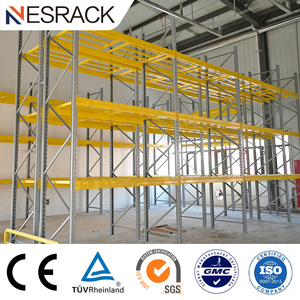
Custom 5-Layer Adjustable Heavy Duty Pallet Racking
Engineered for 100% SKU selectivity. Features 50mm/75mm pitch adjustability, high-tensile Q235B/Q355B uprights, and dynamic beam loading up to 4,500 kg per pair.
Engineering Specs →Precision-calculated heavy-duty systems compliant with FEM 10.2.02, EN 15512, and RMI storage standards. Tailored for dynamic load profiles, maximum cubic space yield, and seismic safety.
Engineered for 100% SKU selectivity. Features 50mm/75mm pitch adjustability, high-tensile Q235B/Q355B uprights, and dynamic beam loading up to 4,500 kg per pair.
Engineering Specs →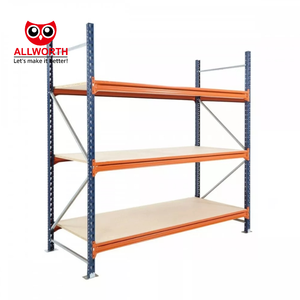
Multi-lane nesting carrier design supporting 2 to 6 pallets deep. Maximizes dynamic storage density while keeping aisle access times 40% faster than standard drive-in racks.
Engineering Specs →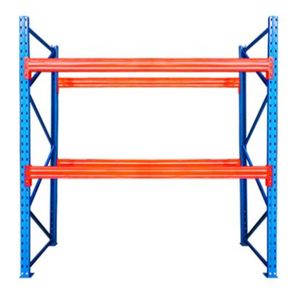
Hybrid picking configuration combining automated lower-level manual carton retrieval with overhead bulk reserve pallet bays for fast-moving consumer goods (FMCG).
Engineering Specs →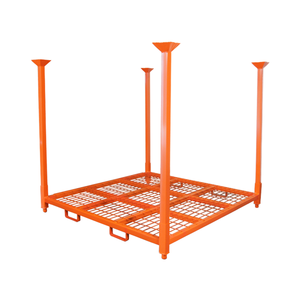
Heavy-gauge tubular steel construction with hot-dip galvanized or thermoset powder coating. Stackable up to 5 tiers without fixed ground anchors, ideal for flexible warehousing.
Engineering Specs →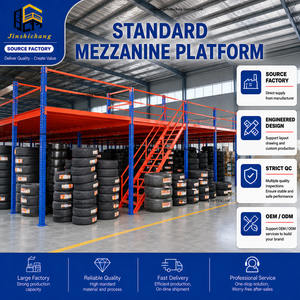
Rack-supported and structural I-beam multi-tier platforms providing floor load capacities between 300 to 1,200 kg/m². Integrates industrial stairs, catwalks, and safety gates.
Engineering Specs →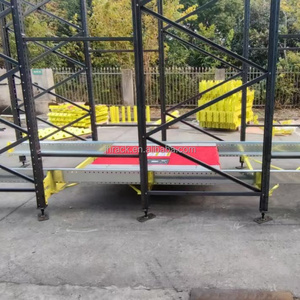
Semi-automated deep lane shuttle cart execution. Supports both FIFO and LIFO logic with smart sensor positioning, cutting fork-truck travel distances by up to 60%.
Engineering Specs →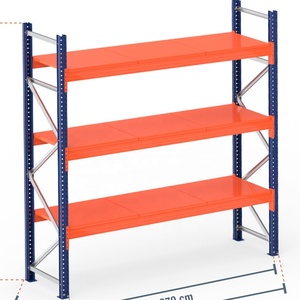
Engineered for high vertical clear heights (up to 15m). Configured with cold-formed interlocking box beams, drop-in safety pins, and specialized anti-buckling bracing frameworks.
Engineering Specs →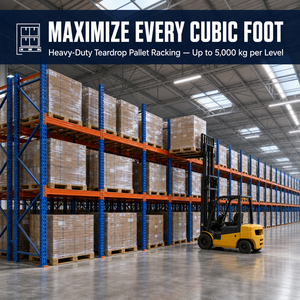
Optimized for rapid parcel sorting and narrow-aisle (VNA) operations. Custom wire mesh decking, collision pallet backstops, and comprehensive upright protection barriers included.
Engineering Specs →Modern global logistics networks demand storage architectures that deliver high vertical structural capacity, operational versatility, and documented fail-safe measures. Adjustable pallet racking systems serve as the structural backbone for global distribution centers. Unlike static welded systems, modern OEM/ODM adjustable racking utilizes cold-roll formed structural profiles that lock securely through multi-claw connector brackets and mechanical safety pins, allowing vertical beam adjustments in steps of 50mm, 75mm, or 76.2mm (3 inches) to adapt immediately to changing SKU volume profiles.
The structural capacity of an adjustable racking installation depends heavily on the grade of steel and precision cold-roll manufacturing. Quality systems rely on structural steel certified to EN 10025 (Q235B and high-yield Q355B) or ASTM equivalents. During cold-forming, continuous roll lines shape complex upright sections featuring up to 12 distinct bending radii. These reverse bends increase moments of inertia and torsional resistance, allowing thin-walled profiles to withstand higher axial compressive forces without local or lateral-torsional buckling under full load conditions.
Surface treatment directly influences long-term structural integrity and maintenance costs, especially in regions with high relative humidity, coastal air, or sub-zero cold storage rooms. Pre-treatment requires an intensive multi-stage protocol: immersion degreasing, ultrasonic water rinsing, acid pickling to strip rust scales, and zinc phosphating to establish an inert bonding surface. Next, automated reciprocator guns apply thermoset epoxy-polyester powder coats uniformly across all upright columns and horizontal beam surfaces. The components are then cured at 180°C to 200°C for at least 20 minutes. This creates a uniform finish (60–90 microns thick) with cross-hatch adhesion tested to ISO 2409 Class 0, resisting chemical attack, chipping from pallet impact, and premature corrosion.
Our heavy-gauge steel beam connectors feature 3 to 5 tapered locking claws that tighten securely into upright teardrop or diamond perforations. Self-locking safety retainers prevent accidental dislodgement when pallets are lifted.
All load-bearing calculations follow FEM 10.2.02 (European Design Code of Static Steel Pallet Racking) and ANSI/RMI MH16.1. Each bay is verified for elastic-plastic frame sway stability, seismic shear, and beam deflection limits (L/200).
Baseplates are laser-cut from 8mm–12mm heavy steel plate and secured with M12–M16 high-tensile wedge expansion anchors. We design engineered anchor patterns to resist lateral base moments in active seismic zones.
Procuring warehouse racking has shifted from simple per-ton commodity purchasing to evaluating total engineering performance, supply chain traceability, and compatibility with automated workflows. Companies investing in modern distribution hubs now plan storage configurations around three structural trends:
1. Compatibility with Automated Material Handling (AMH): The rise of autonomous mobile robots (AMRs) and semi-automated pallet shuttles demands tighter engineering tolerances in adjustable racking. Deflection limits under full operational load have shifted from standard L/200 ratios down to L/350 or L/500 to keep autonomous shuttles running smoothly along deep-lane runners. Upright verticality and installation squareness tolerances must stay within ±1.5mm to prevent sensor errors or pallet jams.
2. High-Bay Warehouses and Modular Vertical Expansion: Rising industrial land prices across primary logistics hubs—such as Jebel Ali Free Zone (UAE), Riyadh Industrial Cities (KSA), Rotterdam, and Texas—have driven clear warehouse heights from 8–10 meters up to 14–18 meters. Procuring single-run, cold-rolled upright columns up to 15 meters eliminates bolted splice joints, increasing structural stiffness and cutting installation labor costs on site.
3. Civil Defense, Fire Safety, and Flue Space Compliance: Strict insurance guidelines (such as FM Global data sheets) and local Civil Defense regulations now dictate racking design. Sourcing specifications require clear longitudinal flue spaces (typically 75mm to 150mm) and transverse flue channels between pallet back-stops so that in-rack sprinkler systems can spray unimpeded during an emergency.
| Racking Architecture | Pallet Selectivity | Storage Density | Floor Space Utilization | Forklift Compatibility | Optimal Industry Application |
|---|---|---|---|---|---|
| Adjustable Selective Pallet Racking | 100% Direct Access | Moderate (35–40%) | Standard Aisles (3.0–3.5m) | Standard Counterbalance, Reach Trucks | Multi-SKU, 3PL Fulfillment, Retail Hubs |
| High-Density Drive-In Racking | Low (FILO/LIFO) | Very High (65–75%) | Compact Drive-In Channels | Narrow-Chassis Counterbalance | Beverage, Homogeneous Goods, Cold Stores |
| Cart-Assisted Push Back Racking | Medium (1 SKU per lane) | High (55–65%) | Standard Operating Aisles | Standard Reach Trucks | Cold Storage, Food Distribution, Intermediate Buffers |
| Semi-Automated Radio Shuttle System | High (Lane Selective FIFO/LIFO) | Maximum (75–85%) | Minimal Aisles Required | Reach Trucks / Automated AGVs | Deep-Freeze Storage, High-Volume FMCG, Raw Materials |
| Rack-Supported Multi-Tier Mezzanines | 100% Manual Hand-Pick | Doubled/Tripled Usable Area | Multi-Level Flooring Over Racks | Pedestrian Picking, Conveyors, Lifts | E-commerce Fulfilment, Spare Parts, Garment Apparel |
Operating a dedicated 30,000 m² production complex with over 300 experienced technical personnel, Guangzhou Heda Shelves Co., Ltd. delivers custom racking solutions from raw coil conversion to final seaworthy container loading. We maintain dedicated roll-forming production lines for beams and uprights, supported by automated robotic welding cells that eliminate common manual welding defects. Our 10-step quality control protocol guarantees that every structural member leaving the factory complies with CE, ISO 9001:2015, and RoHS requirements.
We tailor profile thicknesses (1.5mm to 3.0mm), pitch layouts, horizontal bracing patterns, and corporate powder colors to match your building blueprints and branding.
Every batch undergoes steel yield point tensile tests, weld ultrasonic testing, powder thickness measurements, and load deflection tests before packing.
Heavy components are bundled in structural steel frames with corner edge protectors, waterproof plastic wrapping, and color-coded labels that match the CAD assembly drawings.
Our structural engineers provide free 2D CAD floor plans, 3D architectural renderings, and static calculations to streamline local building authority and Civil Defense approvals.
Direct technical answers to questions asked by procurement directors, supply chain managers, structural consultants, and logistics engineers.
To produce an engineered, code-compliant storage layout, our engineering team requires: (1) Warehouse architectural drawings indicating clear slab heights, column pitch grid, service doors, and dock locations; (2) Concrete slab data, including concrete grade, slab depth, reinforcement type, and maximum allowable point load (kN/m²); (3) Complete pallet dimensions (width, depth, overall height including cargo overhang) and gross pallet weight; (4) Forklift truck specifications, specifically mast collapsed height, maximum lift height, and minimum right-angle stacking aisle turning radius (Ast); (5) Operating environment parameters, such as cold store temperatures, seismic design acceleration (Ss/S1), and local Civil Defense flue clearance requirements.
Progressive collapse resistance is achieved through structural redundancy and protective accessories. Upright frames are anchored using heavy-duty baseplates secured to the concrete floor slab with expansion bolts. Upright face widths (typically 80mm to 120mm) and cross-bracing profiles are calculated to redistribute torsional impact stresses throughout the vertical bay framework. In addition, we install heavy-gauge floor-mounted column protectors, full-depth end-of-aisle wrap-around steel barriers, and mechanical spring-loaded drop pins on every beam connector claw. These pins prevent beams from disengaging even during vertical forklift collisions.
For high-humidity coastal ports (e.g., Jebel Ali, Dammam, Singapore) or temperature-controlled cold rooms (-25°C to +4°C), standard single-layer paint is insufficient. We recommend an intensive multi-stage pre-treatment that includes degreasing, acid pickling, and zinc phosphating, followed by electrostatic epoxy-polyester architectural powder coating cured at 200°C (yielding a dry film thickness of 70–100 microns). For open-sided warehouses or corrosive chemical environments, hot-dip galvanization to ISO 1461 provides a bonded zinc alloy barrier (minimum 55–85 microns) that prevents rust creep along scratch lines.
Our adjustable racking systems and factory production lines carry full international certifications, including CE Marking (Certificate No. 2435-CPR-8605159) for structural steel fabrication under EN 1090-1, ISO 9001:2015 Quality Management System Certification (No. 18624Q00169R0M), and comprehensive RoHS environmental compliance for all powder coating formulations. We supply traceable mill test certificates (MTC) detailing chemical composition and physical yield strength, static structural calculations, and seismic analysis documentation to support consultant approvals and commercial insurance reviews.
To eliminate shipping damage, scuff marks, and frame deformation during multimodal transit, all structural members are bundled into rigid steel-strapped crates. Upright frames are interlocked with non-slip foam dividers, corner protectors, and heavy plastic shrink-wrap. Horizontal beams are stacked in matching pairs with nested connector ears protected by heavy cardboard collars. Every export bundle includes barcoded manifest stickers that cross-reference our 3D CAD installation drawings, helping local assembly crews unload, stage, and erect materials efficiently at the jobsite.
Yes. Because our racking relies on standardized modular upright punching patterns, existing installations can often be reconfigured or expanded. Converting selective racking into a semi-automated radio shuttle installation involves replacing horizontal beam pairs with heavy-gauge galvanised guide rails and pallet supports, provided the upright section's moment of inertia meets the increased axial loads. Adding mezzanine catwalks requires checking column base point loads and punching extra beam levels to support perforated steel planks or B-deck grating, complete with safety handrails and kickplates that comply with OSHA/EN standards.
Consult with our structural engineering team. Receive custom 2D/3D CAD layout proposals, complete static structural capacity evaluations, and factory-direct pricing for your next warehouse expansion.
Contact Us