Engineered Industrial Racking & Pallet Systems
Explore our heavy-duty product portfolio designed to optimize volumetric efficiency, seismic stability, and warehouse throughput across demanding supply chains.
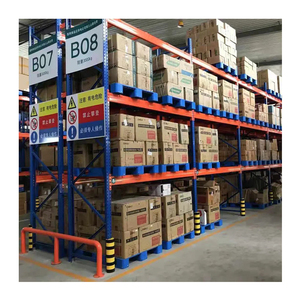
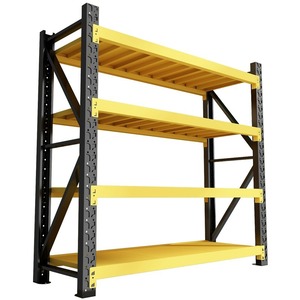
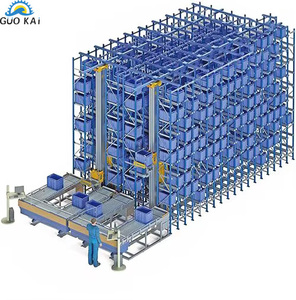
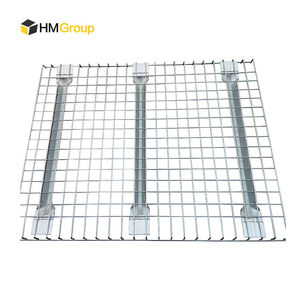
Architectural Dynamics of Drive-In Racking: Structural Mechanics and Density Optimization
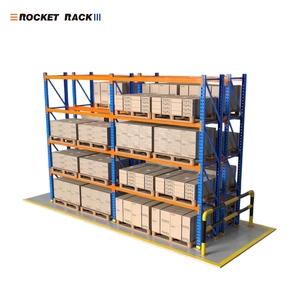
Drive-in and drive-through pallet racking represents the premier engineering solution for facilities requiring maximum spatial volumetric efficiency without resorting to high-capital automated crane infrastructure. Designed specifically for operations handling homogeneous product lines with low SKU turnover and substantial pallet volume, drive-in systems eliminate conventional operating aisles. Instead, counterbalance or reach forklifts enter the structural lanes directly to deposit or pick pallets rested on continuous longitudinal cantilever rails.
In standard selective pallet rack systems, aisles account for roughly 60% of total facility floor space, leaving only 40% for actual storage. High-density drive-in storage racks invert this relationship, achieving up to 75% to 80% volumetric floor utilization. By utilizing Last-In, First-Out (LIFO) inventory retrieval schemes—or First-In, First-Out (FIFO) when configured as Drive-Through racking with front access and rear dispatch—logistics engineers drastically cut cubic operational overhead.
Structural Physics: Cantilevered Load Rails and Dynamic Lateral Sway
From an structural engineering standpoint, drive-in racking presents distinct mechanical challenges compared to standard beam racking. Because conventional horizontal load beams are omitted to allow forklift entry, the structural integrity relies heavily on top-tier portal beam bracing, rear vertical X-bracing, and heavily reinforced upright column geometries.
The cantilever support arms must withstand severe eccentric loads as pallet weight transfers down through continuous side rails. As certified OEM/ODM manufacturers, our engineering team executes Finite Element Analysis (FEA) compliant with EN 15512, RMI (Rack Manufacturers Institute), and AS 4084 standards. We design custom high-yield cold-rolled steel profiles (such as Q235B and Q355B grades) with multi-point omega-profile punchings, ensuring optimal torsional resistance against cyclic loading and accidental forklift chassis impact.
Future Procurement Trends in Warehouse Storage Systems (2025–2035)
Procurement strategies across multinational third-party logistics (3PL) providers, global FMCG enterprises, and cold-chain cold-storage operators are rapidly changing. Procurement directors are shifting away from evaluating racking purely on raw steel spot price per metric ton. Instead, the focus has pivoted toward total lifecycle valuation, ESG metrics, and automation-readiness.
Hybrid Pallet Shuttle Retrofitting
Global procurement teams demand drive-in channel geometries pre-drilled to support drop-in radio shuttle runners. This enables converting standard drive-in bays into semi-automated shuttle systems without tearing down existing upright structures.
High-Strength, Low-Tonnage Metallurgy
Driven by carbon border adjustments and freight optimization, buyers increasingly choose micro-alloyed structural steels that offer higher yield strengths (up to 450 MPa) at thinner gauges, reducing overall shipping freight weight by 12-18%.
Traceable Safety Certifications
Supply chain auditors require authenticated test data. Bidding guidelines increasingly mandate factory-traceable European CE structural conformity (EN 1090 / EN 15512) and ISO 9001 certified production lines with non-destructive weld testing.
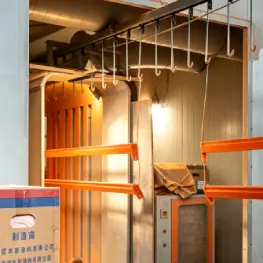
Furthermore, climate resilience has become a core procurement factor. For installations across high-heat, high-humidity regions such as the Middle East (Dubai, Jeddah, Dammam) and Southeast Asian coastal hubs, buyers no longer accept conventional single-coat enamel dipping. Specification guidelines now require rigorous nine-stage automated pickling and phosphating followed by electrostatically applied thermo-hardened polyester powders with film thicknesses exceeding 70-90 microns, or continuous hot-dip galvanizing for sub-zero freezer cold stores.
Technological Innovations: Next-Generation High-Density Warehouse Solutions
Modern warehouse engineering is experiencing a digital convergence. Racking systems are no longer merely passive steel skeletons; they are precision mechanical components of integrated intralogistics ecosystems.
1. Automated Guided Vehicle (AGV) & AMR Compatibility
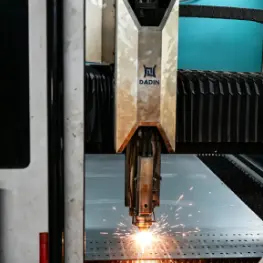
As autonomous counterbalanced reach forklifts and Automated Guided Vehicles (AGVs) replace manual drivers in drive-in bays, structural manufacturing tolerances must tighten. Manual operators naturally adjust for minor rail misalignments; AGVs operating with LIDAR and optical sensors demand millimetric precision along floor rails, column guide tracks, and pallet drop surfaces. Our CNC roll-forming and laser-guided punching machines maintain an axial upright tolerance within ±0.5 mm across an 11-meter column run.
2. Seismic Damping Baseplates & Dynamic Impact Deflectors
Seismic events present severe collapse hazards for drive-in configurations due to their lack of internal cross-aisle bracing. Next-generation systems feature energy-dissipating ductile baseplate anchors and floating friction dampeners. At the ground level, high-density polymer impact shields combined with reinforced structural bullnose floor anchors divert direct collision energy away from front upright columns, maintaining structural integrity even under heavy operational cycles.
3. IoT Structural Deflection and Load-Cell Telemetry
The integration of micro-strain gauges inside critical cantilever arms and top tie beams allows real-time monitoring of live rack deflections. In large automated cold-storage facilities, these wireless sensors communicate directly with Warehouse Management Systems (WMS), issuing proactive maintenance alerts before minor upright deformations or floor settling compromise structural margins.
Factory Direct Manufacturing Prowess: Why Global Engineers Partner with Us
Founded in 2001, Guangzhou Heda Shelves Co., Ltd. has developed into a premier industrial manufacturer of high-density warehouse storage systems. Operating from our dedicated 30,000 square meter modernized manufacturing complex, we combine advanced production robotics with strict quality management to deliver over 30,000 metric tons of certified structural steel components monthly.
25+ Years OEM/ODM Heritage
Over two decades of structural rack engineering, providing custom upright profiles, bespoke cantilever rail brackets, and optimized warehouse layouts for over 10,000 completed facilities globally.
Certified Global Conformity
Fully compliant with international engineering benchmarks: CE Certification (No. 2435-CPR-8605159), ISO 9001:2015 Quality Management (No. 18624Q00169R0M), and certified RoHS surface non-toxicity.
Complimentary 2D/3D & FEA Design
Our in-house technical team of 300+ professionals delivers rapid-turnaround 2D CAD floor layouts, photorealistic 3D structural renderings, and verified load deflection reports tailored to local building codes.
Harsh Climate Surface Coating
Specialized multi-stage immersion pickling, chemical phosphating, and heavy-duty electrostatic powder coating engineered specifically to withstand humid coastal air, desert heat, and sub-zero freezer condensation.
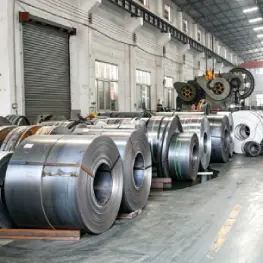
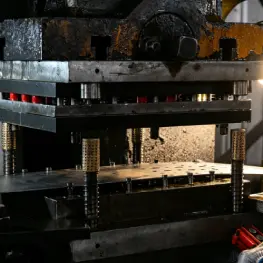
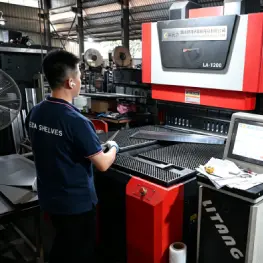
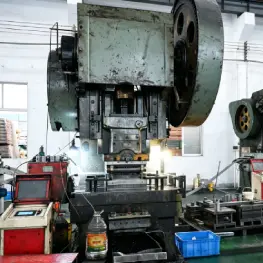
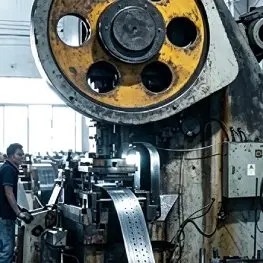
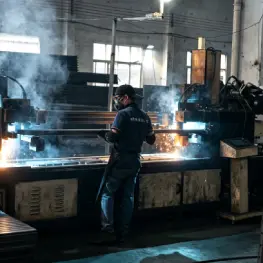
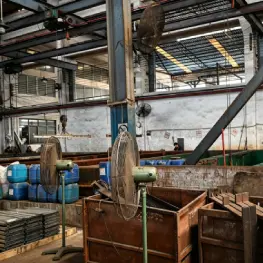
Our factory controls every phase of the manufacturing lifecycle in-house. From raw coil uncoiling, automated multi-station cold punching, and continuous precision roll forming, to robotic CO2 shielded welding, automated powder curing, and export strapping. This direct control ensures tight batch-to-batch consistency and competitive factory-direct pricing for international distributors and EPC contractors.
End-to-End Manufacturing Protocol: 10-Step Quality Verification
Every structural column, guide rail, and tie beam undergoes our verifiable 10-step industrial manufacturing workflow, ensuring reliable performance in demanding distribution centers:
Frequently Asked Questions: Technical & Commercial Guidance
Direct technical answers addressing the core questions raised by procurement managers, structural consultants, and warehouse operations directors:
What warehouse parameters are required to calculate structural capacity for drive-in racking?
1. Building architectural CAD files indicating clear height under roof joists, floor slab thickness, expansion joint locations, and column grids.
2. Exact pallet specifications: pallet width, depth, overall height including cargo overhang, and maximum gross pallet weight.
3. Material handling equipment (MHE) data: forklift model, overall chassis width, mast collapsed height, maximum lift height, and turning radius.
4. Environmental factors: local seismic zone classification, wind/ambient conditions, and warehouse temperature range (ambient vs. blast freezer).
How do Drive-In and Drive-Through racking systems differ in inventory handling?
Drive-Through Racking operates on a First-In, First-Out (FIFO) model. Lanes are open at both ends: forklifts load pallets from the loading aisle and pick from the opposite retrieval aisle. This configuration requires dedicated access aisles on both sides, which slightly reduces overall floor storage density, but provides essential batch rotation for date-sensitive items like cold-chain foods and pharmaceuticals.
What safety factors and deflection limits are used in your OEM/ODM structural designs?
How do your powder-coated systems protect against corrosion in extreme climates?
The resulting finish resists continuous salt-spray tests up to 500 hours, easily handling the high ambient humidity of coastal regions like Dubai and Jeddah, as well as the condensation cycles of cold-storage facilities. For open yards or severe corrosive environments, hot-dip galvanizing to ISO 1461 standards is available.
What international shipping, packing, and installation support do you provide?
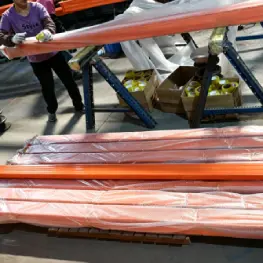
We provide full English technical manuals, part lists with itemized weights, and video assembly guidance. For complex mezzanine and high-bay racking projects, our senior site supervisors can be deployed globally for on-site quality assurance and erection oversight.
Accelerate Your Facility Storage ROI
Connect directly with our senior structural engineering team. Request a complimentary 2D warehouse CAD layout, 3D spatial rendering, and itemized factory-direct quotation within 24 hours.