FIFO Flow
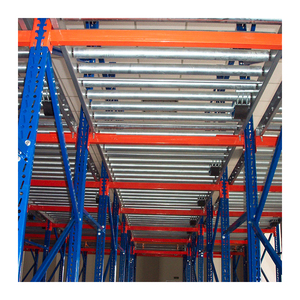
Explore our industrial-grade pallet flow beds, carton live storage rails, cold-room specific gravity racks, and intelligent AGV-integrated live racking systems manufactured in our 30,000 m² certified factory.
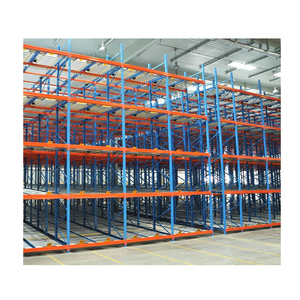
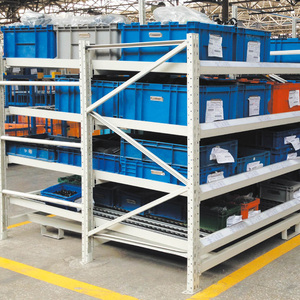
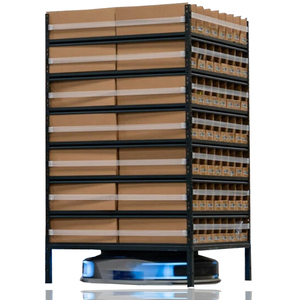
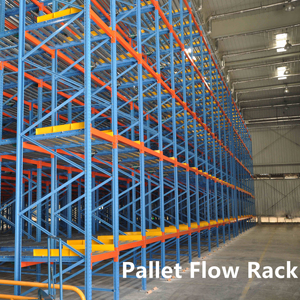
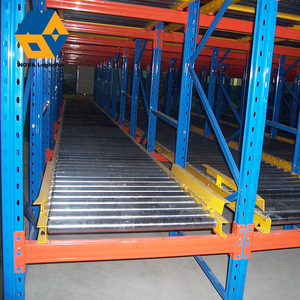
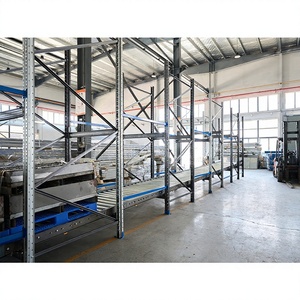
Gravity flow racking (dynamic live storage) operates as a passive conveyor system utilizing the potential energy of inclined roller beds. Achieving smooth, jam-free, and collision-free transport of 1,500 kg pallet loads requires micro-calibrated gradient design and kinetic control.
The standard incline angle in gravity flow lanes ranges from 3.0% to 4.5% (approx. 1.7° to 2.6°) depending on bottom pallet deflection, runner material (hardwood, softwood, plastic, or pressed composite), and total pallet mass. Too shallow an angle causes static friction stalling (lane lockup); too steep an angle increases impact forces at the exit ramp to catastrophic structural levels.
Heda Shelves utilizes an empirical kinematic formula to compute the net acceleration force $F_{net}$:
Fnet = m · g · (sin θ - μ · cos θ), where μ represents the rolling friction coefficient of zinc-coated steel ball-bearing rollers (typically 0.015 to 0.025) plus pallet contact hysteresis. By configuring precision roller tracks with 50mm, 60mm, or 76mm diameter cylindrical steel tubes, our systems maintain a constant rolling velocity between 0.25 m/s and 0.35 m/s.
| Pallet Specification | Typical Weight Profile | Recommended Track Incline | Brake Roller Interval | Separator Valve Class |
|---|---|---|---|---|
| Euro Pallet (1200 x 800 mm) | 300 kg – 800 kg | 3.2% – 3.5% (1.8° – 2.0°) | Every 3rd Pallet Position | Mechanical Pedal Stop |
| GMA / Industrial (1200 x 1000 mm) | 800 kg – 1,200 kg | 3.5% – 3.8% (2.0° – 2.2°) | Every 2nd Pallet Position | Pneumatic / Time-Delay Latch |
| Heavy Industrial (1200 x 1200 mm) | 1,200 kg – 1,500 kg | 3.8% – 4.2% (2.2° – 2.4°) | Every Pallet Position | High-Duty Hydraulic Catch |
| Cold Storage Chilled Plastic Pallets | 500 kg – 1,000 kg | 4.0% – 4.5% (2.3° – 2.6°) | Low-Temp Fluid Centrifugal | Anti-Freeze Self-Reset Brake |
In deep gravity flow lanes (from 5 to over 20 pallets deep), cumulative dynamic pressure—referred to in logistical physics as Static Line Load Accumulation—acts directly on the front-most pallet. If a lane holds 15 pallets of 1,000 kg each, the static forward component creates several tons of horizontal clamping force against the discharge pallet, preventing forklift removal and distorting the front stop frame.
To eliminate this threat, Heda Shelves installs heavy-duty mechanical Pallet Separators (Load Decouplers). When the front pallet arrives at the picking face, it triggers a bottom-mounted trip lever that lifts a secondary brake lever under the second pallet in line, anchoring all rearward pallets 300 mm behind the extraction zone. Only after the forklift extracts the discharge pallet does the mechanical linkage unlock, allowing the next unit to glide safely into the forward position at controlled speeds.
Operating gravity racking inside cryogenic cold-chain and frozen food facilities introduces severe mechanical issues: standard gear lubricants freeze into solid paste, synthetic roller coatings contract and crack, and condensation creates micro-icing along steel roller skins, precipitating uncontrolled pallet slippage.
Heda Shelves cold-room systems utilize specially formulated synthetic low-viscosity siliconized lubricants verified down to -35°C, coupled with knurled galvanized steel rollers providing enhanced kinetic friction against smooth or frosted wooden and polymer pallet skids. Uprights and roll-formed beams undergo hot-dip galvanization or dual-layer anti-corrosive powder coating that resists chemical spalling and moisture blistering under 95%+ relative humidity.
As global supply chains navigate soaring land costs, tight ESG regulations, and rapid robotic automation, the demand for passive, energy-free dynamic gravity racking is accelerating. Here is how modern enterprise procurement is shifting through 2030.
Enterprise logistics hubs in the Middle East, Southeast Asia, and Europe are transitioning away from manual counterbalanced forklifts. Future gravity lanes require millimeter-accurate laser alignment tolerances, custom entry guides, and automated electronic optical sensors at loading apertures so autonomous guided vehicles can drop and retrieve pallets without manual intervention.
With corporate carbon-neutrality commitments under the GHG Protocol, companies are choosing passive gravity flow over power-hungry automated storage and retrieval systems (ASRS) wherever pallet velocity permits. Gravity beds require 0 kWh of electricity, dramatically cutting operating overheads and eliminating electrical maintenance down-time.
Modern mega-distribution hubs are embedding vibration and rotational speed telemetry directly into select brake roller hubs. These self-powered micro-dynamos alert warehouse management systems (WMS) in real-time when roller velocity deviates by ±15%, signaling debris buildup or roller bearing wear before a lane jam causes distribution bottlenecks.
| Evaluation Factor | Gravity Pallet Flow (FIFO) | Drive-In Racking (LIFO) | Push-Back Carts (LIFO) | Radio Shuttle Racking |
|---|---|---|---|---|
| Inventory Rotation | Strict FIFO (Zero Age Decay) | LIFO Only (Last-In First-Out) | LIFO (Up to 6 deep) | Configurable (FIFO / LIFO) |
| Floor Utilization Efficiency | 70% – 85% (2 Aisles Total) | 65% – 75% (Single Aisle) | 60% – 70% (Front Aisle) | 80% – 90% (Deep Channel) |
| Power & Energy Needs | 0 kW (100% Kinetic Gravity) | 0 kW | 0 kW | Li-ion Battery Recharging |
| Forklift Travel & Cycle Time | Shortest (Dedicated In / Out) | Slow (Deep mast driving) | Moderate (Front loading) | Fast (Automatic shuttle) |
| Rack Damage Likelihood | Extremely Low (External mast only) | High (Frequent upright impact) | Low to Moderate | Very Low (External mast only) |
| Capex vs. Maintenance ROI | Rapid (12–18 Months) | Low Capex, High Maintenance | Medium Capex | High Capex, Sensor Servicing |
Established in 2001, Guangzhou Heda Shelves Co., Ltd. operates a vertically integrated 30,000 m² industrial facility equipped with automated cold-roll forming, robotic laser cutting, and electrostatic pretreatment lines.
All our gravity uprights, load-bearing crossbeams, and dynamic bed supports conform to stringent global structural codes including EN 15512 (European Racking Code), RMI (Rack Manufacturers Institute), and AS 4084 (Australian Standard).
100% component traceability from raw steel coils to loaded marine shipping containers.
Spectrometric tensile test on prime Q235B/Q355B coils.
Automated laser shearing within ±0.15mm tolerances.
High-speed 50-ton hydraulic column pitch punching.
18-stage roll stations form rigid omega upright profiles.
Interlocking beam profiles rolled for heavy deflection limits.
Continuous carbon-dioxide shielded robotic joint seams.
Automated shot-blasting de-scaling to Sa2.5 cleanliness.
Acid bath immersion for maximum anti-corrosion bonding.
Swiss Gema electrostatic guns bake 80-120μm epoxy resin.
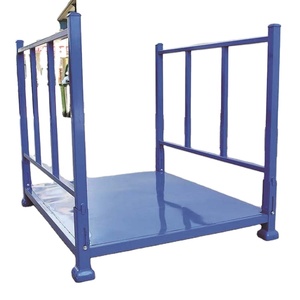
Custom steel pallets and numbered bundles for export.
Key technical, regulatory, and logistical inquiries addressed directly by Heda Shelves senior structural racking engineers.
Connect directly with Heda Shelves structural engineering team. Get comprehensive 2D CAD layout plans, 3D dynamic simulations, and factory-direct pricing for your warehouse project within 24 hours.