Executive Briefing: The Modern Paradigm of Vertical High-Bay Storage
In modern supply chain infrastructures, horizontal warehouse footprint expansion is increasingly cost-prohibitive due to escalating industrial land valuation, stringent zoning limitations, and urban boundary constraints. Consequently, corporate supply chain directors, fulfillment project engineers, and enterprise facility executives are strategically shifting their capital expenditures toward tall warehouse racking architectures. High-bay industrial racking structures exceeding clear heights of 10 to 40 meters unlock exponential volumetric cubic capacity, fundamentally compressing the storage cost per pallet position while accelerating multi-tier retrieval velocity.
Procuring tall warehouse racking systems is no longer a simple transactional purchase of cold-rolled steel profiles. It requires complex structural engineering involving dynamic second-order structural analysis (P-Delta effects), live deflection limits (typically engineered to L/200 or L/300 under uniform loads), seismic zone performance categories (IBC / Eurocode 8 compliance), slab shear stress mitigation, and tight tolerance coordination with material handling equipment (MHE) and Autonomous Mobile Robot (AMR) fleets. As a tier-1 ISO 9001:2015 and CE certified global racking manufacturer operating out of a 30,000 m² state-of-the-art production complex with a 30,000-ton monthly capacity, our engineering team sets the industry benchmark for vertical steel fabrication and intralogistics system integration.
Information Gain Directive: Specifying tall warehouse racking demands stringent verification of steel mill certificates (Q235B / Q355B high-tensile hot and cold-rolled steel), certified electrostatic powder-coating salt-spray testing (>500 hours ASTM B117), chemical degreasing and phosphating pretreatments, and validated finite element analysis (FEA) compliant with EN 15512:2020 and ANSI/RMI MH16.1.
Featured Tall Racking & Structural Storage Solutions
Explore our heavy-duty product recommendations engineered specifically for high-capacity volumetric storage, automated guided vehicles, selective accessibility, and dynamic load profiles.
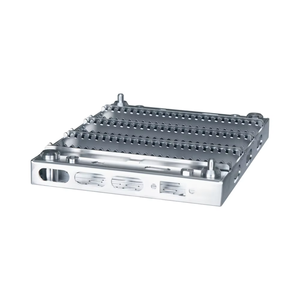 Precision CNC
Stainless Steel Cleaning Rack Components & Precision Laser Cut Brackets
- Material: High-Grade AISI 304/316 Stainless Steel
- Processing: CNC Fiber Laser Cutting & Mirror Polish
- Application: Cleanroom, Pharma, Harsh Chemical Zones
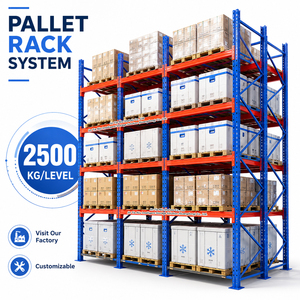 2,500kg / Level
Heavy Duty Pallet Rack System 2,500kg Per Level 5-Layer Industrial OEM
- Steel Spec: Q235B High-Tensile Structural Steel
- Height Potential: Up to 14m Continuous Upright
- Finishing: Pre-treated Electrostatic Powder Coat
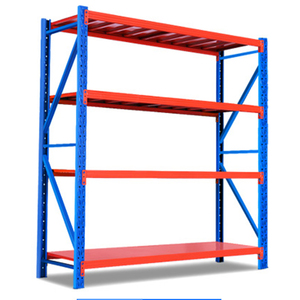 Boltless Modular
HUAWU 200kg Per Layer Boltless Shelving 4-Tier Q235 Modular Steel Rack
- Capacity: 200kg Uniform Distributed Load / Shelf
- Assembly: 100% Interlocking Rapid Friction Fit
- Utility: Order Fulfillment, E-Commerce Part Binning
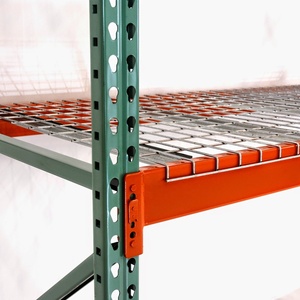 US Standard
Engineered Selective Storage Teardrop Pallet Racking Architecture
- Compatibility: Standard 2-inch Incremental Pitch
- Access: 100% Direct Selective Pallet Picking
- Safety: Automatic Gravity Engagement Beam Pins
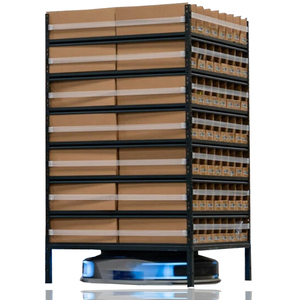 AMR / AGV Ready
Industrial Steel AMR Robot Supporting Shelf AGV Interface Racks
- Tolerance: Millimeter CNC Base Alignment
- Protection: Anti-Corrosion Anti-Static Polymer Layer
- Compatibility: Vision Sensor Underride Clearance
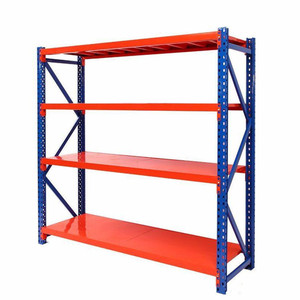 High Strength
Custom Heavy-Duty Metal Storage Shelf Structural Cargo Racking
- Uprights: 90×70mm to 120×95mm Omega Profiles
- Box Beams: Dual C-Profile Cold-Bent Interlocked
- Customization: Sized to Specific Packaging Cubes
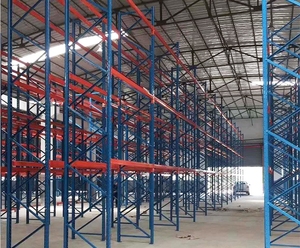 AS/RS High-Bay
Automated Stacker Crane Storage Retrieval AS/RS High-Bay Racking
- Vertical Reach: Engineered Beyond 30 Meters
- Deflection Control: High-Rigidity Guide Rails
- Throughput: 24/7 Lights-Out Automated Handling
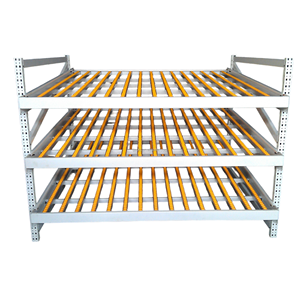 FIFO Dynamic
Collapsible Mobile Gravity Pallet Roller Steel Racking (FIFO)
- Flow Mechanism: Precision Steel Centrifugal Brake Rollers
- Rotation: Strict First-In First-Out Guarantee
- Energy Footprint: Zero-Electricity Gravity Powered
Structural Racking Topology Comparison for High-Bay Facilities
Selecting the optimal tall warehouse racking topology requires balancing storage density, selectivity percentage, forklift capital expenditure, slab leveling specifications (FF/FL numbers under ASTM E1155 or TR34 standards), and cycle-time velocity. The engineering matrix below contrasts the core tall racking configurations supplied to global logistics operators:
| Racking Topology | Typical Clear Height | Selectivity Ratio | Aisle Width Req. | Volumetric Density | Ideal Industry Use-Case |
|---|---|---|---|---|---|
| Selective High-Bay | 8m – 14m | 100% Direct | 3.0m – 3.8m | Moderate (40–45%) | Multi-SKU, 3PL Warehousing, Retail DC |
| Very Narrow Aisle (VNA) | 12m – 18m | 100% Direct | 1.6m – 1.9m | High (60–65%) | Pharma, High-Value Spares, FMCG Centers |
| Radio Shuttle High-Bay | 10m – 22m | Deep-Lane LIFO/FIFO | 2.8m – 3.2m | Very High (75–85%) | Cold Storage, Beverage Hubs, Bulk Raw Goods |
| Automated AS/RS Crane | 18m – 40m+ | 100% Automated | 1.4m – 1.7m | Maximum (85–92%) | 24/7 Giga-Distribution, Manufacturing Buffer |
| Multi-Tier Rack-Supported | 6m – 12m | Manual / Tote Hybrid | Aisle-Walkway Dependent | High Cubic Utilization | Fashion E-Commerce, Apparel, Split-Case Pick |
*Note: Engineering tall structures above 12 meters requires mandatory dynamic seismic calculation (spectral acceleration response parameters Ss and S1), heavy-duty foundation baseplates with structural expansion anchors, and rigorous column perpendicularity verifications (out-of-plumb tolerance < 1/500).
Future Procurement Trends in Industrial Tall Racking
Macro-economic pressures, robotic interoperability, and sustainability compliance are fundamentally transforming how international logistics procurement teams evaluate tall racking suppliers.
1. Shift to Total Cost of Space (TCOS)
Corporate buyers have shifted away from evaluating price-per-kilogram of raw steel. Procurement modeling is now driven by Total Cost of Space (TCOS). Tall racking configurations that maximize vertical clear heights reduce long-term land lease amortization, decrease concrete foundation footprints, and lower temperature-controlled HVAC energy consumption per stored pallet.
2. AMR & Robot-Centric Interoperability
Enterprise procurement requirements now mandate native mechanical interfacing with autonomous mobile robots (AMRs) and automated pallet shuttle carriers. This requires tight manufacturing tolerances on base plate flushness, bottom-tier beam clearances for optical docking sensors, and ultra-durable wear strips along guidance channels to eliminate robotic misalignments.
3. Decarbonized Steel & ESG Scrutiny
Multinational supply chains subject to European CBAM (Carbon Border Adjustment Mechanism) and global Scope 3 ESG mandates are requesting certified Environmental Product Declarations (EPDs). Sourcing from automated facilities utilizing low-emission scrap-recycled EAF (Electric Arc Furnace) coils and low-VOC powder coating lines provides immediate tender advantages.
4. Direct-to-Factory Turnkey EPC Contracting
Third-party middlemen and brokerage traders are being replaced by direct relationships with original equipment manufacturers. Turnkey procurement encompassing architectural 3D CAD modeling, custom upright stamping, automated containerized maritime packing, and on-site certified installation oversight avoids cumulative distributor markups and communication latency.
5. Pre-Engineered Modular Extensibility
Given volatile interest rates and shifting demand cycles, warehouse developers demand modular designs. Uprights and beams engineered with standardized punching patterns allow easy retrofitting from wide-aisle selective configurations to high-density Very Narrow Aisle (VNA) or double-deep layouts without requiring total structural scrap or re-anchoring.
6. Resilience Engineering in Extreme Climates
With high-bay developments surging across the Middle East (UAE, Saudi Arabia Vision 2030 initiatives) and Southeast Asia, procurement engineers prioritize racks engineered for extreme thermal gradients (>45°C ambient), coastal moisture, and fine airborne particulates through heavy pickling, phosphating, and specialized zinc-rich hybrid coatings.
Technological Evolution of Tall Warehouse Racking Systems
The engineering of tall structural storage systems is undergoing rapid technological innovation. Structural steel fabrication has evolved beyond static roll-forming lines into digitally orchestrated, sensor-integrated cyber-physical systems. These advancements ensure maximum structural safety while minimizing steel tonnage:
Dynamic Seismic Modeling & Base Dissipation
Modern tall racking structures deployed in active seismic territories (such as the Pacific Rim or southern Eurasian fault zones) integrate non-linear response history analysis (NLRHA). Base plates feature calibrated energy-dissipating ductile anchor assemblies that deform elastically during seismic shock, preventing catastrophic upright buckling and protecting the warehouse slab.
Digital Twin Structural Health Monitoring (SHM)
Next-generation tall racking integrates optical fiber strain sensors, triaxial accelerometers, and wireless tiltmeters mounted to critical column uprights. These sensors relay real-time structural health data into a digital twin platform, alerting warehouse managers to operational forklift impacts, beam overloads, or anchor slippage before micro-deflections compromise structural integrity.
Automated Stacker Crane Rail Synchronization
In 20m+ AS/RS installations, structural racking serves as the supporting skeleton for high-speed stacker crane guide rails. Advanced laser-calibrated roll-forming lines ensure longitudinal rail deviation remains under ±1.5mm across the entire vertical run. This prevents high-velocity crane resonance, reduces mast vibration, and maintains precise robotic picking at 240 meters per minute.
Why Tier-1 Global Contractors Partner with HEDA Shelves
Combining over two decades of heavy industrial manufacturing with turnkey structural engineering, we deliver reliable pallet racking, industrial shelving, and mezzanine platforms across 120+ countries.
30,000 m² In-House Factory
Headquartered in Guangzhou, our consolidated industrial campus maintains end-to-end control over all raw coil slitting, profiling, welding, and surface treatment, eliminating subcontractor delays.
CE, ISO 9001 & RoHS Certified
Our manufacturing processes comply with rigorous European CE certification (No. 2435-CPR-8605159), ISO 9001:2015 quality standards, and environmental RoHS compliance for verified tender compliance.
30,000 Tons Monthly Output
Continuous roll-forming lines, automated robotic welding cells, and automated multi-gun powder coating booths ensure swift delivery on large-scale giga-warehouse infrastructure projects.
Free 2D CAD & 3D Modeling
Our senior structural engineers provide full CAD warehouse floor plans, clearance calculations, and 3D visual renderings free of charge before production, expediting Civil Defense and local permitting.
Certified 10-Step Racking Production Workflow
Every structural member manufactured inside our facility follows a traceable quality control protocol from primary steel melt to containerized export blocking:
Components undergo automated ultrasonic weld testing, coating thickness verification, and impact bend testing. Packing bundles are color-coded, steel-banded with corner protectors, and numbered to directly match the engineering installation schematics.
Frequently Asked Procurement & Engineering Questions
In-depth technical answers addressing concrete slab requirements, seismic anchoring, Civil Defense approval, and fire protection integration for tall racking installations.
What floor slab engineering specifications are required for tall warehouse racking exceeding 12 meters?
How do tall racking designs comply with NFPA 13 fire sprinkler regulations and flue space requirements?
What parameters are needed for a free turnkey 3D layout design and structural load calculation?
How are tall racking structures anchored against seismic forces and dynamic upright impacts?
Can HEDA Shelves engineering drawings support Civil Defense and municipality approval across the Middle East?
What is the difference between cold-rolled steel and hot-rolled structural steel in tall racking applications?
How does the pickling and phosphating process enhance corrosion resistance in coastal logistics hubs?
What international design codes govern the structural analysis of your tall racking systems?
Accelerate Your Vertical High-Bay Storage Project
Partner directly with an established tall warehouse racking manufacturer. Submit your facility drawings today to receive a comprehensive structural layout, seismic calculations, and direct factory pricing within 24 to 48 hours.