Featured Industrial Warehouse Racking & Gravity Flow Systems
Manufactured with high-tensile Q235B/Q355B cold-formed structural steel, precision dynamic roller tracks, and anti-corrosion electrostatic powder coatings, our products deliver seamless integration across high-density logistics hubs.
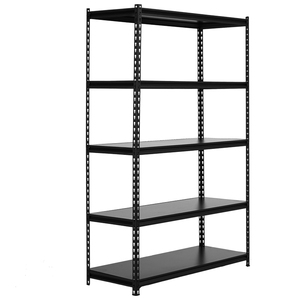
Adjustable Medium Duty Metal Boltless Rack Shelf
Flexible modular shelving engineered for rapid configuration changes, retail storage showcases, and hand-loaded intermediate fulfillment facilities.
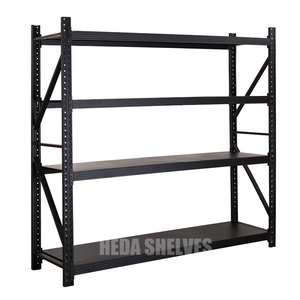
Customizable Industrial Medium Duty Steel Shelving
Epoxy-finished matte black shelving offering superior scratch protection, modular beam pitches, and high rigidity for multi-SKU retail staging.
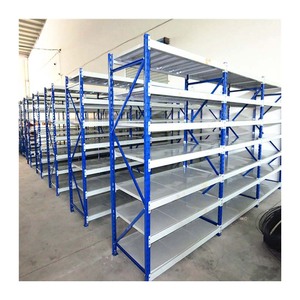
Light Duty Selective Metal Warehouse Boltless Racking
Precision cold-rolled shelf profiles allowing rapid adjustability on 50mm increments, optimal for carton packing and spare parts handling.
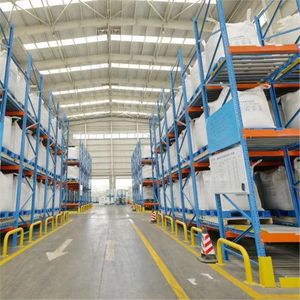
Heavy Duty Dynamic FIFO Gravity Roller Racking System
Engineered for 1000kg+ pallet capacities, featuring continuous steel roller tracks, dynamic speed controllers, and end-stop impact absorption.
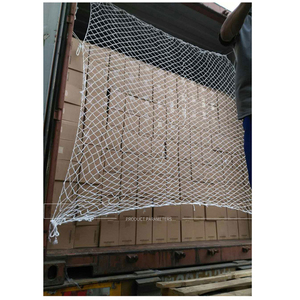
Adjustable Heavy Duty Polypropylene Container Cargo Net
High-tenacity UV-stabilized knotless mesh safety netting designed to secure palletized freight during container transport and rack-face drop hazards.
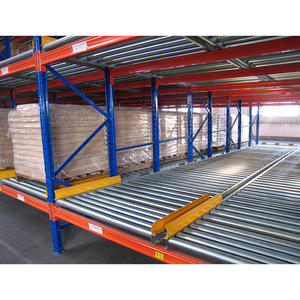
FIFO High-Efficiency Warehouse Gravity Pallet Flow Rack
Sloped dynamic bed racking leveraging gravitational velocity for automated inventory replenishment. Eliminates cross-aisle forklift traffic.
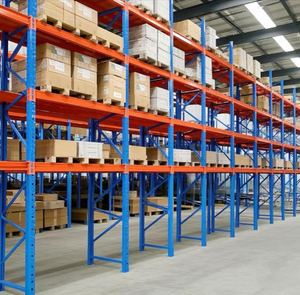
Industrial Grade Heavy Duty Teardrop Pallet Rack
North American teardrop hole pattern compatibility with high-strength locking pins, anti-rust zinc phosphate undercoat, and heavy channel bases.
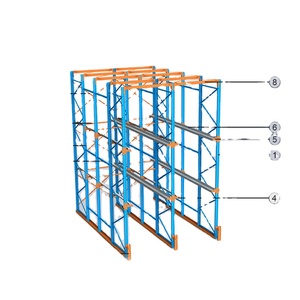
Heavy Duty Drive-In / Drive-Through Pallet Racking
Engineered for cold store rooms and single-SKU batch warehousing by removing operational aisles, boosting volumetric utilization by up to 80%.
Physics & Kinematics of Gravity Flow Pallet Racking Systems
Understanding kinetic deceleration, centrifugal speed governance, and structural equilibrium in high-density live pallet storage.
1. The Mechanical Dynamics of Inclined Gravity Roller Beds
Gravity flow pallet racking (commonly referred to as dynamic live storage or pallet flow racking) is an automated compact storage methodology that relies strictly on natural kinetic energy and physical gravity rather than electromechanical drives. The storage lanes consist of heavy-gauge steel upright trusses supporting specialized roller tracks engineered on an inclination slope typically between 3.0% and 4.0% gradient (1.7° to 2.3°).
When a forklift operator places a unitized pallet load onto the charge (loading) face, gravitational force resolves into two vectors: the normal force pressing downward against the rollers, and the tangential downhill force that accelerates the pallet forward. As the pallet progresses downhill along full-width galvanized steel rollers or multi-track wheel assemblies, its velocity is governed by the following dynamic friction and kinetic energy equations:
F_down = m * g * (sin(θ) - μ_r * cos(θ)) | E_k = 0.5 * m * v² + 0.5 * I * ω²
Without intervention, consecutive acceleration across an extended lane (e.g., 10 to 25 pallets deep) would result in uncontrolled kinetic terminal velocities, potentially crushing forward pallets or damaging the extraction framework. To mitigate this hazard, our engineering teams integrate centrifugal speed controller rollers (brake rollers) spaced at exact intervals along the track. These internal mechanical governor brakes dynamically exert resistance directly proportional to the rotation speed, ensuring the pallet maintains a strictly regulated descent velocity between 0.15 m/s and 0.25 m/s.
2. Comparative System Architecture: Gravity Flow vs. Alternative Storage Systems
Selecting the optimal intralogistics system requires balancing capital investment against volumetric space density, material handling throughput, and stock rotation rules (FIFO vs. LIFO). The comparison matrix below outlines critical structural and operational parameters:
| Storage System | Rotation Principle | Volume Utilization | Forklift Travel Time | Operating Energy Cost | Civil Defense & Flue Space |
|---|---|---|---|---|---|
| HEDA Gravity Pallet Flow | Strict FIFO (100% Guaranteed) | 80% – 85% (High Density) | Reduced by 45% (Dedicated Aisles) | Zero (Pure Gravity Mechanics) | Engineered Flue Separation |
| Selective Pallet Racking | Any Order (100% Selectivity) | 40% – 45% (Aisle Intensive) | High (Forklift Enters Every Aisle) | Low (Forklift fuel only) | Fully Compliant Open Layout |
| Drive-In Pallet Racking | Strict LIFO (Last-In, First-Out) | 70% – 75% (High Density) | Slow (Forklift Drives Inside Rack) | Moderate (High Rack Impact Risk) | Dense Stack, Requires Extra Sprinklers |
| Radio Shuttle Automation | Flexible FIFO / LIFO | 85% – 90% (Maximum Density) | Fast (Automated Internal Transfer) | High (Lithium Battery / Electronics) | Complex In-Rack Sensor Sprinklers |
As demonstrated in empirical warehouse logistics studies, while radio shuttles achieve slightly higher volume storage density, gravity flow systems offer unparalleled mean time between failures (MTBF) because they eliminate electronic motherboards, battery charging cycles, signal dropouts, and motor failures inside extreme temperature environments such as cold stores (-30°C).
3. Load Separators and Discharge Safety Physics
At the retrieval (discharge) face, accumulated pallets behind the front load exert immense line pressure—equal to the sum of downhill weight vectors of all trailing pallets. For example, in a 15-pallet-deep lane carrying 1,000 kg pallets, the line pressure on the front unit can exceed 4,500 N. If an operator attempts to extract the front pallet while under this dynamic load, violent friction locks the pallet against the rear stops, posing severe forklift rollover risks or pallet breakage.
To eliminate this phenomenon, HEDA integrates our proprietary Heavy-Duty Mechanical Pallet Separator. As the first pallet reaches the end stop, an automatic mechanical trip pedal isolates the second pallet 150mm upstream. When the front pallet is lifted by the forklift, the separator resets automatically, allowing the trailing column to smoothly advance forward by exactly one position in a controlled cascade.
Future Procurement & Technological Trends in Gravity Flow Racking
Strategic supply chains are pivoting toward hybrid automation, harsh-environment metallurgy, and digitized lifecycle monitoring.
AGV & AMR Autonomous Integration
Modern mega-hubs are decoupling human drivers from rack interfaces. Future-proof gravity lanes are precision-fitted with optical docking reflectors, mechanical centering guide chutes, and standardized pick-face tolerance gaps for Autonomous Mobile Robots.
- ±2mm Positioning Tolerances
- Laser-guided Entry Funnels
Smart IoT Lane Sensing & Jam Detection
Procurement specifications increasingly mandate passive and low-energy IoT monitoring. Micro-switch and optical sensors integrated into the side guide profiles monitor pallet dwell times, detect stuck loads, and alert WMS operators before dispatch bottlenecks occur.
- Automated Lane Empty Alarms
- WMS API Live Inventory Sync
Cold-Chain Optimization (-30°C Resilience)
Rising demands in frozen food distribution and pharmaceuticals dictate cryogenic metallurgy. Standard bearings seize in cold conditions. Future procurement prioritizes synthetic low-temp fluorinated lubricants and micro-grooved roller surfaces that overcome ice condensation.
- Non-Freezing Bearings
- Thermal Contraction Tolerances
Low-Carbon & High-Yield Metallurgy
Global carbon border adjustment mechanisms (CBAM) are compelling EPC buyers to verify steel carbon footprints. Racking manufacturers are transitioning to micro-alloyed Q355B cold-rolled coils, achieving a 20% reduction in overall deadweight while maintaining identical yield strength.
- EPD Carbon Certification
- High Modulus Elasticity
Full-Cycle Precision Racking Manufacturing System
Every component of our dynamic gravity racks undergoes full internal traceability across our 30,000 m² automated facility, eliminating contractor deviations and ensuring rigorous load tolerance execution.
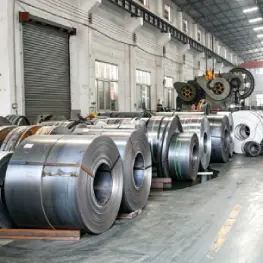
Prime Grade Raw Steel Inspection
Direct sourcing from certified tier-one Chinese steel mills (Baosteel, Shougang). Every batch undergoes metallurgical spectrometry, tensile testing, and elongation verification before entering slitting lines.
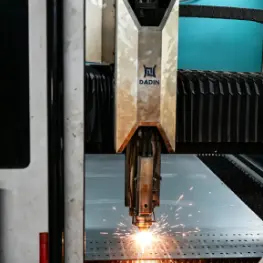
Precision CNC Cutting & Slitting
High-speed automated CNC laser and mechanical shear slitting lines ensure burr-free edges and dimensional consistency with tolerances within ±0.3mm across multi-meter sections.
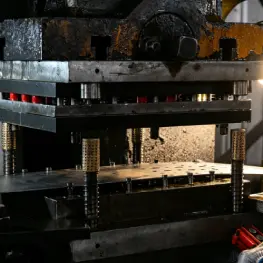
Continuous Multi-Die Column Punching
Synchronized hydraulic punching dies create 50mm / 75mm teardrop and diamond pitch holes with absolute pitch fidelity, ensuring perfect beam locking and zero field re-drilling.
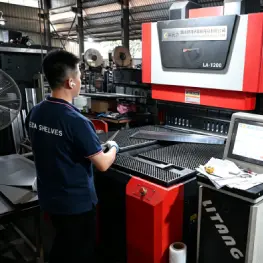
Multi-Stage Cold Roll Forming
Our 24-station rolling mills form heavy-duty upright profiles with multi-bend omega (Ω) structural sections, dramatically enhancing the cross-sectional moment of inertia and buckling resistance.
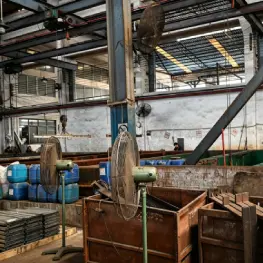
Chemical Pickling & Phosphating
Full 8-stage immersion tank treatment removes all scale, oil, and rust, depositing a micro-crystalline iron phosphate conversion coating that delivers ASTM B117 salt spray endurance exceeding 500 hours.
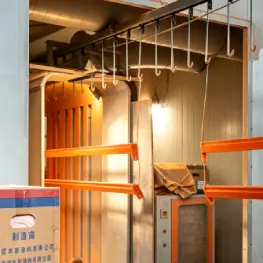
Automated Electrostatic Coating
High-voltage electrostatic Swiss Gema spray guns coat non-toxic thermoset epoxy-polyester powder, followed by 200°C tunnel curing to create a tough, chip-resistant finish tailored for harsh warehouse climates.
Why International Engineering Contractors Partner with HEDA Shelves
Founded in 2001 in Guangzhou, China, Guangzhou Heda Shelves Co., Ltd. has grown into an international leader in heavy-duty logistics and intelligent warehouse racking systems. Backed by 300+ seasoned engineers, structural calculation specialists, and overseas project managers, we transform empty warehouse envelopes into optimized revenue generators.
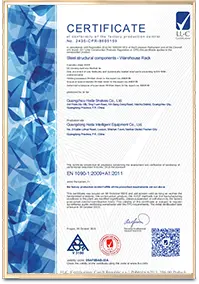
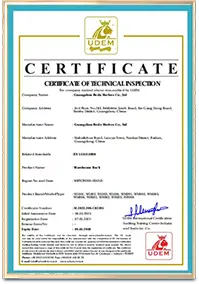
Our solutions comply strictly with international structural design codes, including FEM 10.2.02 (European Federation of Materials Handling), RMI (Rack Manufacturers Institute ANSI MH16.1), and AS 4084 (Australian Standard for Steel Storage Racking). We supply turnkey engineering calculations, Finite Element Analysis (FEA) reports, and permit-ready 2D/3D CAD drawings.
From primary breakbulk freight to major global ports—including Jebel Ali, Khalifa Port, Jeddah, Dammam, Los Angeles, Rotterdam, and Hamburg—our export team secures heavy sea-worthy bundled packing with custom color-coded assembly tags for rapid erection.
Frequently Asked Technical & Purchasing Questions
Clear, expert responses to the critical questions asked by procurement directors, EPC contractors, and warehouse operations teams.